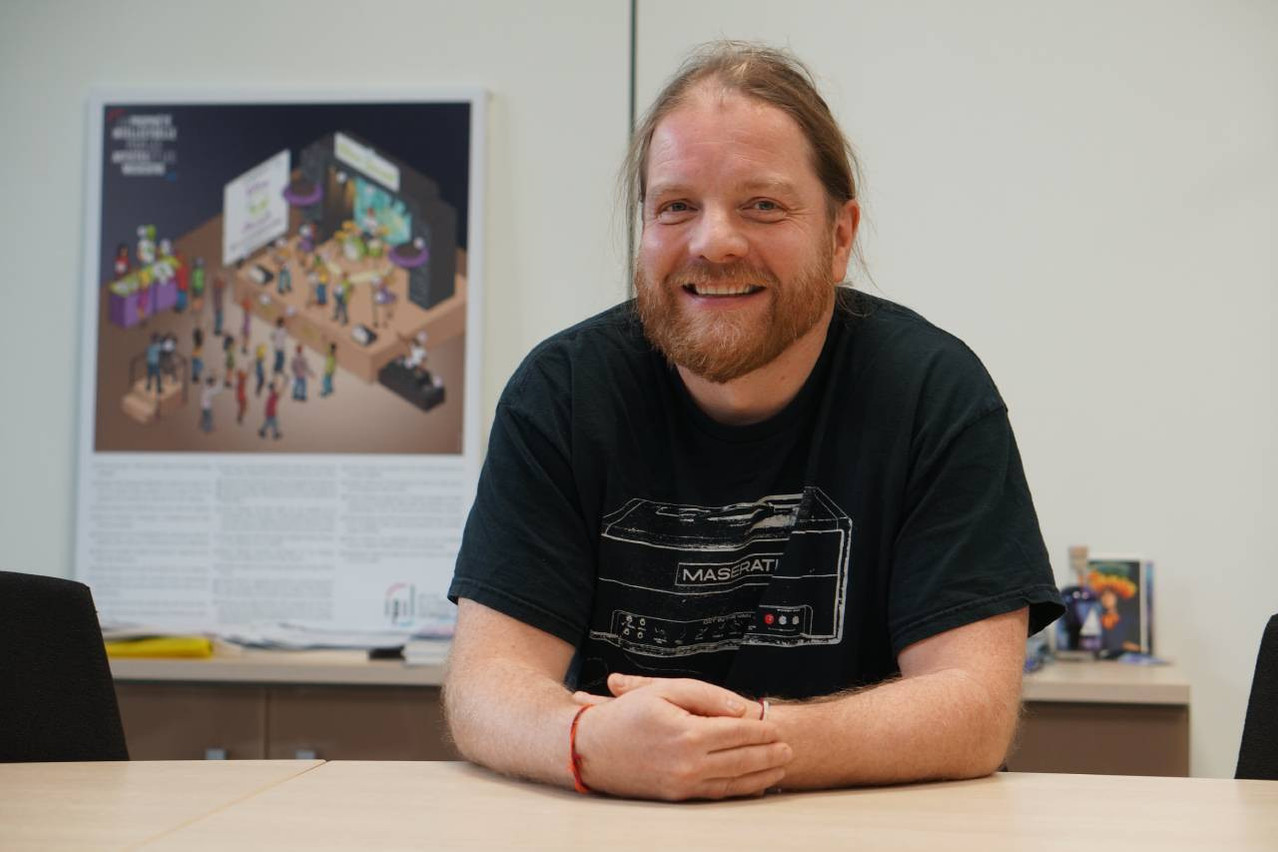
"We are not against AI," explains Sacem Luxembourg managing director 
According to a study carried out in 2024 by Sacem and Gema, music creators could see their revenues fall by 27% by 2028, and more than 70% of them fear the impact of artificial intelligence on their future. Faced with this situation, Sacem, the Luxembourg music rights management company, is trying to protect the authors, composers and publishers whose works are sometimes used without authorisation by AI generators. A legal framework exists, says Marc Nickts, but it remains little applied in practice.
Present in Luxembourg for more than 40 years, Sacem ensures that music remains a remunerated and protected creation. But at a time when algorithms are drawing on millions of existing works, the model is being shaken up. Marc Nickts looks back at this fragile balance between artificial intelligence and copyright.
AI, a revolution difficult to control
For collecting societies, artificial intelligence represents an unavoidable technological development, but also a major legal and ethical challenge. The challenge is not to oppose innovation, but to ensure that the law applies in this new environment, as it has always done for human creation.
With this in mind, Sacem was among the first to introduce an official "opt-out", stating that works in its repertoire cannot be used to train artificial intelligence models without prior agreement. A symbolic measure, but one that is still difficult to enforce: the tech giants continue to feed their systems with protected content, without authorisation or remuneration.
Authors' societies across Europe are mobilising to ensure that copyright is respected in the age of AI. Discussions are underway between several of them and technology companies, notably in Germany and Denmark, where legal proceedings have already been initiated. For its part, Sacem has expressed its willingness to enforce the existing legal framework, but no agreement has yet been reached with the main AI players. "Discussions have not reached a conclusion. There is no concrete reality today," Marc Nickts concedes.
The study conducted by Sacem and Gema highlights the scale of the phenomenon: the global market for AI-generated music could exceed $3 billion by 2028, while no remuneration is currently paid for works used as training data.
Trusting the human
While negotiations between authors' societies and technology giants are struggling to find common ground, the question also arises at individual level: How can creators continue to invent and innovate, while using tools capable of producing for them? In the face of these changes, Sacem is choosing to trust its members. It is not seeking to prohibit the use of these technologies, but to preserve the place of human input, a pillar of copyright since time immemorial.
For the organisation, the boundary is clear: AI can assist creation, but cannot be the author. A work must be the result of an artistic gesture, an intention, an aesthetic choice; elements that a machine, to date, does not possess. "The key point is that there must be a human contribution to the creation," says Marc Nickts. "With us, an artificial intelligence cannot join. We start from the principle that our members are human beings."
In practical terms, this means that works generated with the help of AI can be registered with Sacem provided that the essential part of the creative process remains human. To support its authors and composers, the organisation has published a practical guide on AI, which informs them about good practice, legal issues and the precautions to take when using generative tools. This approach is based on a simple principle: copyright is not obsolete, it simply needs to adapt. Marc Nickts sums it up as follows: "The principle of copyright has always been able to adapt to new technologies. We are convinced that copyright remains the most direct and honest form of remunerating human creation."
Putting culture back at the centre
The issue of artificial intelligence goes beyond technological innovation. It raises questions about the place of human emotion, diversity and uniqueness in creation. "Artificial intelligence cannot reproduce the way we feel when music moves us," says Marc Nickts. While platforms are experimenting with tools capable of producing music on a large scale, Sacem is arguing for greater transparency and human-centred creation.
The public, says its director general, needs to know when a work has been generated by an AI and when it comes from a human author. "We need to humanise the debate, so that creation remains 'human-centric'". By seeking to regulate the use of artificial intelligence while supporting creators, Sacem intends to remind people that in the digital age, copyright protection remains inseparable from the defence of human creation.