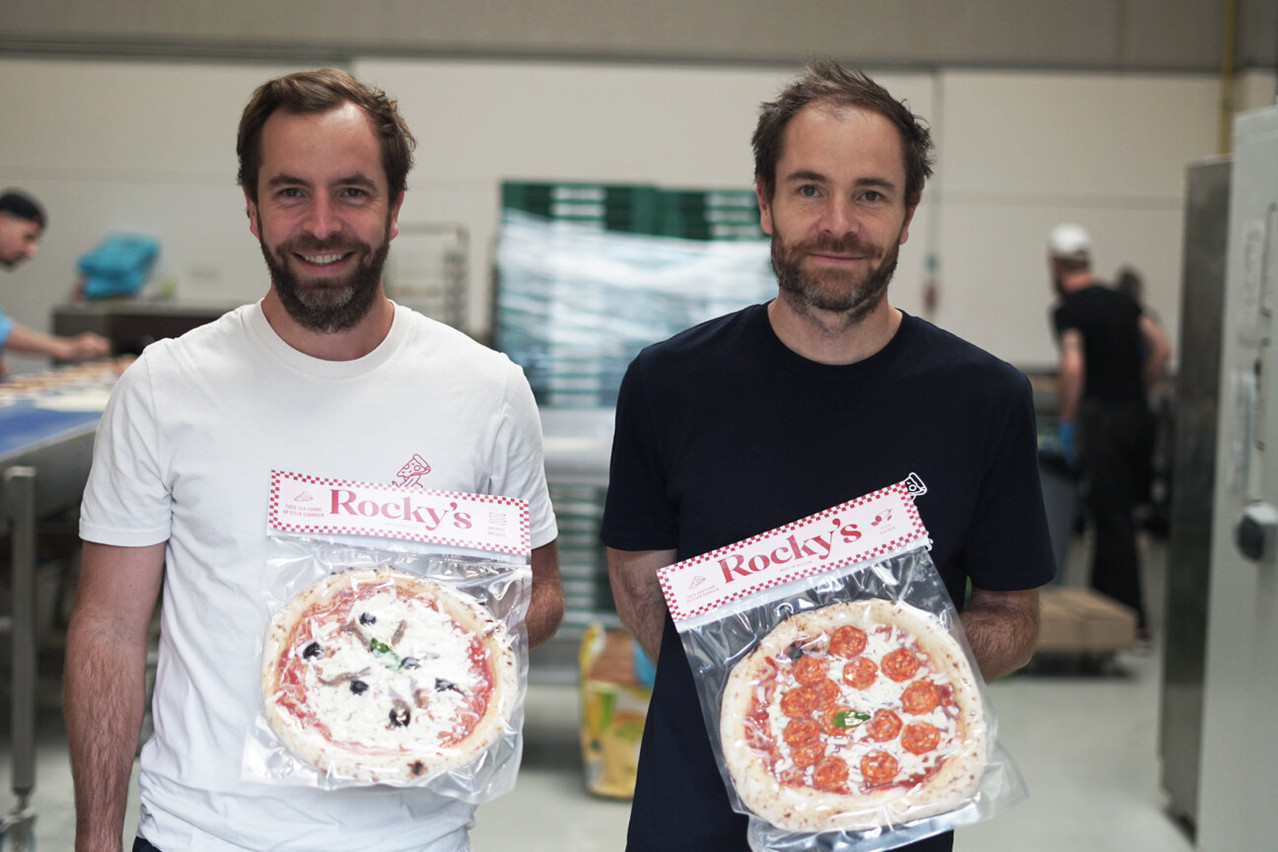
Founded in 2022, Rocky’s Pizza started out in a 200-square-metre workshop. It expanded its operations ten months ago by acquiring L’Artisane, Belgium’s largest producer of fresh pizzas, based in Courcelles, near Charleroi. It was this takeover that opened the doors to Cactus, a long-standing customer of L’Artisane. All Rocky’s Pizza products are now made in Courcelles.
In Belgium, the brand is sold in around 40 Delhaize stores, as well as at Intermarché, Cru and Färm, and also supplies pizzerias, hotels and padel clubs. In Luxembourg, Cactus stocks eight pizzas, including an organic Margherita. Two tasting events are planned for 30 and 31 October in Bascharage and at La Belle Étoile. We meet the two founders, Alexis and Arnaud Mestdag.
How did Rocky’s Pizza come about?
Alexis Mestdag. – “I went to Rome and then Naples to train at one of the best schools. That was just as Covid hit. On my return, I told myself I wasn’t going to reopen a pizzeria, because I’d had enough of the hospitality industry and I couldn’t see what more I could have brought to what was already on the market. However, I did wonder why there was such a difference between what you found in supermarkets and what I’d learnt in Italy. Based on that realisation, I wanted to launch a range of higher-quality pizzas, initially as frozen products. But the war in Ukraine broke out at that time, and all my prospective customers were telling me: ‘We don’t stock frozen ones. For a start, Dr. Oetker takes up the whole aisle. And given the cost of energy, it’s going to be tricky. ‘But do you have any fresh pizzas?’ As everyone was saying the same thing, I decided to go into fresh pizzas. At first, I did it on my own. Then I hired my first pizza chef, then a second… We’ve grown since then.
What changed following the takeover of L’Artisane in January 2026?
Al.M. – “We’ve taken over L’Artisane, a company that makes pizzas mainly for private-label brands, so that we can continue to grow Rocky’s Pizza and also breathe new life into L’Artisane, which is a sleeping beauty.
Arnaud Mestdag. – “The takeover was crucial in enabling us to gain access to large retailers, such as Cactus, to obtain IFS Higher Level certification [a standard required for access to the retail sector in the agri-food industry, ed.], and to gradually professionalise Rocky’s Pizza’s operations, which has also enabled us to secure more favourable terms for purchasing raw materials for our various brands.
We’re delighted to be making a grand return to Cactus, so to speak.

Is Luxembourg your first market outside Belgium?
Ar.M. – “Yes. We saw that Cactus was open-minded and keen to explore new products. It’s a market on a human scale, and there’s a lot in common between the people of Luxembourg and Belgium. For us, it made sense to start with the Luxembourg market to test the product outside Belgium.
Do you have any other markets in mind?
Ar.M. – “For the time being, we’d rather consolidate our position in the Belgian and Luxembourg markets, because we want to offer our customers the best possible service. We want to be firmly established in our market before we have to rush all over Europe.
In Belgium, you shop at Delhaize. So why Cactus in Luxembourg?
Ar.M. – “We’re delighted to be making a grand return to Cactus, if I may say so. They were a long-standing client of L’Artisane when we took over the business, which allowed us to go straight through the head office. And when they tested the products, they were blown away by the quality compared to what L’Artisane was producing as standard. The company’s vision is to create the best own-brand product and the best ‘high-end’ pizza in supermarkets. I’m not too keen on the term ‘high-end’, but I’d say the best ‘quality’ pizza in supermarkets. Rocky’s is left to prove for a total of 48 hours – 24 hours in a tray and 24 hours shaped into a ball. Generally speaking, with industrial producers, it’s an hour at most.
How much will the pizzas cost?
Ar.M. – “Generally speaking, we want it to be under €10.
Is the contract with Cactus an exclusive one?
Ar.M. – “It’s not exclusive. We’re just really pleased to be working with the market leader in Luxembourg, which is also a long-standing leader. It’s a bit like in Belgium, where you go straight to Delhaize’s head office. It’s not out of the question that we’ll be expanding very quickly – perhaps via other platforms – to Luxembourg, in any case, into Delhaize or other outlets.
What turnover are you aiming for in your first year in Luxembourg?
Ar.M. – “We didn’t want to set a sales target because, from what we’d heard, Luxembourg wasn’t exactly a market for fresh pizza. I think it’s also sometimes the case that the product doesn’t ‘match’ what the customer is looking for.
Could you also supply the hospitality sector in Luxembourg?
Ar.M. – “We’re thinking about diversifying. As we’re not from the region at all, we need to build up a customer base. We want to expand into the food service sector and, in Luxembourg, we’re looking for partners. We have a lot of hotels as clients because they want a simple solution. Instead of burgers, which involve about fifteen steps, a pizza only takes two: you open the packet, pop it in the oven, and that’s it.
We add some olive oil to the dough. That’s the only change we’ve made to the recipe.

How can you make a pizza at home that tastes as if it’s just come out of the oven?
Al.M. – “The tip is to preheat your oven and take your pizza out of the fridge whilst the oven is preheating. Then, you need to preheat your oven to between 250 and 230 degrees. Ideally, you should bake it on a baking tray. Ovens vary in power from one make to another, so I’d say a minimum of five minutes, a maximum of seven. Generally, the inside will still be soft, whilst the outside is crispy.
Did you have to adapt the recipe, as this is a pizza that’s reheated?
Al.M. – ‘Yes, we’ve adapted the recipe. We needed to keep the dough fairly moist. In Naples, I learnt that, traditionally, you don’t put olive oil in the dough because olive oil is an expensive ingredient. We add olive oil to the dough to make it moister. That’s the only change we’ve made to the recipe. We could give it a much longer shelf life, but to maintain the quality of the product, we set it at 12 days. Lots of customers buy Rocky’s and freeze them. As we only use fresh ingredients to make our pizzas, there’s no problem with freezing them. The key is to reheat them at a lower temperature: instead of 250, use 180 degrees for ten to twelve minutes.
What’s new on the horizon?
Ar.M. – “We’re going to develop high-protein pizzas and pasta dishes. I think these will be launched here in early 2027 [in Belgium, ed.].”