How did La Malle de Lux come about?
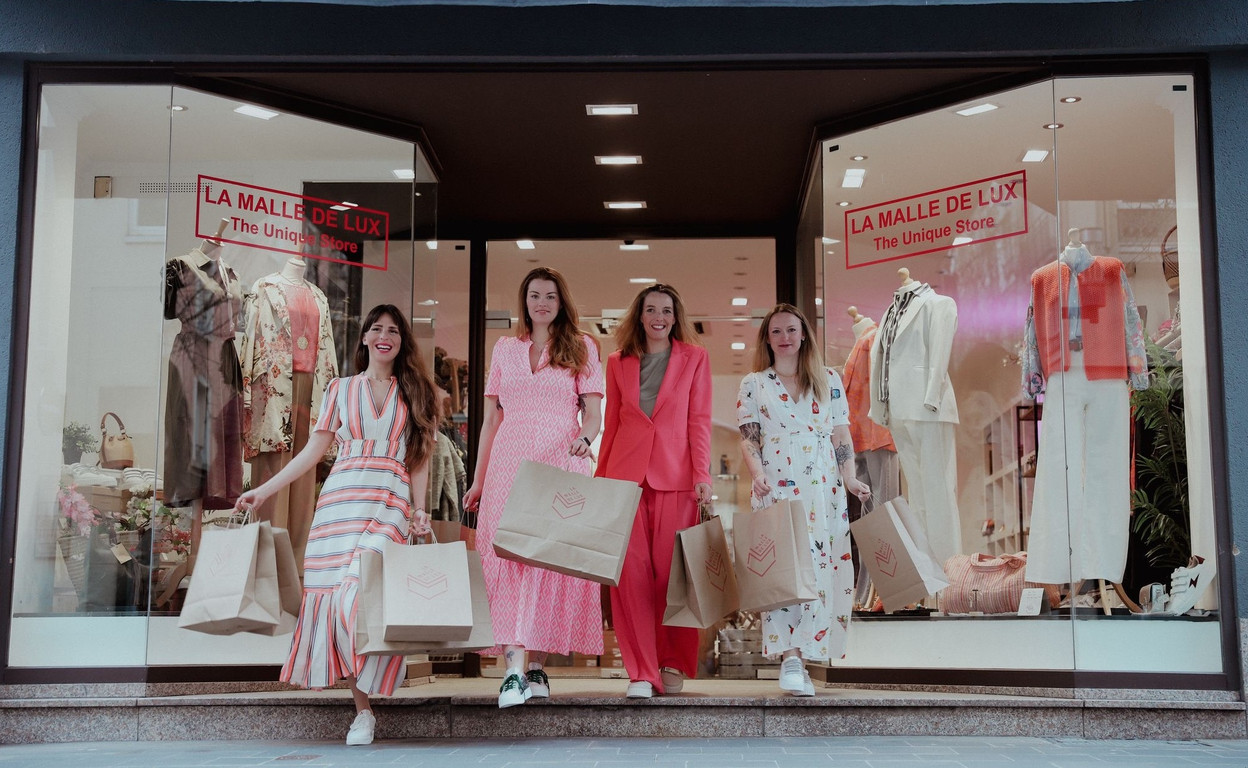
Philippine Dobrzensky. – “I set up La Malle de Lux in 2015. Initially, it was a pop-up shop concept designed to promote small designers and brands of clothing, jewellery and accessories that weren’t established in Luxembourg.”
I came from the fashion world and had worked in Paris for several years, so I knew a lot of designers. I started with events lasting three or five days, sometimes two weeks, in rather unusual venues. My first proper pop-up was at the Sofitel. I invited a few hundred customers and word of mouth spread very quickly.
Why has this concept found an audience in Luxembourg?
“Above all, I think what I was offering didn’t really exist. When I arrived, the market was quite conservative. There were some lovely shops, but perhaps there wasn’t that one slightly more original little shop, with a different range of brands.
Even today, I believe I have found a niche between fast fashion and luxury. I want to offer something of high quality, accessible and original, backed by excellent service. We know the collections and the designers, and why we have chosen them. It is this relationship that makes all the difference.
After ten years of pop-ups, why did you decide to open a permanent shop?
“Before Covid, my pop-ups were largely organised as events, particularly evening after-work get-togethers that attracted large crowds. After the pandemic, I felt that habits had changed: customers were less inclined to travel for this sort of event. So I realised I needed greater visibility and a more regular presence in the town centre.
These are difficult times for the entire retail sector.

For several years, I occupied various premises on a temporary basis. This sometimes meant setting up an entire shop for just a few weeks or months. At one point, I had a premises that was originally intended to last six months, but where I ended up staying for several years. When that lease came to an end, I realised that, after almost ten years, I was ready. The permanent shop, which opened in February 2025, truly represents the culmination of all that hard work.
Has the way you work changed since opening a permanent shop?
“Yes, enormously. In the early pop-ups, I worked a lot in collaboration with small designers and didn’t necessarily buy the stock. That meant the project was almost self-funding. But the commissions on these collaborations are lower. To build a sustainable business, I started buying more collections myself, sometimes up to a year in advance. This allows for better profit margins, but it also means taking on a lot more risk.
These days, it’s important to strike the right balance: buy less at the start, top up as needed during the season, and, above all, keep a very close eye on cash flow.
Do female customers shop differently today than they did in 2015?
“Yes. They’re being more careful about their spending and what they buy. These are difficult times for the whole retail sector. So I’m careful about the brands I choose, particularly those made in Europe where possible. At the same time, I want to maintain a range of price points.
I’ve also launched an online shop, but for my customers, it mainly serves as a showcase. Customers look at the products, then come into the shop and say, ‘I saw that on your website.’ They still want to try things on, feel them and exchange them.
In a society where so many things are becoming automated, I think it’s important to keep this relationship alive.
Is it precisely this service that enables a small shop to hold its own against the big chains?
“It’s essential. That warm, family-like atmosphere and the service have been lost to a great extent. We know our customers and our collections very well. When a customer comes to see me, it’s sometimes a bit like going to the hairdresser’s. We have a chat, we know her; she can send me a message after seeing an item on Instagram and ask me to put it aside for her.
It’s not just buying and reselling that interests me. What I love is the whole human aspect of it. In a society where so many things are becoming automated, I think it’s important to keep this relationship alive.
What does the small size of your business currently enable – or prevent?
“There are three of us, plus two employees. Being a small business obviously allows us to maintain that personal touch, but, financially speaking, I couldn’t afford to take on another person at the moment. Opening a permanent shop in Luxembourg involves significant fixed costs. Rents are high, so are labour costs, and the market remains unpredictable.
It’s sometimes frustrating because I’ve got lots of projects in mind, but I can’t do everything. A right-hand man would be a huge help, but I can’t afford to pay one at the moment. To take this much further, perhaps one day we’ll need someone who believes in the project and can invest in it whilst contributing their own ideas.
Is Luxembourg still the best place for La Malle de Lux, despite everything?
“Yes, I think it’s actually the perfect market for what I’m offering. There are relatively few independent and multi-brand shops, whilst customers are also looking for small shops with their own distinct identity.
Success means being able to carry on doing what I do, and continuing to make a contribution to the Luxembourg business community.

In Paris, there are thousands of other businesses doing exactly what I do. In Luxembourg, my shop really has a purpose. It’s also an accessible market in the sense that, as a small business, you can quite easily build a network, gain access to the press or meet influential people. On the other hand, the clientele is very discerning. They travel a great deal and are already familiar with a huge number of brands. So you always have to offer them something they haven’t seen anywhere else.
What does success mean to you?
“On a personal level, I’ve found a balance in my work. Success, for me, means being able to carry on doing what I do, continuing to make a contribution to the Luxembourg business community and keeping the human touch.
I’d also like to develop more partnerships with other local entrepreneurs. I’m thinking, for example, of a concept where several activities could complement one another.
I don’t consider myself to be a particularly ambitious person. However, I am an idealist, an optimist and, above all, very determined. For years, I didn’t pay myself a penny because I knew I was building something. I think that, when you’re an entrepreneur, you also need to know how to be very humble.”
This article was written for the October 2026 issue of Paperjam magazine, published on 16 September. The content is produced exclusively for the magazine. It is published on the site to contribute to Paperjam’s comprehensive archive. Click on this link to subscribe to the magazine.
Is your company a member of the Paperjam Club? You can request a subscription in your name. Please let us know via club@paperjam.lu.