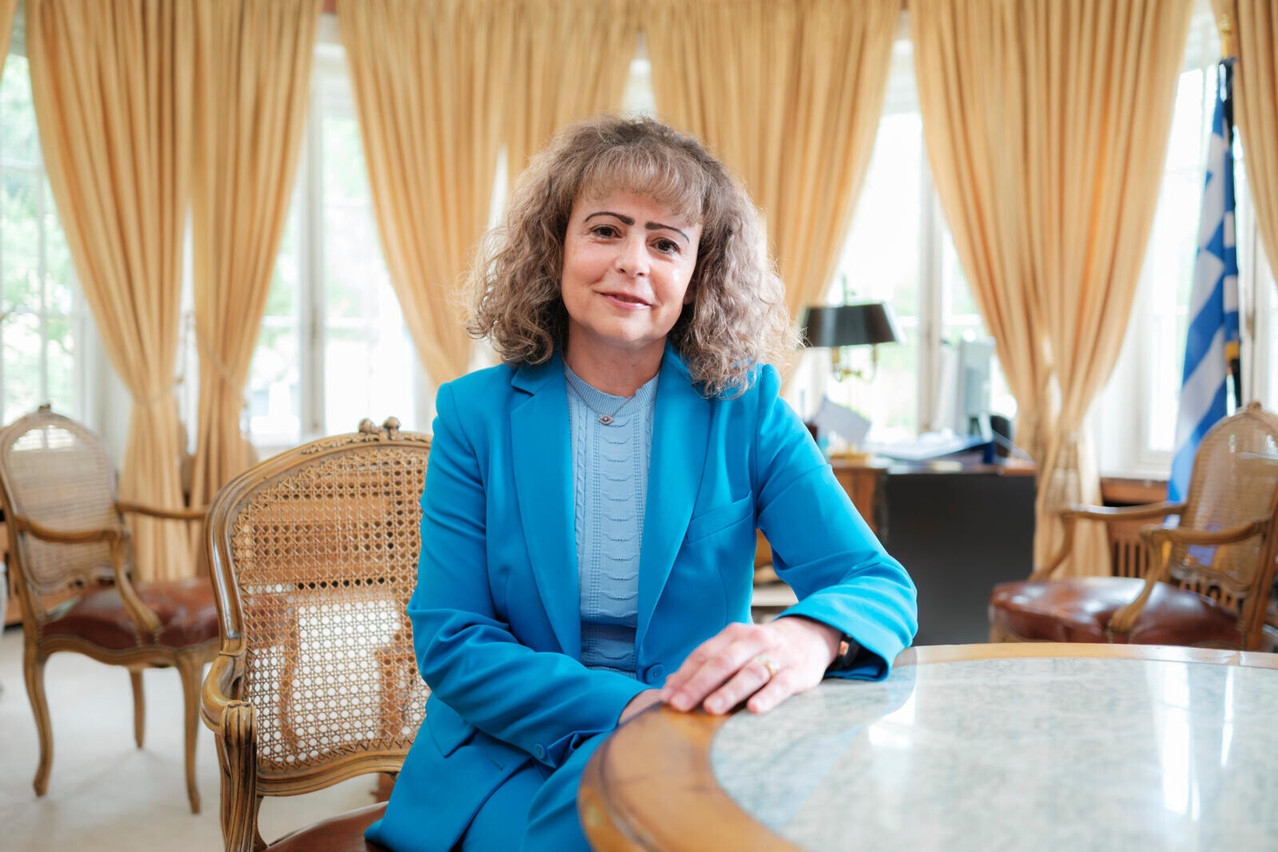
You took up your post as Ambassador to Luxembourg in January 2025. What were your first impressions of the country, and what has surprised you most since your arrival?
Christina Alexopoulou. – “My first impression was of a country that is remarkably international, open and outward-looking, while at the same time retaining a very strong sense of identity. Luxembourg is small in size, but its political, financial and European footprint is exceptionally large.
What has perhaps surprised me most is the extent to which Luxembourg has continuously reinvented itself. It has successfully moved from its traditional industrial and financial strengths into areas such as space, satellite communications, digital technologies, cybersecurity and sustainable finance.
I have also been impressed by the country’s ability to bring together its international dimension with a very pragmatic approach to economic development. This capacity to anticipate change, adapt and identify new opportunities is something I greatly admire and believe offers useful lessons for Greece.
Relations between Greece and Luxembourg are regularly described as excellent. In which areas do you think there is still untapped potential or room to deepen the bilateral relationship?
“Our political relationship is already excellent, so the challenge is not to redefine it, but to make it even more substantive. I see considerable potential in economic and technological cooperation, particularly in finance, investment, maritime affairs, space, cybersecurity and innovation. There is also room for stronger links between our business communities, research institutions and innovation ecosystems.
People-to-people links can take the relationship between two countries from the institutional level to a more important level.

We should also make greater use of the opportunities created by the presence of a strong Greek community in Luxembourg. Ultimately, our objective should be to translate the excellent political relationship into more business partnerships, more investment, more institutional cooperation and more exchanges between our people.
From an economic perspective, where do you see the strongest potential for closer cooperation between Greece and Luxembourg? What is still preventing companies from doing more business together?
“There is significant potential because the two economies have complementary strengths. Greece has undergone a profound economic transformation and today offers important opportunities in areas such as energy, infrastructure, logistics, tourism, technology and the digital economy.
Luxembourg, meanwhile, has developed an exceptionally international business and financial ecosystem, with particular expertise in investment funds, wealth management, cross-border finance and innovative financial services.
I think the main challenge is not a lack of opportunity, but visibility and connectivity. Businesses need to know each other better. More direct contacts between companies, investors, chambers of commerce and institutions can help identify opportunities that may not yet be visible. Our role as an Embassy is also to facilitate these connections.
Greece is one of the world’s leading maritime nations, while Luxembourg has developed its own maritime cluster. Where do you see the most concrete complementarities between the two countries?
“Maritime affairs are a particularly interesting area of complementarity. Greece brings its position as one of the world’s leading maritime nations and a very strong shipping ecosystem, while Luxembourg has developed important expertise in maritime services, finance and related activities. There is therefore potential for cooperation across a much broader spectrum than vessel registration alone. Shipping finance, maritime technology, the green transition, logistics and specialised maritime services are all areas where our two ecosystems can interact.
I also see opportunities for greater cooperation in research and innovation related to the future of shipping. The maritime sector is undergoing a profound transformation, driven by decarbonisation and new technologies, and both countries have strong reasons to be part of that transformation.
Perceptions are changing, not as fast as economic fundamentals. The economic fundamentals of Greece have changed, that’s for sure.

You have also held discussions with GovSat on secure satellite communications, defence and space. Should we expect concrete Greek-Luxembourg projects in these areas, beyond institutional exchanges?
“These are areas where I believe there is genuine potential for practical cooperation. Space, secure communications, cybersecurity and defence are increasingly interconnected, particularly as Europe seeks to strengthen its strategic autonomy and resilience. Luxembourg has developed important capabilities in space and satellite communications, while Greece is also strengthening its presence in the space sector and has significant expertise in defence, security and maritime affairs.
Our objective should be to move progressively from institutional exchanges towards concrete partnerships between companies, institutions and research organisations. This takes time, but the discussions we have had are intended precisely to identify areas where cooperation can become practical.
More than a decade after the Greek debt crisis, how much has Greece’s image changed among Luxembourg investors and financial-sector professionals? Do perceptions still lag behind the country’s economic transformation?
“Greece’s image has changed very significantly. The Greece of today is a very different economy from the one that international investors associated with the crisis years. We have restored credibility, strengthened our banking system, attracted significant international investment and made substantial progress in digitalisation, infrastructure and energy. Greece has also demonstrated that it can implement major reforms and remain an attractive destination for international capital.
Perceptions are changing, not as fast as economic fundamentals. The economic fundamentals of Greece have changed, that’s for sure. But we have to give more visibility to businesses and investors about the opportunities they have in Greece. This is why one of our priorities is to ensure that Luxembourg’s business and financial community sees Greece as it is today, rather than through the lens of the past. There is still work to do in communicating this transformation, but growing interest from Luxembourg is a clear indication that perceptions are changing.
Are current air links between Greece and Luxembourg sufficient to support stronger business ties?
“Aegean currently connects Athens and Luxembourg three times a week, while Luxair operates seasonal flights to several Greek destinations, including Thessaloniki and a number of islands. We expect Luxair to establish direct year-round flights to Athens, complementing the services already operated by Aegean. If Luxair were to add two weekly connections, together with Aegean that would bring the total to five flights a week.
I would dare to compare Luxembourg to the city-state of Athens in ancient Greece, in terms of its organisation and importance.

Stronger connectivity is very important for enhancing the economic relationship between our two countries. It would facilitate not only tourism, but also business exchanges and the movement of officials and professionals between Greece and Luxembourg.
Greece is nearing the end of its 2025-2026 term on the UN Security Council and will hold the presidency again in October. Where has Greece found that it can genuinely make a difference?
“Greece’s participation in the Security Council has given us an opportunity to contribute constructively to some of the most important international challenges, while reinforcing our commitment to multilateralism and international law. We have sought to act as a bridge, promoting dialogue, consensus and respect for the principles of the UN Charter. Greece has also placed particular emphasis on issues where we have specific expertise and a strong interest, including maritime security and international law.
A country can make a difference in the Security Council not only through its size, but through the credibility of its positions, its ability to build consensus and its willingness to engage constructively with all sides.
Greece will hold the presidency of the Council of the European Union in the second half of 2027 and has identified the integration of the Western Balkans as a priority. What concrete progress would you like to see achieved during those six months?
“The European perspective of the Western Balkans is strategically important for the European Union and for the stability of our wider neighbourhood. Greece would like to see tangible progress in the enlargement process, particularly for those countries that are ready and willing to advance. Accession must, of course, remain merit-based, with each candidate fulfilling the necessary criteria and commitments.
For Greece, this is not simply an institutional priority. It is a strategic investment in a more stable, secure and prosperous Southeast Europe. During our Presidency, we would like to contribute to keeping the enlargement process credible, active and results-oriented.
I will be an unofficial ambassador for Luxembourg for life.

The Greek community in Luxembourg has grown considerably over the past decade. Who are the Greeks moving to Luxembourg today, and what do you think is driving that growth? Has the profile of the community changed?
“There are now more than 6,000 Greeks living in Luxembourg, and the community has certainly become more diverse. It includes professionals working in European institutions and international organisations, people working in finance and other specialised sectors, entrepreneurs, researchers and academics, as well as families who have established their lives here. This reflects Luxembourg’s attractiveness as an international centre, but also the increasing mobility of highly skilled Europeans.
What is particularly encouraging is that the community is not simply growing in numbers; it is becoming increasingly active and integrated into Luxembourgish society, while maintaining strong links with Greece. This makes the Greek community an important bridge between our two countries.
What will you miss most about living in Luxembourg?
“Most of all, I will miss its people. I think people are very important. Knowing the people is perhaps the most important thing that an ambassador can do. People-to-people links can take the relationship between two countries from the institutional level to a more important level.
When you look back on your time in Luxembourg, what will stay with you most?
“I will be an unofficial ambassador for Luxembourg for life. I cannot help telling people the story of a country that is constantly reinventing itself and adapting to a changing international environment.
As I said earlier, Luxembourg is a very special country. Its importance is not measured by its size, but by its potential, its organisation and its credibility. I would dare to compare it to the city-state of Athens in ancient Greece, in terms of its organisation and importance.”