The timing was deliberate. On the same day, LuxConnect released its 2025 financial results: a net profit of €9.8 million, up 12.6% year-on-year, on revenues that held stable at €42.5 million. “This result reflects the strength of our business model and the commitment of our teams,” 
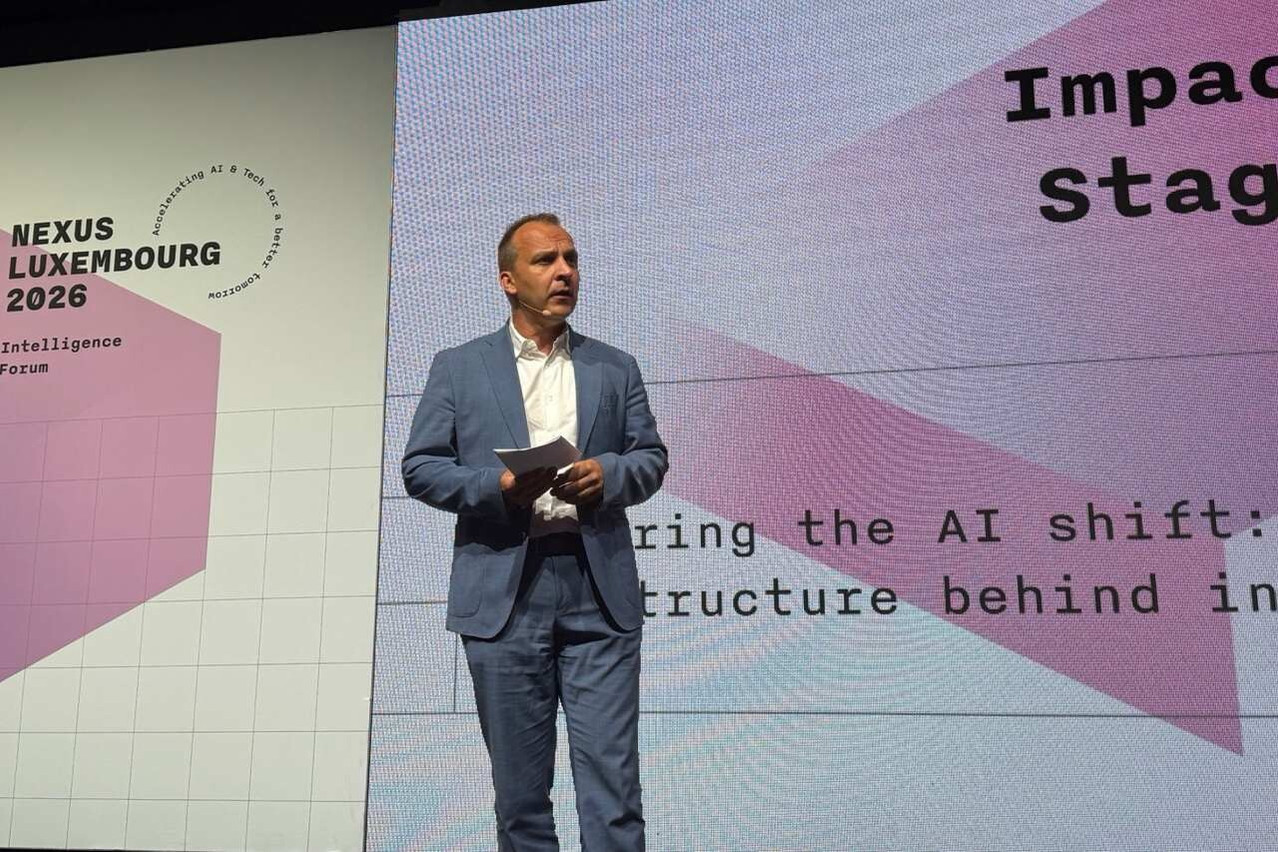
On stage, Paul Konsbruck had no slides. Standing in front of the room at Nexus Luxembourg, LuxConnect’s CEO delivered a talk that cut against the usual conference grain. A thesis, instead. “AI is the next industrial revolution,” he said. “The first one was with steam, the second one was with electricity. This one is basically based off intelligence. But just as factories required railways, roads, and power stations, today we have a new generation of infrastructure that is required for the use of AI.”
Michel Asorne, chairman of the board of directors, struck the same tone in the press release: “The 2025 results demonstrate the solidity of LuxConnect’s position and the relevance of its long-term strategy. The company continues to invest in projects that are essential for Luxembourg’s digital future while maintaining a strong focus on sustainability, innovation, and operational excellence.”
2025 was also a year of transition at board level. After many years of service, both Jacques Thill and Carole Muller stepped down from the Board of Directors. On the investment side, the headline project is in Bissen, where the data center is being prepared to host the AI Factory – the next-generation MeluXina supercomputer, Luxembourg’s national high-performance computing infrastructure.
The future of AI is not only a technological question, but it is an energy question.

The angle nobody talks about
Where Konsbruck was sharpest at Nexus was on energy. “The future of AI is not only a technological question, but it is an energy question,” he said. Every GPU needs electricity. Every data center needs electricity – not only to run the machines, but to cool them, which he says is “often underestimated.” Global forecasts, he noted, point to AI becoming one of the largest drivers of electricity consumption worldwide.
The pace of change is striking. Konsbruck recently attended the world’s largest data center trade fair in Washington. “If you just see those racks, where you have in-rack cooling – before we had rooms of 500 square meters that were used just for the infrastructure to do the cooling. Now it’s in-rack cooling that is possible. We have the same power availability on one square meter that before was on 300 or 500 square meters,” he told the Nexus audience. Infrastructure that was state-of-the-art just a few years ago, he added, “might now already become insufficient.”
LuxConnect is adapting. According to the press release, 2025 saw the installation of photovoltaic panels on the roofs of DC1.3 and DC2, as well as the replacement of end-of-life UPS systems with more efficient technologies. “Efficiency is a factor of resilience,” Konsbruck said at Nexus. “When you talk about geopolitical struggles, energy becomes a factor in resiliency and in sovereignty.”
If there’s no compute, there is no AI.

Twenty years ahead
At Nexus, Konsbruck grounded his argument in three foundations: compute, data, and connectivity. “The demand for compute power is exploding. It’s not any more storage, it is GPU high performance computing, and the challenge is not any more storing information but processing it. If there’s no compute, there is no AI.” Data quality and data sovereignty matter just as much. And none of it works without connectivity. “Data centers, fiber networks, high performance computing – it’s not separate but a completely integrated ecosystem.”
That ecosystem, he argues, is already largely in place in Europe. LuxConnect alone operates 1,900 kilometers of national fiber optic network and four data centers across two locations. At European level, he pointed to the HPC network as the most powerful high-performance computing infrastructure on the planet – not because of any single machine, but because of the combined capacity of all interconnected systems. “Today the European network of high performance computing is in fact the largest that exists on this planet because it’s not one machine that is somewhere, but it’s the connection of all those HPCs together,” he said at Nexus.
LuxConnect is also preparing its infrastructure for the deployment of IRIS² – the EU’s Infrastructure for Resilience, Interconnectivity and Security by Satellite program. “In my opinion, sovereignty starts with infrastructure,” Konsbruck said at Nexus. “And this is something positive for Europe.”
He closed with a thought about legacy. “If at some point in history people look back at this industrial revolution that we are facing right now, everybody will focus on the enormous progress that we will probably make in pharmaceuticals, in medicine, in research. But something that will be forgotten (and hopefully some historians will notice it) is in fact the creation of infrastructure. That is the backbone of that evolution.”