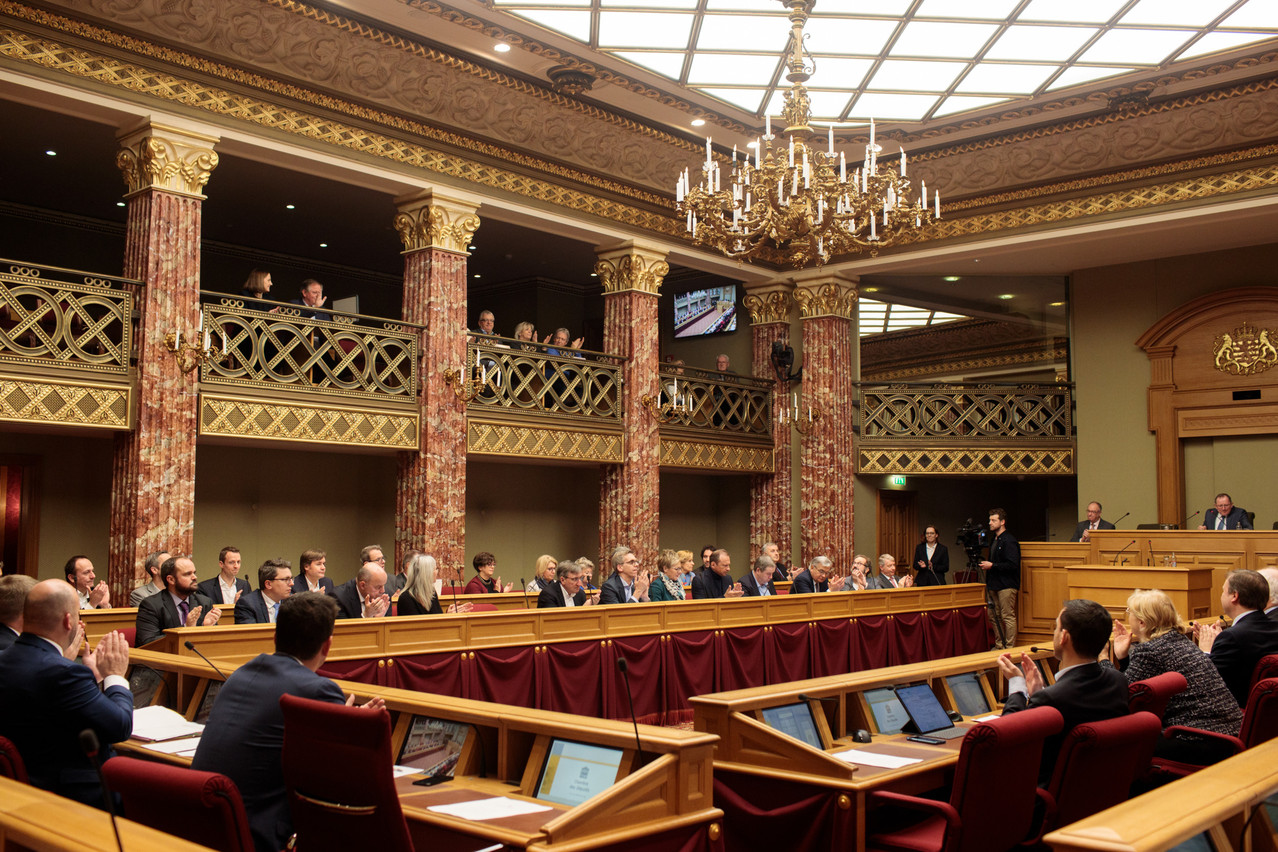
Deputies on the morning of 14 July met in parliament to discuss the government’s decision to postpone the vaccine mandate.
Prime minister  Xavier Bettel (DP) on 13 July addressed the MPs to explain the government’s decision. On 8 July, Bettel, alongside health minister
 Paulette Lenert (LSAP) and justice minister
 Sam Tanson (déi Gréng), had shared that the vaccine mandate--which had been in the works since spring--would not be implemented for now.
The government majority has thus officially positioned itself against a compulsory vaccination, whether it is sectoral or for the over 50s. It specified, once again, that it would be necessary “to be ready in case of emergency”, in the autumn, if the pandemic required it.
Majority parties in the government on Thursday 14 July carried the government’s decision. Main opposition party CSV--which had at the height of the omicron wave pushed for a vaccine mandate for all over18s--joined the government on its decision, but stated that it wanted a pandemic law and a finished vaccine mandate prepared ahead of the first parliamentary sessions in September.
On 13 July,  Claude Wiseler (CSV) explained that he was “left wanting on certain subjects” after hearing the governmental statement, but ultimately follows its reasoning.
“Hope for the best and prepare for the worst”
Ahead of the debate,  Mars Di Bartolomeo (LSAP) said that "hoping for the best and preparing for the worst" was a good approach, but he was keen to point out that his party had been "very cautious" from the outset about the vaccination requirement. "Without triumphalism, the evolution of this issue has given us reason. The government is on the right track," he added.
"Today, we do not have legally strong enough evidence to abolish a fundamental right of citizens,” summarised  Josée Lorsché (déi Gréng). "The purpose of the obligation has always been to allow health care to function normally. At present, there is hardly anyone in intensive care.” Another argument, also put forward by Bettel, is that the worst-case scenario that would lead the panel of experts to recommend that the over-50s be vaccinated "is only one of the seven scenarios they presented",
 Gilles Baum (DP) said. "This one is based on the hypothesis of a rapidly spreading and very aggressive variant.” This scenario is being looked at seriously but its likelihood is not big enough, in the eyes of the majority, to introduce a vaccination obligation.
Opposition points at backtracking
While waiting to see what might happen at the beginning of the new school year, part of the opposition--the ADR, déi Lénk and the Pirate Party--did not hesitate to confront the government about its backtracking. Pointing at "the numerous changes of governmental opinion on the subject and the pirouettes of Mr Bettel in an attempt to get back on his feet",  Nathalie Oberweis (déi Lénk) says, the opposition welcomes the governmental decision.
 Sven Clement from the Pirate Party sees the government's position as a "political decision. They are just afraid that compulsory vaccination will cost them votes in the next year.”
Additional reporting by Tracy Heindrichs. This story was first published in French on Paperjam. It has been translated and edited for Delano.