When Mangrove seed funded Skype a bit more than 20 years ago, the vision for the product couldn’t be bigger: connecting the entire world—by not only disrupting the large incumbents but also increasing the market manyfold with a clear and superior digital experience. 7 more breakout billion dollar companies followed since, and all had one thing in common—a similarly big but clear ambition.
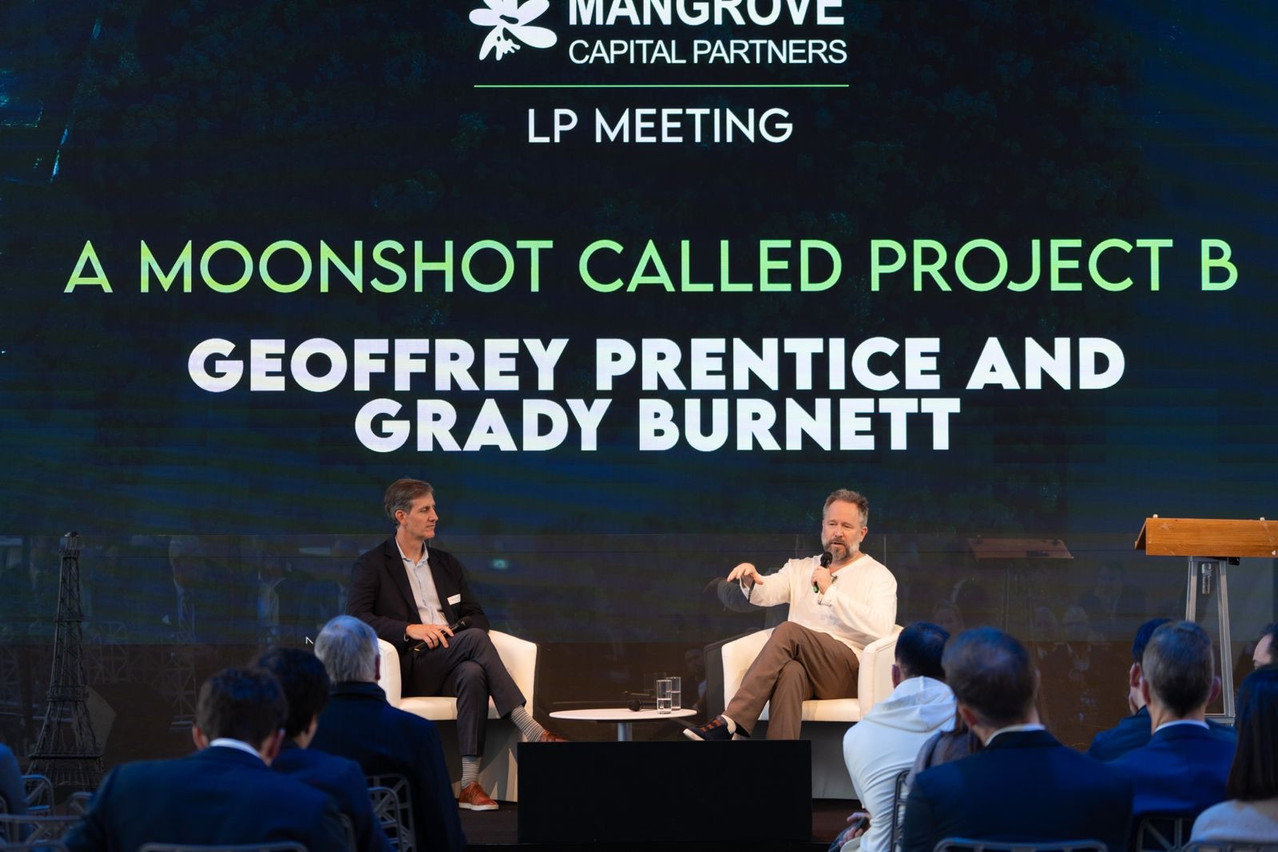
When operators like Geoffrey Prentice and Grady Burnett, the co-founders of Project B, reach out that they have been thinking for some time about an idea to get 1bn+ active users engaged on a network, you know it is serious… “What’s a huge industry, that’s sitting on a legacy platform, that is ripe for disruption, preferably a monopoly.” They told us that they found it, and will go at it using a playbook they rolled out successfully many times in the past—disrupt a major monopoly with a 10x better product by leveraging a major tech platform shift. You know magic can happen when a startup ticks all the “boxes”…
“Project B is really a reimagination of what the $3tn sports industry can be, and we’re starting with basketball. Creating a new alternative league, at the highest level, played alongside fans globally, in a digital and in-person format. Fundamentally, it is built with and around top athletes, so they have ownership in this new league, build it together, on a truly global stage.” Besides being a generational and “out of the box” opportunity, I have to admit that, in today’s climate of AI, compute, defense, etc. mania, it is also a refreshing one, driven by first principles.
Here are the five reasons we invested.
1. Rockstar founders who delivered time and again
Project B is the brainchild of two greats—two founders who know a thing or two about scaling consumer platforms. Geoffrey Prentice and Grady Burnett are the perfect cocktail to go after such a bold opportunity of building such a global platform from scratch—a true first. Geoffrey is the co-founder of Skype, Atomico, and multiple other ventures, while Grady, his college room mate, shaped some of the largest tech platforms in the world, including Youtube and Instagram, as a former senior ops Exec at Meta and Alphabet. Needless to say, we are grateful they chose us last year to join them on this explosive journey as one of their first institutional investors…
2. A gigantic mismatch between demand and supply
“The sports industry was just ripe for this technology to be developed on top of this legacy platform. Why basketball? It’s not a global platform, all the games are in the US, distribution rights are all cable rights in the US, yet the audience and potential are global.”
On the demand side, this is already today a market of 2bn+ people who watch games regularly. If you take into account “casual fans”, the market is more like 3bn+. On top, basketball is widely considered the fastest growing major sport globally, with Women’s Basketball developing the fastest.
The supply is in the hands of one major legacy league, the NBA, focused on the US market and capturing the lion’s share (close to 90%) of global league revenues (over $15bn). Let this sink in: This is over 20x bigger than the second-most prominent league. While industry revenues are increasing at a staggering close to 10% per year, players see little to zero participation in this value creation. Now, if we look at total basketball-related revenues (vs. league only), the opportunity increases by another 5x, exacerbating the problem even further.
The structural liquidity mismatch couldn’t be bigger. While the monopoly runs on an American timezone and geography with close to 100% of the games on local prime time, capturing over 90% of local cable revenues, only 12% of the fans are based in North America, while only 2% of the games are on streaming and even less so on social. Do not get me wrong, I grew up with the NBA and admire the players, but it’s disappointing to see such a great core product stuck in the past with a stagnant fan experience.
In short: until now, the audience was forced to come to the action. It is time we flip the script and bring the action to the audience.
3. A structurally underserved supply locked in by a large legacy monopoly
In contrast to a decade ago, many of the best players today are non-US born. Just have a look at the six last MVPs… The trend is clear: the talent pool is increasingly fragmented globally and should not have to relocate abroad into small or peripheral markets simply to access the marketplace.
A platform lives from its supply and should (obviously) compensate it properly. Instead athletes today have to cope with a league built on an outdated structure, game schedule, distribution, compensation model, undermining the performance and well-being of the athletes.
Whenever there is a large complacent monopoly, there is a large opportunity. The incumbent here sits firmly on top of this imbalance and has no interest in adapting or incentivising the players properly. For female players, the reward/value gap is even a staggering 100x larger. But the reality also is that 45% of top 50 global superstar athletes are now women.
Project B is fundamentally built around and with the athletes so that they have proper ownership: not only a substantially better cash compensation, but also a proper equity incentivisation plan. Here is a great example of the incredible value of how cornerstone players, but also so many other players, can create for their respective franchise and the league.
4. “Every game matters”: content reinvented for today’s audience
Re-imagining an analog local fabric into a digital-first and culturally relevant product experience is core to our DNA. Project B is building the future of global sports with a cohesive global fan and athlete experience: frictionless (global streaming distribution instead of cable TV lock-in, optimised for consumption and active participation in each geography…), unified (across social media, long-form content…) and immersive (360 experience, behind the scenes, merchandise…).
The core experience is beautifully simple, built on a single aim: to bring the action where it matters. Seven tournaments, nearly two weeks long, in seven global cities, with world class players competing for a championship in each city, and, of course, fully accessible wherever you are in the world with zero overlap, so every game can live fully on a the global stage.
5. Sports, a great asset class, with basketball as a starting point
Sports is a beautiful and huge asset class which we believe is ripe for tech disruption and that has been already driving “tech-like” returns. It is also a resilient, and fast growing space. In other words, people tend to prioritise sports when they cut back elsewhere…
Basketball happens to be the second most watched sport in the world, with a close to 50/50 female/male audience, and a game I love It is also the game with the largest monopoly controlling 90% of the market. If you look at other sports, like soccer, they have up to ten leagues covering various geographies and timelines.
Simply put, the ambition of Project B is to reimagine what this $3tn industry should be, by applying a tech-first, scalable business model. Project B’s inaugural 2026/27 season is approaching quickly. With already dozens of top global players signed for the league, the team is going big and fast. See you in Tokyo?