It is commonly thought that older people should adopt an ultraconservative strategy, while younger generations can afford to take more risks. This reasoning is based on the idea that, because of their age, older people have less time to compensate for any losses, which is true.
However, we find that many clients have a comfortable retirement and/or regular property income and feel that they never need a significant chunk of their wealth. Although around 80% of our customers have a balanced investment profile, a significant proportion of senior citizens do not invest in financial products and accumulate cash in their accounts, untouched for years. The result is a stagnation or gradual erosion of their purchasing power, often without any real realisation.
If senior citizens have assets that they think they have no use for, it may be wise to start thinking about diversifying their investments and questioning their intentions in terms of passing on their assets.
Investing as a senior citizen
Senior citizens often have a clear vision of their finances, guaranteed income, available assets and capital already built up. This allows them to tolerate a degree of volatility and enjoy freedom of action, as their immediate liquidity needs are often less constrained than those of their children.
Conversely, the younger generations, who are looking for a stable income or are still building up their savings, need to maintain sufficient liquidity for their life projects (property acquisition, children’s education, professional investments). Their real capacity to commit capital to financial products is often much more limited.
It is therefore advisable to adapt the management of your assets to your investment profile, rather than systematically favouring holding cash, which leads to a gradual erosion of purchasing power. Such a strategy also increases the likelihood of passing on greater wealth to one’s heirs.
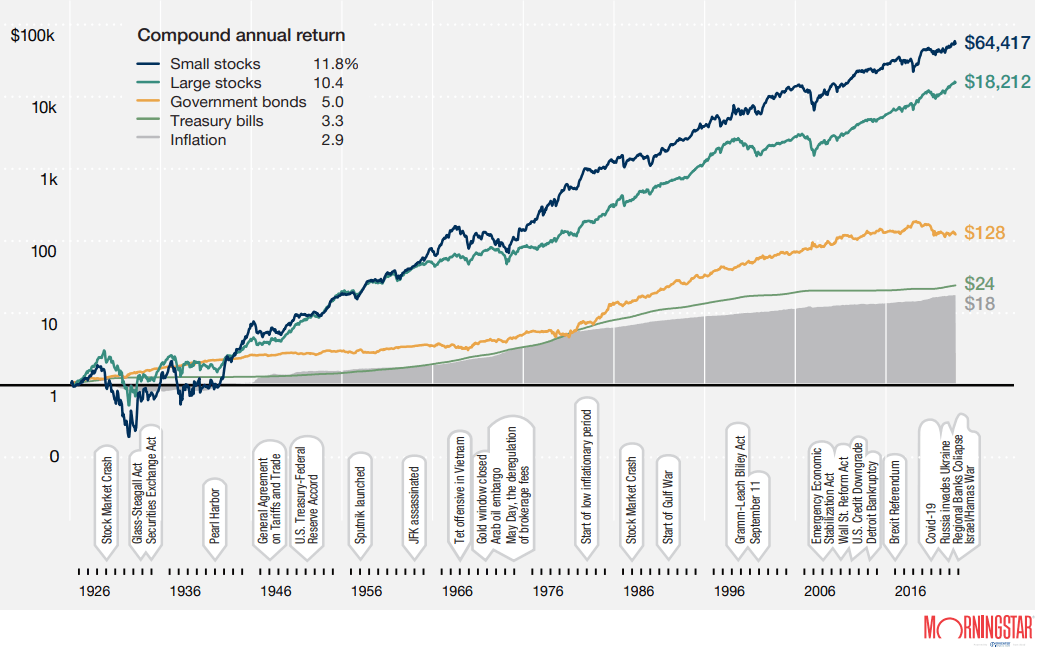
100 years of changes in returns per asset and inflation. (Infographic: Morningstar)
The chart above illustrates the evolution of US market performance over the last 100 years. This data, which is more comprehensive for the US than for Europe, which did not exist in its current form for the observation period, highlights the value of investing in financial products.
Over this period:
—average inflation was 2.9%,
—Treasury bills (<12 months) generated an average yield of 3.3%,
—bonds posted an average yield of 5.0%,
—US equities recorded an average performance of 10.4%.
A concrete example based on a client holding €100,000 over ten years with a balanced investment profile (50% equities/50% bonds). This example shows that, over a ten-year period, an investment of €100,000 held in cash (3.3%) would have grown to an average of €138,358, whereas an investment made with a balanced profile—the profile adopted by the vast majority of our customers—would have built up capital of €215,926 (€50,000 at 5.0% and €50,000 at 10.4%).
Allowing for inflation (2.9%), the investment held in cash would have amounted to €103,956, and barely maintained its purchasing power, while an investment made using a balanced profile would have built up capital of €162,237.
Even with more cautious assumptions about stock market performance, a diversified investment clearly remains more advantageous over the long term than a money-market investment.
The importance of estate planning
Estate planning is the second pillar of wealth planning for senior citizens. Inheritance planning is not just about passing on assets, it is also a way of preserving peace and family cohesion. All too often, a lack of preparation leads to conflict, tension and hasty decisions that can damage the value of the estate and/or family harmony.
A well-designed estate plan makes it possible to clearly define the heirs and beneficiaries, organise the distribution of assets and optimise the legal and financial aspects.
Often perceived as an administrative process, estate planning is, in fact, an essential strategic tool. It helps to secure wealth, preserve family harmony and pass on values as well as assets. Yet many people put it off until later, convinced that this type of decision belongs in a later phase of life. This approach, while understandable, can be counter-productive. Advance planning offers greater freedom of action, a clear horizon and options that often disappear when succession becomes urgent or contentious.
Instruments such as marriage contracts, gifts, wills, asset insurance or foundations are powerful levers for securing assets and facilitating their transfer.
The first step is to consult your private banker, who can help you manage your assets and refer you to a specialist estate planner. The estate planner coordinates the necessary parties (notaries, tax specialists, lawyers, insurers, foundations) and supports the client by gathering information about their needs in order to structure the planning and transfer of their estate.
In short, whatever your age, it is essential to consider how your assets are invested and to think about how they will be transferred. This is particularly important for senior citizens, who often have a global view of their situation and greater freedom of action. However, there is no obligation to plan one’s succession: everyone remains free to manage and pass on their assets according to their own convictions and priorities. The most important thing is to make informed choices, aligned with your personal and family objectives, to preserve your peace of mind.