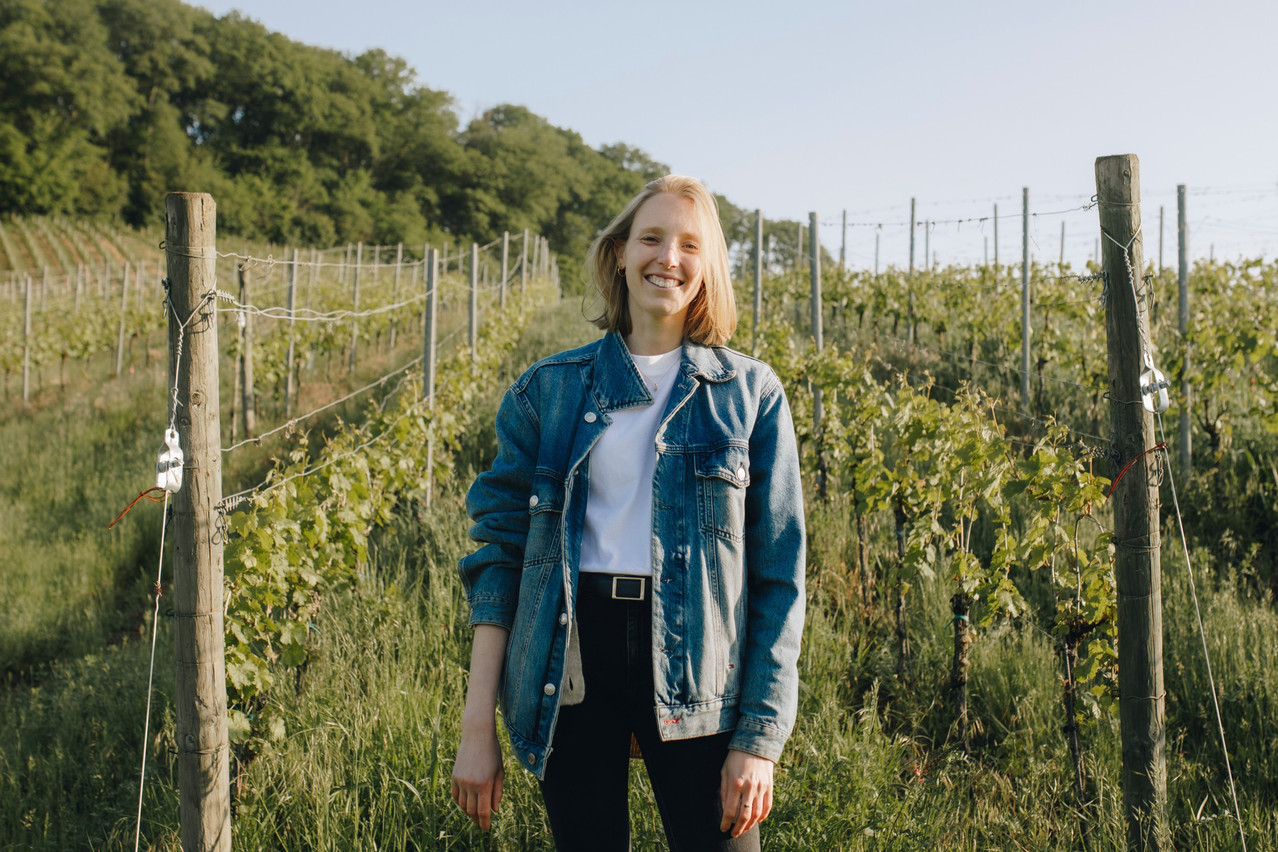
Marie Kox has fond memories of growing up with a family in the wine business. Although she says she had some distance from it, she was present for some of the harvests and events at Domaine Sunnen-Hoffmann, which back then was run by her mother, Corinne Sunnen, and her winemaking uncle, Yves Sunnen, who has since retired.
Marie says that neither of them, nor her father--Luxembourg engineer and politician and former housing and internal security minister, Henri Kox--pressured her to go into the family business. Marie recalls it was a bit later that she thought, “Why not study winemaking?” Her older sister, meanwhile, had decided to take a different career path.
So Marie decided to start her formal studies in viticulture, oenology and wine commerce at the University of Natural Resources and Life Sciences in Vienna, Austria, and then earned her related master’s degree at L’Institut Agro Montpellier in France. It was during her studies, she admits, that her passion for wine really took hold, as she jumped into discovering wine production methods and different ways of working through her internships. “There are so many things you can discover in the wine world,” she adds. “Pretty much anywhere in the world now you can find wine production. The wine world is big, and it’s always interesting to discover something new.”
Passion for organic viticulture
In May 2024, Marie took over the role of CEO of Domaine Sunnen-Hoffmann. At the time of writing, she was just shy of turning 32.
In her new role, she has been focusing on some of the challenges facing the wine industry at the moment. First is related to certain alcohol-free trends, people not drinking as much wine anymore. In light of this, Marie says, “You really need to tell your story, the philosophy behind your production, to show it’s still worth it to drink a good glass of crémant or wine, even if it’s not that much in quantity. It should be really important that everything is based on quality.”
Additionally, there’s the impact of climate change. As Marie explains, weather conditions can be fast-changing, and extreme rainfall, for instance, can have a heavy impact on production. “It makes the work with nature even more problematic, but that’s why it’s so important to work with nature,” she explains.
For over 20 years, Domaine Sunnen-Hoffmann has been working in organic viticulture--a legacy Marie is passionate about continuing. “That’s really important, also to work with the soil, so it’s healthy and has a lot of life in it and also can take up the water when it rains,” she explains, adding that the team is working as well to “push a little bit the immune system of the plant,” so it can be more resistant to potential fungi.
Investments for the future
Over the years, there have been major investments in products and facilities. In 2002, for instance, older vats were replaced with new stainless-steel vats with 300- to 2,000-litre tanks, while in 2006 a new cooling system was installed to help better preserve flavours. In 2013, the tasting room got a complete renovation as well.
Marie says there’s a big investment plan currently underway as well. “Young winemakers do get a lot of help from the government… so we’re planning to invest a little more in our buildings and machines,” she explains.
You really need to tell your story, the philosophy behind your production, to show it’s still worth it to drink a good glass of crémant or wine, even if it’s not that much in quantity.

The cellar already had a bit of a transformation before last year’s harvest, and works have recently started on a new roof to help ease the summer heat that can affect the cellar’s temperatures. There are two buildings--one already had a solar panel on top, the other will now be getting one. New plans are also underway to remove and replace some of the outdated tanks.
Privilege and responsibility
Running a family business, Marie says, can be a challenge because it’s not a 9-to-5 job. But Marie gets satisfaction in her role, also in how she’s able to leave her own mark as she continues the family legacy. “It’s quite interesting to express myself, in the products we [make]. You can really show your personality in the products and tell the stories of the different wines and crémants,” she says.
For instance, she has been putting a lot of efforts into the production of Pinot noir because “I do think we have a lot of potential here in Luxembourg to produce really fine red wines as well.”
Additionally, she feels a certain sense of privilege and responsibility in her role. “As I work with nature, I have the possibility to do something good for nature,” she says. “I do have a choice: I can choose the path of more responsibility” when it comes to climate change.
“We need to try to keep the vineyards healthy and alive as long as possible, so that that it’s still possible for the next generation to take them over.”
A long history
Founded in 1872, Domaine Sunnen-Hoffmann has been a family winery for over six generations and operates with the philosophy of “producing wines in harmony with nature, so that they always reflect the characteristics of the terroir and the varietal.”
Ecological impact
One step was taken around 25 years ago, when Domaine Sunnen-Hoffmann became the first winery along Luxembourg’s Moselle region to grow vines organically using “Bio-Lëtzebuerg” criteria, first by experimenting within a two-plot area of 0.35ha, later extending to its entire cultivation.
The company uses neither herbicides nor chemical fertilisers, and only organic compost and fertiliser is permitted. In the case that plants face disease, natural products are used. Leaf-removal is performed in a bid to enhance air circulation--important for preventing damp conditions that could potentially allow unwanted fungi to grow.
In 2009, Domaine Sunnen-Hoffmann received an honourable mention at the Bio-Agrar-Präis awards by the ministry of agriculture, viticulture and rural development.
Educational farming
Since 2005, the company has been a member of the Luxembourg Association of Open and Educational Farms, through which primary schools can opt in for educational farming activities.
These generally include a three-hour tour, where youngsters can learn more about the work of winemakers, walk through the vineyards and play an educational game. Kids also get to take home a free bottle of grape juice.
This article was written for the Wealth Management supplement to the April 2025 issue of Paperjam magazine, published on 26 March. The content is produced exclusively for the magazine. It is published on the site to contribute to the full Paperjam archive. Click on this link to subscribe to the magazine.
Is your company a member of Paperjam Club? You can request a subscription in your name. Let us know via club@paperjam.lu