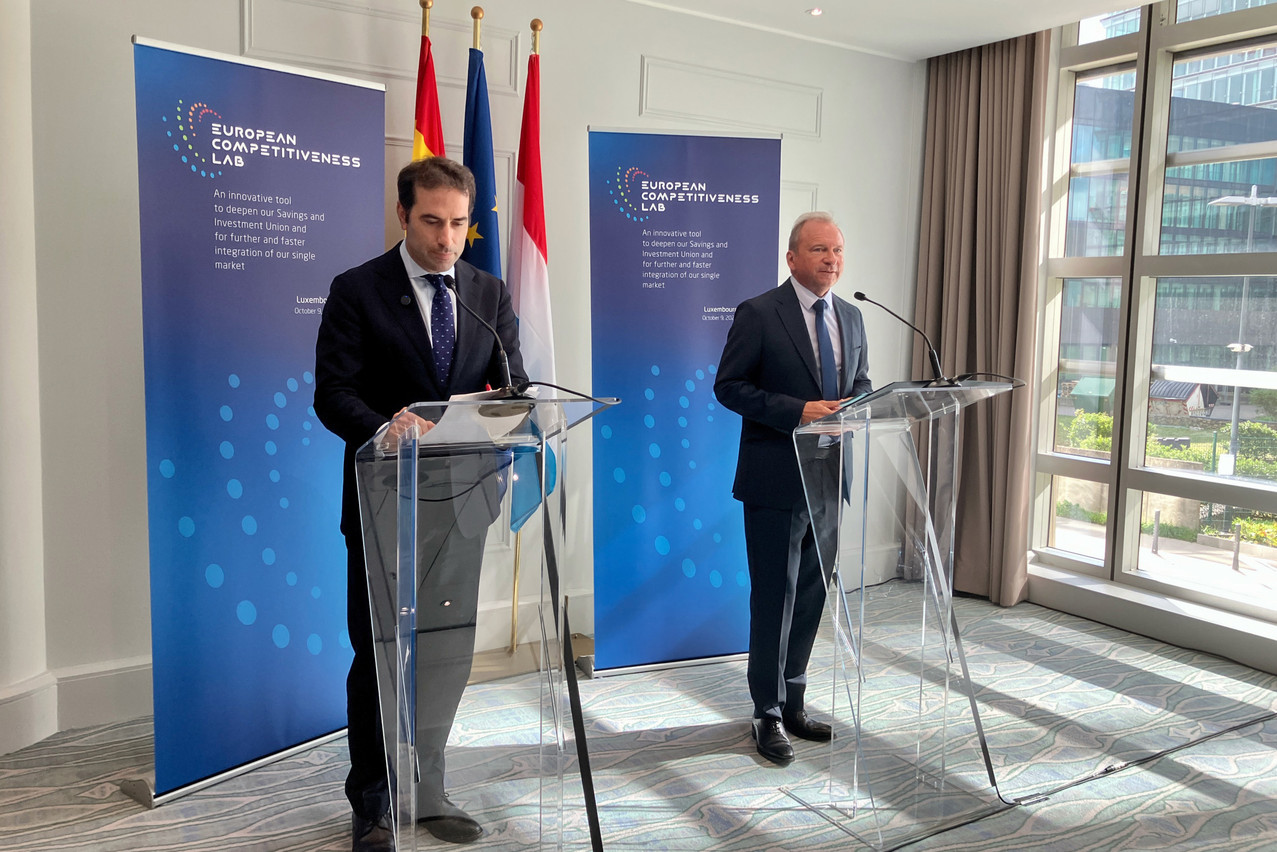
In the margins of the Eurogroup and Ecofin Council meetings, held in Luxembourg on 9 and 10 October, the third meeting of the European Competitiveness Lab was held. The Lab, an initiative launched by the Spanish government and led by the Spanish Minister for the Economy, Trade and Enterprise, Carlos Cuerpo, aims to enable groups of Member States to test, on a voluntary basis, projects designed to deepen European capital markets and increase competitiveness in Europe. "A coalition of the willing", in the words of the Spanish minister.
This Thursday's meeting brought together 25 delegations, including 11 ministers, as well as the President of the ECB, Christine Lagarde, and the European Commissioner for Financial Services and Savings, Maria Luís Albuquerque. Only seven delegations took part in the second meeting in June.
A project for a European securitisation platform was presented on this occasion. "A platform that we see as a valuable complement to the Commission's reform of the regulatory framework for securitisation", insisted Finance Minister 
Securitisation allows issuers to bundle illiquid assets into a financial product in order to turn them into securities that can be traded on the markets. Creating a European platform would make it possible to standardise these long and complex transactions, thereby facilitating access to this market for smaller players. As well as structuring transactions, it could also ensure regulatory compliance and data transparency, thereby generating economies of scale. To finalise the contours of this platform, the absence of which is detrimental according to Gilles Roth, particularly in terms of pooling costs, a technical committee will be set up with interested national authorities and professionals.
The Finance Europe Label is moving forward
The European Competitiveness Laboratory also provided an update on the Finance Europe Label, launched on 5 June by Luxembourg, France, Spain, Germany, the Netherlands and Estonia. This label is designed to help European savers improve the return on their savings by directing their investments towards financing European companies. To obtain the label, a financial product must demonstrate that at least 70% of its assets are invested in the European Economic Area (EEA), that its investment universe favours equities in order to contribute to the equity financing of European companies, and that it has a minimum investment period of five years. Any tax incentives associated with this label will, for their part, be determined by the States in accordance with their tax policies.
"Our objective is to strengthen Europe's competitiveness for more sustainable growth. The Finance Europe label is one way of achieving this", said Gilles Roth. "The discussions showed a shared commitment to taking pragmatic steps to unlock capital and define strategic priorities for its use," continued the minister.
Third item on the agenda: the future. Carlos Cuerpo spoke about the next projects that the members of the Laboratory will be working on: strengthening the single capital market, financial education and improving financing channels for SMEs. The next meeting of the members of the European Competitiveness Laboratory is scheduled for early 2026.