Luxembourg’s fund management industry is undergoing a structural change that is reshaping the traditional concept of substance. For years, establishing a management company in the Grand Duchy generally meant concentrating staff within the country to meet supervisory expectations.
Findings from the KPMG Large-scale ManCo and AIFM Survey 2026, covering large in-house ManCos—including super ManCos and AIFM-only entities—show that this model is becoming more geographically distributed. Major fund groups are expanding their branch networks across Europe, with foreign branches now accounting for almost half of their combined workforce.
A quiet revolution across borders
The annual survey examines 20 of Luxembourg’s largest management companies and AIFMs, which collectively represent approximately one-third of the market. Among the surveyed firms, 80% of super ManCos and 70% of AIFM-only ManCos operate at least one branch, Alan Picone, partner and asset management market leader at KPMG Luxembourg, said in an interview on 23 October 2026.
The speed of the change is particularly striking. Between 2021 and 2025, the distribution of employees between Luxembourg headquarters and foreign branches moved from approximately two-thirds versus one-third to an almost even split (see Chart 1).
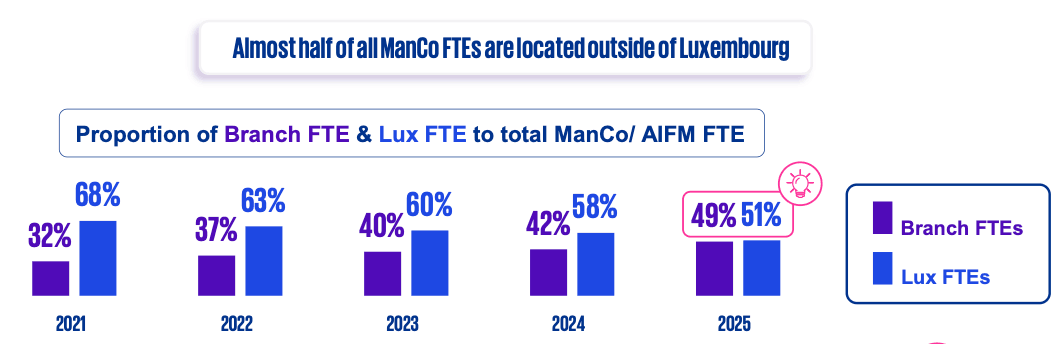
Chart 1: Over the past five years, branch FTEs have grown by 7% annually to match broadly stable Luxembourg headcount, while branch activities have expanded across portfolio management, operations and ancillary services. Source: KPMG Large-Scale ManCo & AIFM Survey 2026
This does not necessarily signal an erosion of Luxembourg substance. Rather, Picone said, it reflects a broader model in which the Luxembourg entity retains central management, strategic decision-making and detailed oversight while branches perform a growing share of the operational work.
“Scalability and synergy have become a key priority at group level,” Picone said. The aim is to strengthen a ManCo’s ability to onboard and manage new products without increasing its workforce at the same rate. “The objective is to enable business growth without a proportional increase in headcount.”
Internalising portfolio management
Management companies have historically relied heavily on delegation to access portfolio-management expertise outside Luxembourg. That framework is now changing.
Nearly half of the surveyed entities conduct investment-management activities through their branch networks, including branches in France, Germany and Italy. By employing portfolio managers through a branch rather than appointing a separate third-party delegate, an AIFM keeps the activity within the same legal entity.
“This fundamental structural change reshapes regulatory obligations and control architecture,” Picone said.
The proportion of ManCos with at least one branch providing first-line operational support increased from 37% in 2024 to 48% in 2025, according to figures supplied by Picone. He argued that the development strengthens Luxembourg’s reach as a European management hub.
Branch activity also extends beyond investment decisions. Compliance, valuation support, anti-money-laundering controls, risk management and investor relations are increasingly distributed across branch networks.
PwC’s Observatory for Management Companies – Barometer 2026 similarly found that marketing and distribution were the most heavily staffed branch activities, averaging 32 full-time-equivalent employees, followed by portfolio management, with an average of 30.
From regulatory mailbox to strategic hub
The expansion of branch networks forms part of a wider transformation in the role of the management company. Rather than operating primarily as a regulatory cost centre, ManCos are becoming broader European business-management platforms.
According to KPMG, 59% of surveyed ManCos and AIFMs provide ancillary services to their groups beyond their core regulatory responsibilities. These services include fund administration, transfer-agency functions, MiFID services and support for cross-border distribution.
The ManCo of the future
The emerging model concentrates senior leadership, governance and strategic control in Luxembourg while distributing more execution across branches and technology platforms.
Picone expects artificial intelligence and automated agents to assume a larger role in routine activities such as regulatory reporting and document processing. This could allow employees to focus more of their time on strategy, judgement and oversight.
A leaner and more decentralised operating model will, however, place greater demands on governance and risk controls. As supervisors examine how effectively branch networks and technology are managed, senior leaders will need to demonstrate clear oversight arrangements, strong operational control and robust frameworks for algorithmic and AI governance.
Picone said local governance has strengthened alongside the expansion of branch networks. Some 57% of surveyed firms reported that at least one Luxembourg-based conducting officer also held a wider group mandate, such as global head of risk or compliance. He described this as a significant development among firms of this size.
Fewer ManCos, more assets
The change is taking place against a backdrop of market consolidation. According to KPMG, the number of Luxembourg ManCos declined from from 315 to 289 over five years, while assets under management expanded from €4.3trn to €6.3trn (chart 2).
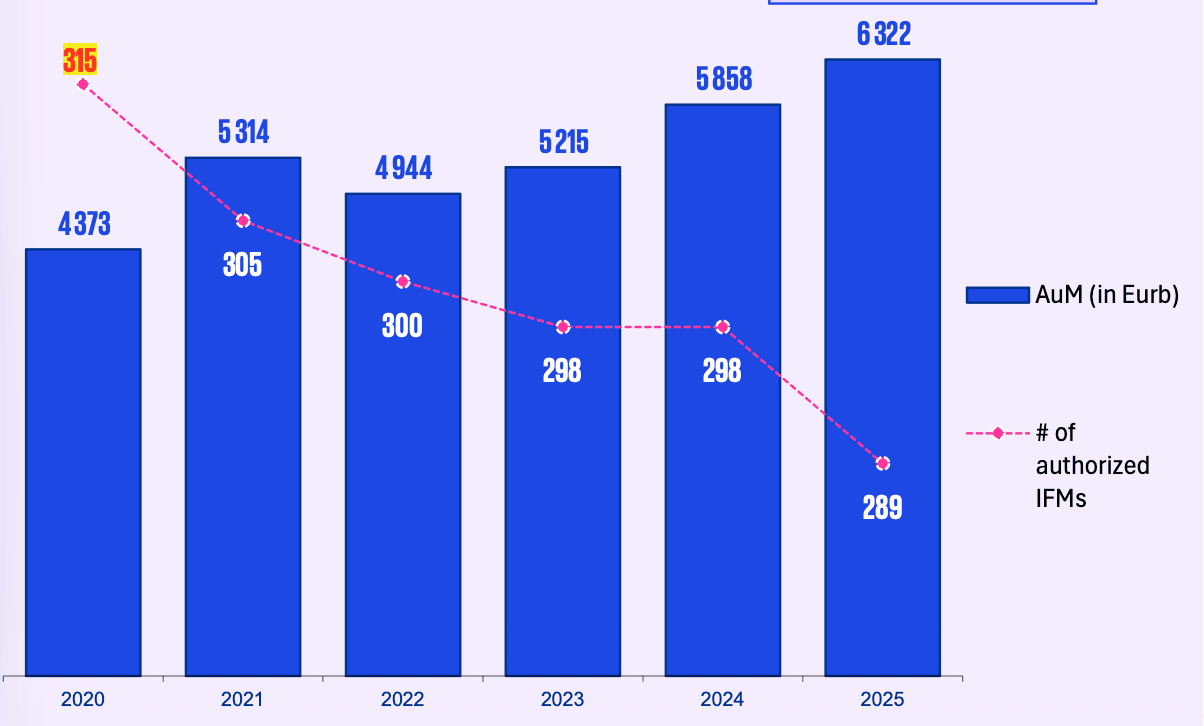
Chart 2: Consolidation of ManCos & AIFMs as a vector of scalability Sources: KPMG and CSSF Annual Report 2023, CSSF Annual Report 2024, CSSF Investment Fund Managers (situation as of 31 December 2025)
The figures point to an industry composed of fewer but larger management companies. Branch expansion has supported that growth, while Luxembourg has retained its central role in governance, oversight and strategic decision-making.