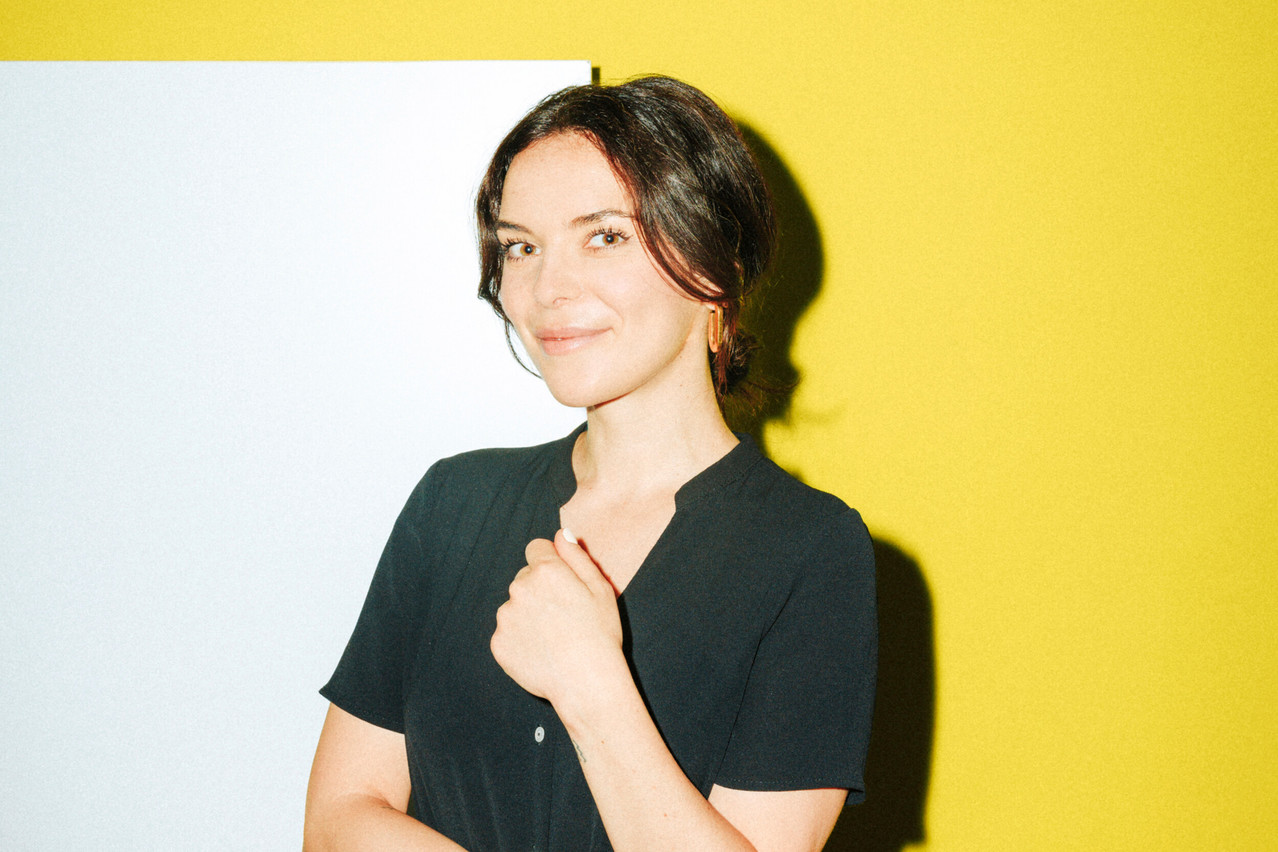
How did your passion for flowers turn into a career?

I then returned to Luxembourg to undertake technical training and a three-year apprenticeship. Even back then, I knew I wanted to set up my own business with a different approach to that of a traditional florist.
Why did you choose the name Infiiorata?
“The name refers to the Italian verb ‘infiorare’, which means ‘to make something bloom’, as well as to my family origins. For me, the two ‘I’s represent a form of balance. I didn’t want to choose a name that was too directly associated with a florist’s. Infiiorata is more about a world and an identity. It’s almost an alter ego that allows me to express a more sensual, feminine and conceptual vision of flowers.
Why didn’t you open a traditional shop?
“I knew right from the start that I didn’t want a shop where I’d have to wait for customers every day. My job is to design projects, not just to sell flowers. I did, however, try running a shop for three months. That experience confirmed that this way of working wasn’t right for me. It also leads to greater wastage, as flowers are living, perishable products.
Every project begins with the location, the client and the intention. I don’t start with a catalogue of designs.

I prefer to put bouquets together to order and distribute them through a few selected retail outlets. This leaves me more time for large-scale projects, weddings and brand activations.
How is your business organised?
“Around 80% of my business now comes from the B2B sector. Infiiorata is at the heart of the studio and encompasses floral installations, corporate events, set design and brand activations. In particular, we work on product launches, dinners, corporate spaces and campaigns aimed at a company’s clients.
I then created two further brands. Iinamorata specialises in weddings, whilst Infiiorino offers more affordable bouquets, flower subscriptions and workshops, particularly for businesses. These three areas of activity are aimed at different audiences, but are united by the same approach.
What sets your work apart from that of a traditional florist?
“Every project begins with the location, the client and the intention. I don’t start with a catalogue of arrangements. I try to understand the overall identity and work out how the flowers can reinforce it. I might also use fruit, vegetables, charcoal or other materials. The aim is to create an installation that is consistent with the client’s vision, rather than simply a floral decoration.
The job remains very physically demanding, and it takes time to train someone in flower preparation and arrangement.
I’m also looking for varieties that are rarely seen in Luxembourg, such as artichoke flowers, certain varieties of garlic, turmeric and lotus. The shapes and forms of these plants allow me to create different arrangements.
How do you handle a product as delicate as flowers?
“I work mainly with seasonal produce, delivered from the Netherlands up to three times a week, depending on the projects. You have to predict precisely when the flowers will be in bloom and what their colour and shape will be on the day of the event. Not having a permanent shop allows me to order as closely as possible to what is needed and to significantly reduce waste. During my trial in the shop, I noticed that customers no longer wanted to buy certain flowers as soon as they looked too open, even when they were still beautiful.
This requires a great deal of preparation, as prices and availability vary with the seasons. The wedding season is mainly concentrated in the summer, whilst B2B business picks up significantly at the start of the new school year and continues until December.
How did you finance and develop the business?
“Even before the official launch, I had already been working on Infiiorata’s brand identity, set up the Instagram account and started building up a client base. I then launched the business from home, which allowed me to keep costs down at the start. I’m very careful with my spending and have grown the business gradually, without any external funding.
Since 2021, it has roughly tripled. B2B is now the most profitable part of the business, although each project varies depending on the flowers, the season and the scale of the installation. Social media is important, but LinkedIn has also enabled me to demonstrate that floral design can be a genuine B2B business, with its own strategy, logistical challenges and value for brands.
Technology can support the process, but it cannot replace manual skills or product knowledge.
Do you always work on your own?
“I’m the company’s only employee, but I work with freelancers when projects require it. Some are based in Amsterdam and share the same approach to the work. I also use external service providers for deliveries and certain logistics operations.
This model gives me flexibility and limits the financial risk. On the other hand, the work remains very physically demanding, and it takes time to train someone in flower preparation and arrangement. It is not a skill that can be learnt overnight.
Can artificial intelligence (AI) help you in a craft trade?
“I use it to create mood boards, organise social media content or save time on certain tasks. So it can help me with managing and presenting projects, but it doesn’t replace manual work. Nature never corresponds exactly to a visualisation. Sometimes clients also show me AI-generated images featuring flowers that simply do not exist. In such cases, I have to explain to them what is actually possible.
Flower arranging is also closely linked to a personal style. Technology can support the process, but it cannot replace either the artistry or an understanding of the product.
How would you like to see Infiiorata develop?
“I want to continue developing Infiiorata’s projects with companies and luxury brands, both in Luxembourg and abroad. I have already carried out projects in London and Paris, and international enquiries for weddings are also on the rise.
Sometimes you have to weather the rainy days for things to blossom, but I’ve never felt more at home than [I do now].
Infiiorata must retain its high-end positioning and bespoke nature. Infiiorino, on the other hand, could be rolled out much more widely, across more retail outlets, and even, in the long term, as a network or franchise.
This growth will require us to recruit more staff and delegate more tasks. The aim, in particular, is for other people to take charge of the preparation and logistics so that I can focus more on the creative and artistic direction. But I never want to lose the passion that gave rise to the project.
What does success mean to you?
“Success means being able to choose the projects and clients that truly reflect Infiiorata’s identity, without having to accept every request. It also means having the freedom to make my own decisions and build a business that I can identify with. Sometimes you have to weather the storm before things can blossom, but I’ve never felt more at home than since I set up this business.”
This article was written for the October 2026 issue of Paperjam magazine, published on 16 September. The content is produced exclusively for the magazine. It is published on the site to contribute to Paperjam’s comprehensive archive. Click on this link to subscribe to the magazine.
Is your company a member of the Paperjam Club? You can request a subscription in your name. Please let us know via club@paperjam.lu.