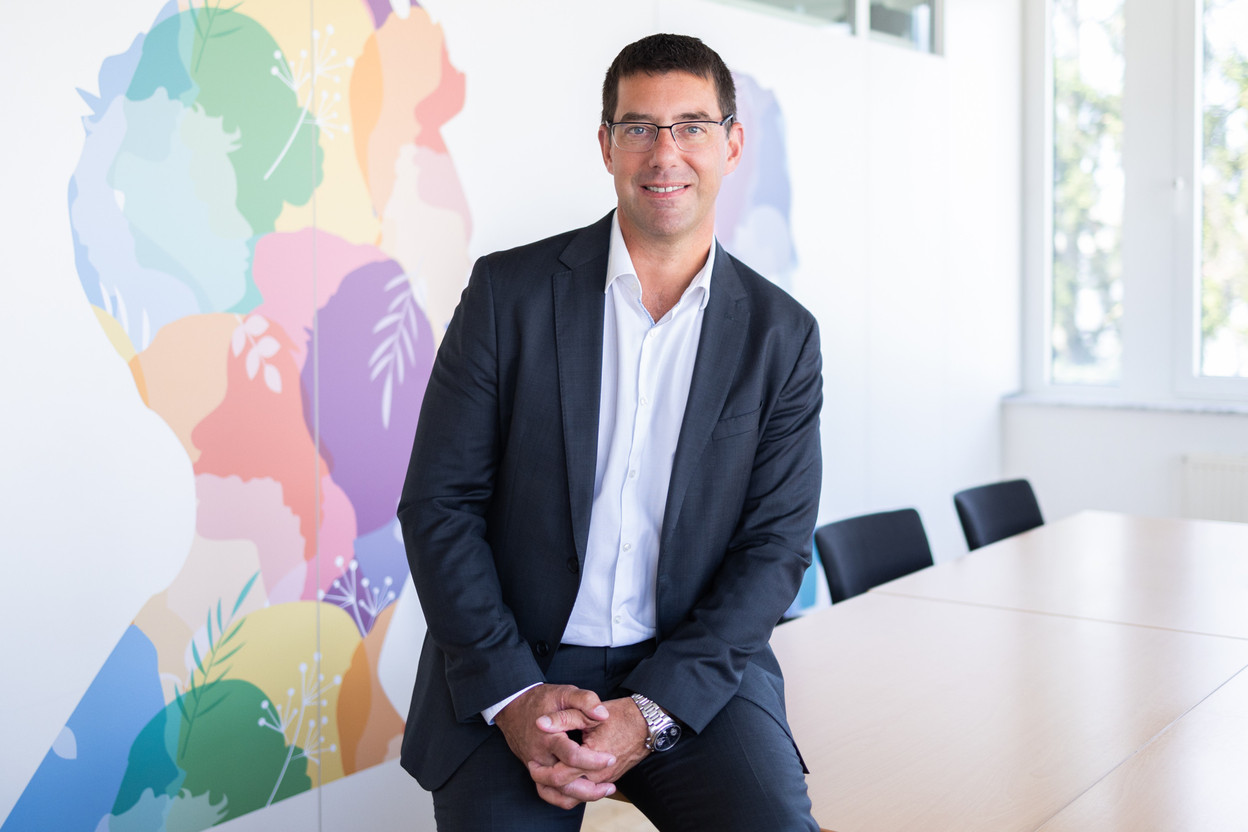
Julien Bossu dreamt of commentating on Champions League matches, but he finally found another field to play in: human resources. Specifically, in the construction sector. After an internship at Ferrero, he joined Soludec, where he cut his teeth for eight seasons. Then came the change of dressing room: spotted by the CDCL, he signed without hesitation, attracted by the family spirit of the group and the challenge of uniting a team. Since 2016, he has been working at the highest level as HR director and member of the management committee. But there’s no question of sitting on the bench: he plays an active role, as close as possible to his teams.
Paperjam: If you had to boil the job of HR director down to a single word, what would it be?
Julien Bossu: Facilitator.
Why?
We are that link between management and staff, able to create a real two-way dialogue. When management launches a project, our role is to ensure that the teams buy into it. But buy-in doesn’t mean accepting everything: being an HR director also means knowing how to say no and propose alternatives when we think they are fairer.
Construction has a reputation for being a hard job. How can you make it attractive?
It’s true, we don’t have the advantages of the banks or the state. But we have two options: complain… or be imaginative. Our strength is pride in what we do. In 20 years’ time, I’ll still be able to say to my children: “We built Hamilius, we built Skypark.” Being part of something concrete is what still attracts talent in search of meaning.
And then, we are a family business committed to human values that many people are looking for today. Values that are often easier to live by than in large international groups, where objectives and rhythms are of a different nature.
Construction imposes a strict framework. How have you managed to make it more flexible?
There’s no teleworking for us: the site doesn’t lend itself to it. And I’m keen to avoid any divisions between those in the office and those in the field. On the other hand, we have rethought our working hours. Before, they were fixed (7am-noon, 1pm-5pm), with no possibility of adaptation. The result: cross-border commuters stuck in traffic jams and, more generally, employees who wanted more flexibility.
We have therefore started from scratch: you can arrive between 7am and 9:30am and depart from 3:30pm. The lunch break can be reduced to 30 minutes if desired. In other sectors, this might seem trivial, but for us it’s a minor revolution. Managers feared a loss of productivity. In reality, the teams are accountable and deadlines are met.
If you had to give three essential qualities for the job of HR director, which ones would you choose?
The first is openness. In my 20-year career, I’ve learned that employees are prepared to hear the truth if we take the time to explain the hows and whys of our decisions, even when we’re making people redundant.
The second is to take responsibility. Once you’ve made a decision, you have to stick to it. That doesn’t mean not listening beforehand, but if you make a mistake, you acknowledge it and move on.
Finally, I’m a great believer in giving people a second chance. Everyone can make mistakes, myself included. The important thing is to learn from them.
You say you’re not afraid of making people redundant. Has your relationship with it changed with experience?
To say that the first one wasn’t scary would be a lie. I was 24 and I still remember that moment: the fear came mainly from the unknown, not knowing how the person was going to react. With experience, the anxiety diminishes, but it never becomes easy. You can use the wrong words and come up against people who refuse to listen. At such times, I remain firm, but always respectful. Dismissal never happens between two doors. It’s a serious moment, you’re putting an end to a professional project, and behind it there’s a family. So you have to be as honest as possible.
That’s when you realise how important it is to have the right people around you. For 20 years, I have been able to count on the friendship and advice of Louis Berns, who works in employment law at Arendt & Medernach. He has always told me a simple rule: you need a solid case, backed up by facts. Whether it’s a dismissal or any other sensitive decision, if the elements are there, then we can do the job properly.
We want to remain a voice that counts in the debate.

You’ve just been elected co-chair of HR Community. Why did you accept this role?
When 


The idea is not to revolutionise everything. Julie and Alexandre have done a remarkable job. We want to continue with continuity, with new initiatives: tutoring, mentoring, podcasts… and above all to remain a voice that counts in the debate. The white paper on the future of work showed that HR Community can carry weight and be heard, including by players like Fedil, UEL and Adem.
What has been the most difficult moment in your career?
Unquestionably, the announcement of the death of an employee. I’ve been in this situation three times, and it’s by far the hardest. At times like that, there’s no hierarchy: you’re faced with a wife and children, and you have to find the right words. You go home, you sleep badly, but the family has to carry on living with this tragedy. You never really get over it: I still remember the names, the first names, the personnel numbers.
That’s why safety remains my priority. Helmets, harnesses, audits, control procedures… it’s expensive but it’s essential. Our responsibility is simple: to ensure that every employee can go home in the evening. And, unfortunately, sometimes that’s not the case.
Imagine you’re having a job interview with the Julien of 20 years ago. What would you think?
I’d tell him: be yourself. Not who the other person wants you to be. It took me almost ten years to understand that. At first, I was afraid of disappointing people. I thought that a HR manager had to say yes to everything and please everyone. Then one day, during a training course, a coach--Lydia Haan-Fleurent--stopped me dead in my tracks: “If you carry on like that, you’re heading straight for the wall.” We had a long chat that evening, and she made me realise that I was good at being me, and bad at playing a role. That was a real liberation. Since then, I’ve stopped overacting and being afraid to say no. And I don’t think I’ve ever been as good at my job as I was after that breakthrough.
If you hadn’t gone into HR, what would you have done?
Commentating on football matches! The Champions League, the big stadiums, travelling all over the world--what a great life! At home, I sometimes muted the TV to practise, much to the despair of my mother, who didn’t take too kindly to the job.
Internships are essential; there’s no substitute for reality on the ground.
And how did your passion for human resources come about?
By chance! I was far from being a regular student. I started with law, but I spent more time having fun than studying. Then I tried communications and political science, because I had always dreamed of being a sports journalist.
It was my father who got me started. One day he handed me a brochure from a university offering human resources studies. At first, like any frustrated young person, I dismissed it out of hand. But I ended up asking around, and discovered that it had everything I liked: communication, law, sociology…
The revelation came during my work placement at Ferrero. I was lucky enough to be accompanied by a great HR director, Jean-Pol Chleide, who taught me the trade. Since that day, I’ve been convinced of one thing: internships are essential; there’s no substitute for reality on the ground.
Is there a book or film that illustrates a good or bad corporate culture?
I’m very fond of Sartre and his saying: “Hell is other people.” In business, that can also be true… but that’s precisely where HR has a key role to play. Every time a new employee arrives, there are questions, and that’s normal. Our role is to explain and reassure. You don’t hire someone to disrupt a team, but because there’s a need. Being clear from the outset avoids mistrust, facilitates integration and prevents the “others” from becoming a living hell.
What if you had to choose a song to illustrate your daily life as an HR director?
“Girls Just Want to Have Fun” by Cyndi Lauper. I love that song; it’s got this crazy energy. And I always come to work in that same frame of mind, telling myself it’s going to be a good day.
Any hidden talents that your colleagues don’t know about?
I cook! I love cooking. I subscribe to a magazine, I love shopping, browsing the shelves, discovering new spices. It has become a real passion and also how I get away from work.
In this summer series, HR directors also become journalists. 
I wore ties for years without conviction. At the start of my career, I thought they were compulsory. No one ever told me I could do without them, so I kept them for seven or eight years. At the CDCL, I immediately asked what I should wear. With a managing director in trainers, I can assure you it’s liberating! So, the next time I wear a tie? The day Fabrice invites me to a Michelin-starred restaurant. [He laughs.]
As far as housing is concerned, the priority is clear: build, build and build some more. The real stumbling block is permits. Administrative procedures take too long: between the submission of a project and the first shovel being turned, it can take five or even ten years.
What question would you ask the next and final HR director in this series? It’ll be 
How does she see the packages evolving between industry, banking, insurance and the public sector? In industry, the economic realities are different. So how do you attract people when you can’t compete financially?
This article was originally published in French.