What should you put in your shopping basket when your budget doesn’t stretch to buying everything? At the Mondorf-les-Bains International School (EIMLB), this question becomes a financial education exercise. During an activity at Cactus, pupils had to choose the items needed to organise a small meal, with a limited budget at their disposal.
Price was not the only factor to consider. Whether local or not, organic or conventional, and nutritional value: the pupils had to compare, weigh up the options and make do with what they had. It was a way of bringing to life the decisions they will have to make in their everyday lives.
“With a limited budget, they had to make choices,” explains Fabio Condorelli, professor of economics and head of the Sustainable Entrepreneurial Schools and financial education programmes at the EIMLB.
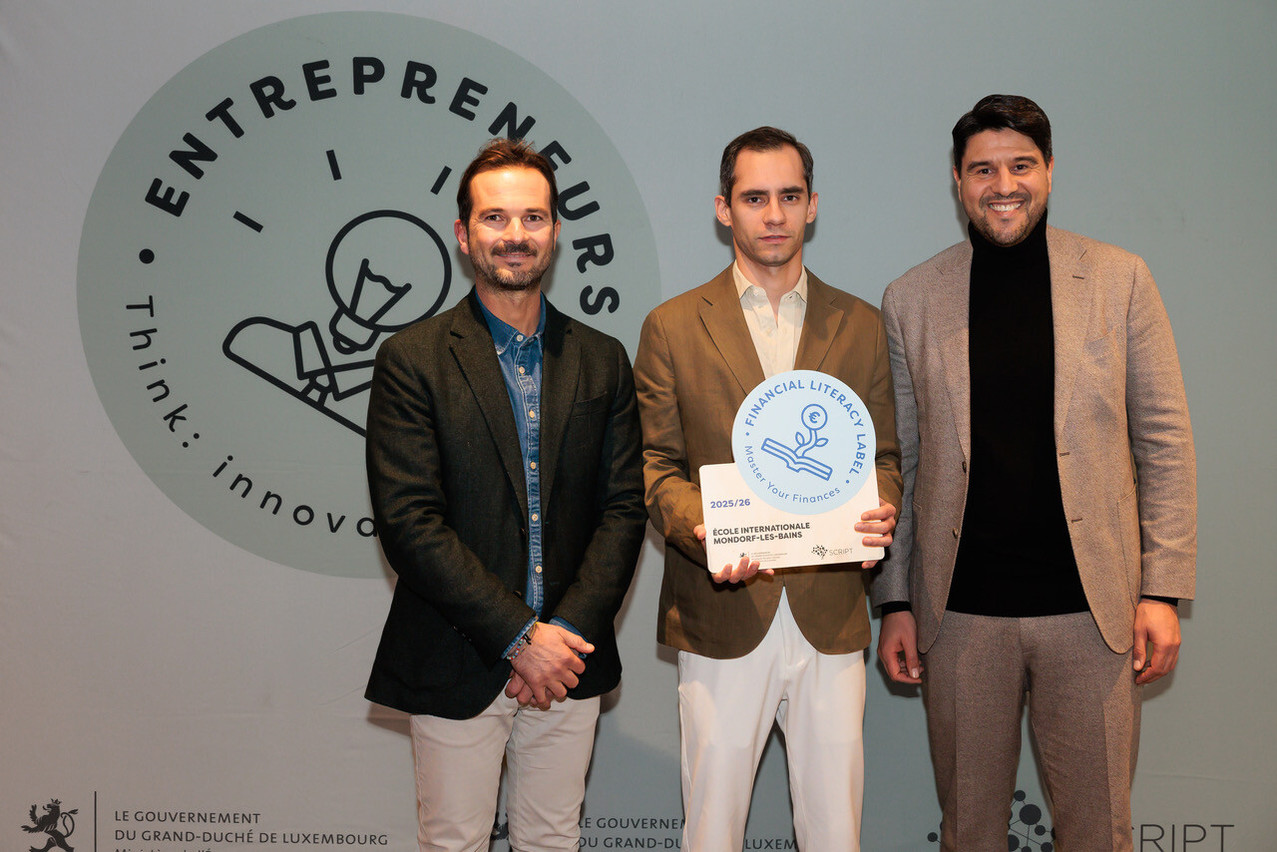
The school was one of thirteen schools honoured on Friday 13 November at the European Convention Centre in Luxembourg, during the first National Day of Entrepreneurship and Financial Education. During the ceremony, Paperjam spoke to Fabio Condorelli and Marc Welter, financial education coordinator at Script – the department within the Ministry of National Education responsible for educational and technological research and innovation – about the activities carried out in the classroom and the next steps for the scheme. Launched in 2025, the initiative encourages schools to familiarise pupils with money management.
Keep track of your spending to understand your savings
In Mondorf, the exercises vary according to ability level. For Year 9 pupils, the work took the form of a ‘budget matrix’, amongst other things. Over a period of six to eight weeks, they were asked to analyse their spending, distinguishing between what they considered essential and what they could cut back on.
“The aim of this matrix was to understand how much each pupil could set aside at the end of the month,” explains Fabio Condorelli. The exercise brings a financial concept back to a personal experience: understanding what is left once expenses have been taken into account. It also forces pupils to question their spending habits and the priority they give to different purchases.
For the teacher, the challenge lies in broadening the pupils’ understanding of money. “They weren’t aware that money is also a means of investing. It’s not just a means of spending.”
He also reports a keen interest in activities outside the classroom. “They wanted more; they wanted to go on more outings.” The enthusiasm spread from one group to another: upon discovering the activities their classmates had been doing, some pupils asked to take part in the same experiences.
Thirteen schools for the first presentation
At national level, this first round of participation is an encouraging sign for the scheme’s organisers. “We’re very pleased,” says Marc Welter. With thirteen schools having been awarded the scheme’s accreditation, the response “has even exceeded our expectations slightly,” he notes.
The scheme is based on a set of criteria defined by the Ministry. Schools must organise activities, visits and projects that meet the scheme’s requirements. In Mondorf, Fabio Condorelli describes an initiative carried out over the school year, which involves coordination by the teaching staff.
When asked whether there was a specific budget allocated to his institution for these projects, the professor replied in the negative. He emphasised the role of collective commitment in bringing them to fruition.
According to Marc Welter, the label’s development is also supported by a network of around a dozen partners, including the ABBL Foundation for Financial Education and the Financial Sector Supervisory Commission. This network is set to continue expanding and driving new initiatives.
From the budget to the initial investments
As well as recognising educational institutions, the scheme also provides for the certification of pupils’ skills: the Finanzführerschein, literally a ‘financial licence’.
Marc Welter describes two complementary levels. For Year 7 classes, the focus is on budget management and identifying the pitfalls associated with incentives to spend or online payments. The aim is to provide guidance on situations that young people may already be facing.
For Year 8 pupils, the development component should support their preparation for student life and financial independence. This involves exploring markets, investment and the relationship between risk and return, whilst also covering the financing and securing of future purchases through credit and insurance.
“It’ll be a preparation for life as a young adult or as a student,” explains Marc Welter.
In Mondorf, this journey begins with decisions within easy reach: choosing a product, cutting back on an expense or works out what you can put aside. These are all opportunities to put financial independence into practice, before you start earning your first income and taking on more significant commitments.