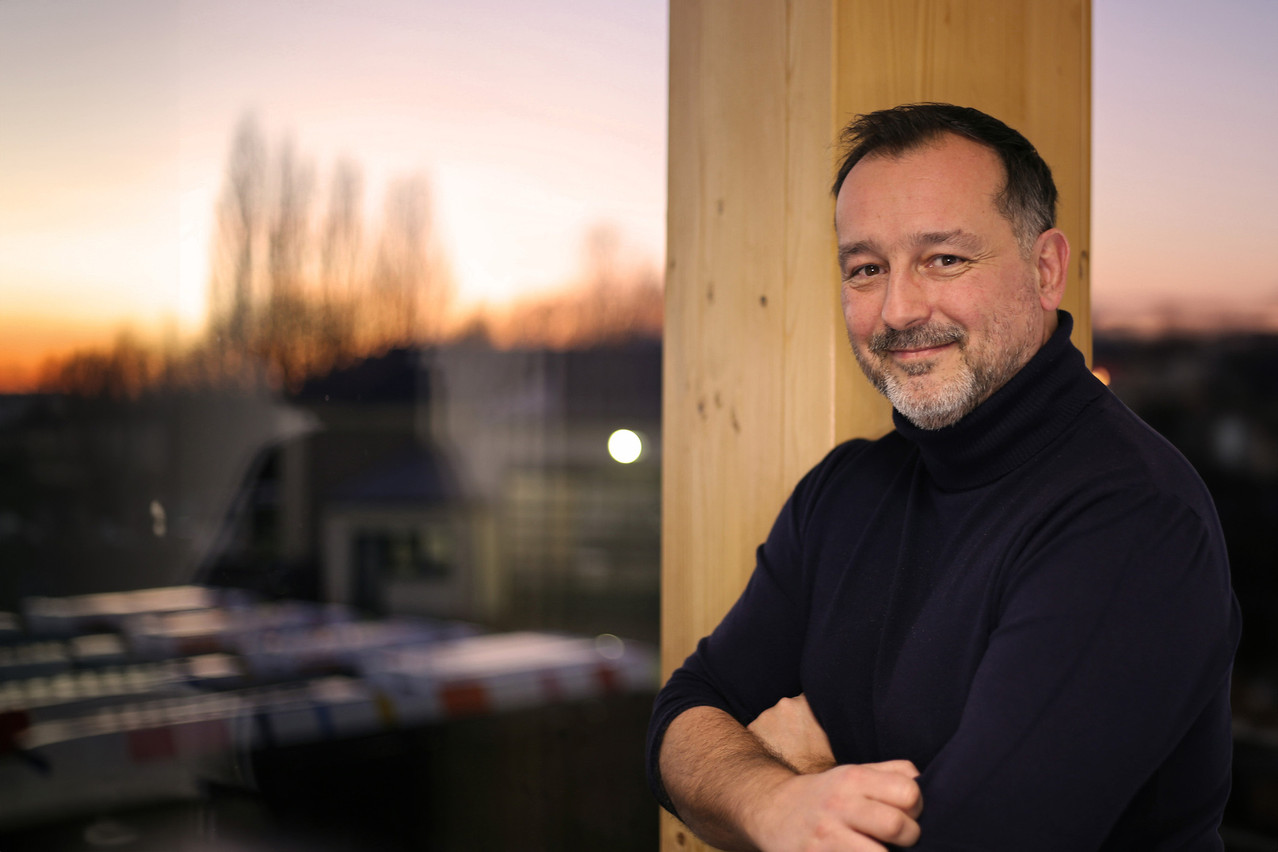

Paperjam: If you had to boil the job of HR director down to a single word, what would it be?
Fabrice Encelle: Unpredictable.
Why?
Because I never know what my day is going to be like. I rarely manage to keep to my schedule as I had planned: there’s always something unexpected, an emergency, a priority to reorganise. And that’s exactly what I like. I hate routine and human resources gives me none.
You worked for a long time in banking and audit/consulting. What changes when you move into human resources in the mobility sector?
The major HR issues remain the same, whether you work in finance, audit/consultancy or mobility. The vocation doesn’t change. What changes here is the much more concrete, pragmatic side: you’re dealing with people directly, less conceptually than in banking, for example. Most of the employees are bus drivers, often on the move and therefore harder to see on a daily basis. Every interaction is therefore essential. As a result, more emphasis is placed on the spoken word, the telephone, face-to-face exchanges, rather than the written word.
Among all the facets of HR you have explored, which did you prefer?
What has always attracted me is recruitment. There’s the challenge of finding the right person, the direct impact that this can have on the company and also that element of intuition in assessing a candidate. A good recruitment is a real success; a bad one can cost up to 2.5 times the person’s annual salary.
But what I like best of all is to see a talent develop. I remember a young candidate I met at my first job. During the interview, he blew it--but I felt he had real potential. I urged my colleagues to give him a chance. Today, he sits on the management committee. It’s stories like that that make this job so rewarding.
Artificial intelligence is increasingly being used in recruitment. Do you see it as a real help or a risk to watch out for?
I’d say it depends on the phase of recruitment. For prescreening, why not? But let’s be honest: you already need to receive a lot of CVs for AI to really make a difference, which is a luxurious problem to have! Where I see real added value is in sourcing. I’ve tested a tool, Rsight, that uses a simple job description to search for relevant profiles all over Europe, by cross-referencing different databases. This really saves time on a very time-consuming task. However, when it comes to the heart of recruitment, nothing can replace the human touch. Maybe one day AI will recruit AIs… but, for people, the recruiter and the manager will always remain key.
No telecommuting or flexible working hours for a bus driver: how do you manage to improve their daily lives and offer them prospects despite everything?
The first improvement is predictability. Drivers will no longer find out their timetable one or two weeks beforehand, but will soon have visibility over a full month, and for holidays we have visibility over several years.
We are also currently launching local supervision. A driver is often alone in their bus, so having support staff at certain sites means we can keep in touch, answer questions and support people’s desire to move on. Finally, we’re working on career prospects. Some become team or depot managers, others join the support services. Three members of my HR team are former drivers: proof that soft skills and experience can count just as much as a diploma.
Targeting and retaining talent is a real challenge in Luxembourg. Is this also the case in the transport sector?
We’re lucky in that we don’t have any major difficulties. The collective agreement in Luxembourg is particularly advantageous, especially compared with neighbouring countries such as France. In concrete terms, we’ve recruited over 200 drivers in the space of a year, which just goes to show how much interest there is in the job. Of course, there is some turnover, but it remains limited. In fact, some of our posts are fixed-term contracts, as some assignments are linked to temporary needs, such as during rail works requiring replacement buses.
Imagine interviewing the Fabrice of 20 years ago. Would you hire him?
I owe a lot to the person who hired me, 
For my part, I’ve also recruited people who have gone on to build their lives in Luxembourg and start families. It’s a responsibility that goes way beyond work: changing jobs changes your life. At the time, my English wasn’t perfect, but they trusted me. And I can’t thank them enough for that.
If you hadn’t gone into HR, what would you have done?
Entrepreneur. Without hesitation. I always have a thousand ideas a second, and I think it’s an incredible time to create: the prospects are immense. What’s more, I’ve already had some entrepreneurial experience. Alongside my career, I co-founded a recruitment startup with a technology designed to simplify life for SMEs. The idea was to enable a manager to create a hard-hitting job advert in just a few clicks, then choose to delegate all or part of the process to us. But you can’t lead two lives at the same time. To go any further, I would have had to take major risks, with loans to repay and a family behind me. I chose stability, with no regrets. One day, I’ll certainly give it another go.
And do you think you have the qualities needed to succeed as an entrepreneur?
I may be a little over-optimistic, but I think I have some of them. The most important thing for me is knowing how to surround yourself with the right people. I also believe that experience is an asset. The most successful entrepreneurs are not necessarily those who come out of school with a brilliant idea, but often those who already have solid experience in the field and understand the needs of the market.
In your playlist, is there any music that would sum up your job?
“Bohemian Rhapsody” by Queen. Not for its lyrics, but for its variety: in a single song, the rhythm changes all the time. There are quiet passages and then suddenly everything speeds up, the intensity rises and you have to react in a hurry. That’s exactly the image I have of HR.
Outside of an HR context, what’s the song you could listen to all your life?
I’m a big fan of Stan Getz, the saxophonist who popularised bossa nova. And I also adore Amy Winehouse. I know I’ll always be able to listen to those two artists and never get tired of them.
Any hidden talents that your colleagues don’t know about?
I have a passion for rugby and strategy games. I even came close to becoming a professional player of Magic: The Gathering, one of the most famous collectible card games in the world. I was lucky enough to take part in the world championships twice: the first time, I finished 300th… out of 350. The following year, better prepared and surrounded by a real team, I finished around 100th. A great improvement.
And that’s when I realised something essential: even in an individual game, the collective makes the difference. If you don’t have teammates to train with, to exchange ideas with and to progress with, you don’t progress. With them, you move forward much more quickly. It’s a lesson that I still take to heart today in my job.
A real or fictional character that you drew inspiration from in your management style?
One person has made a particularly strong impression on me: John Pessima. I met him at Deloitte, during a project to set up a recruitment tool, and I was blown away by his availability and his ability to anticipate needs.
Beyond the professional, a true friendship was born. His background is worthy of a novel. Originally from Sierra Leone, he studied in precarious conditions, in a room with three people but two beds: at night they took turns revising while the others slept. Despite this, he succeeded brilliantly, continued his studies in England, joined Deloitte, then launched businesses to support his country, particularly in agriculture and housing. He went on to work at the World Bank, run education projects, get a PhD… he remains a real source of admiration and inspiration for me.
In this summer series, HR directors also get a turn to be the journalist. Olivier Schmitt (CHL) has left you a question: “Beyond the issues linked to artificial intelligence, how do you see the HR function evolving in the coming years, particularly in its relationship with others?”
It’s hard to ignore the AI tsunami and its repercussions completely. I would say both an increasing role in everything to do with the use of data but also an increasing importance in leadership development. There have never been so many expectations of leaders: technical mastery of their field, comfort with technology, communication skills, strategic vision, the ability to help their teams grow, not to mention all the essential soft skills. So many dimensions that make the development and support of leaders more essential than ever.
And what question would you ask the next HR director in this series (Julien Bossu, CDCL)?
When will I see him wearing a tie? [He laughs.] But no, on a more serious note, I would ask him what solution he would see to improve the housing issue, which in my view is the number one problem in Luxembourg.
This article was originally published in French.