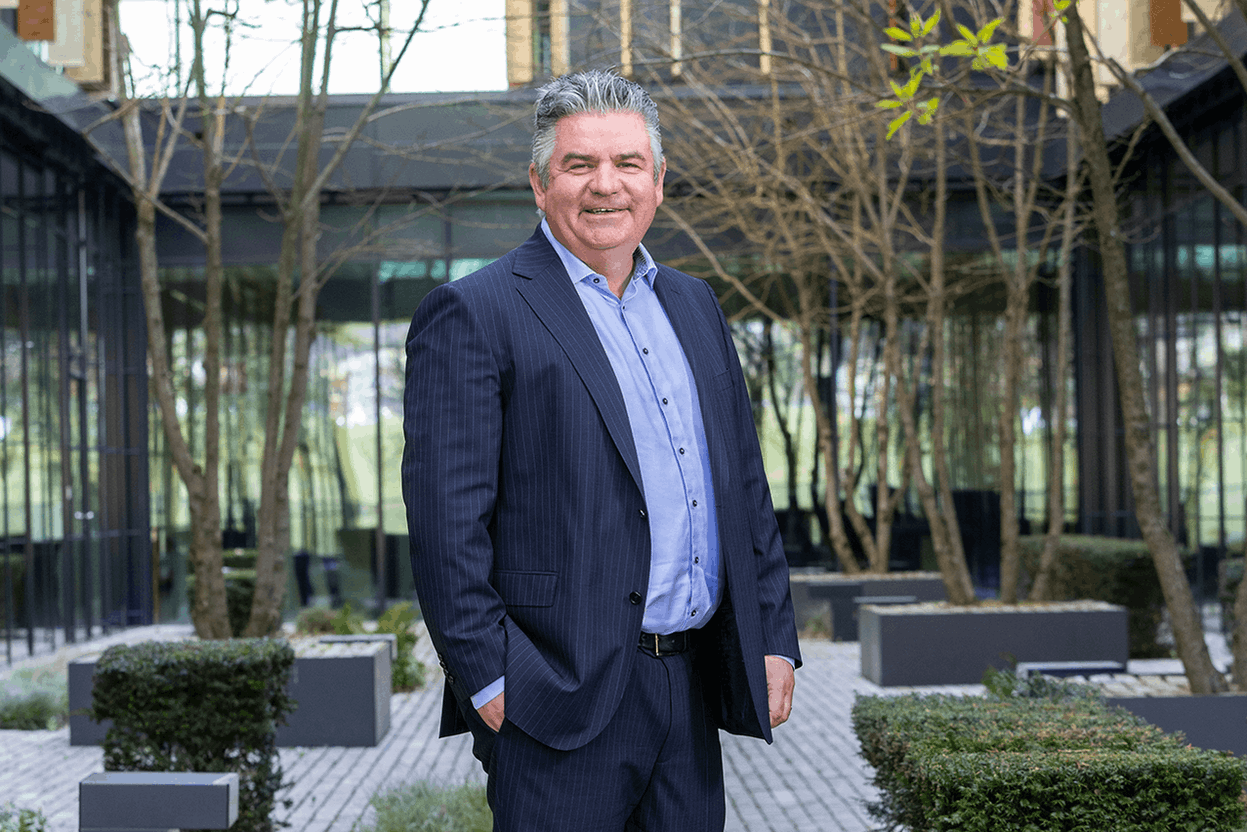
Olivier Schmitt trained all over the world before diving into the world of work. With a double degree in business management and human resources from the IAE in Metz, an MBA from ESCP in Paris and certificates in Montreal and London, his academic career already reflects his boundless curiosity. As an HR director in various international structures, he explored several sectors before settling down at the Centre Hospitalier de Luxembourg (CHL). His career path reveals a HR Ddrector who is pragmatic, passionate about his job and deeply committed to his teams. Since his arrival, he has been the first HR director to sit on the health establishment’s management committee, a sign that the function is no longer just a support function, but a key part of the strategy.
Paperjam: You have to rewrite the HR director’s job description in just one word: which word do you choose?
Olivier Schmitt: Two words, if you’ll allow me the leeway: reliability and loyalty.
Why?
Reliability, because we are constantly in demand and our responses must be clear, immediate and useful, in the face of employees’ concrete problems. Loyalty, on the other hand, refers to trust, truth and the values that underpin solid, lasting human relationships.
What gives you the most trouble: attracting or retaining talent?
Both, my captain! Luxembourg is a wonderful country, fiscally and socially attractive, but we are all on the same starting line. The difference lies elsewhere: in the way we build a truly human working relationship. In practical terms, this means involving employees in decision-making, listening to their expectations and, above all, anticipating the social changes that are transforming working life. That’s how we prove our commitment, much more than by making promises. But we have to stick to it: if we don’t respect what we’ve announced, we don’t just lose a talent, we lose their trust--and with it, other potential.
Do you see ChatGPT as a competitor or just an HR assistant?
Some of my colleagues advocate for the use of AI in recruitment. Me, with my reactionary side, I remain cautious. AI is not so new: each generation has seen its own innovation, which means we have to adapt. ChatGPT is amazing, but reading an application, understanding the logic behind a career path, getting a feel for the personality behind a CV or covering letter... a machine can not do that yet.
I can even see it in my 17-year-old daughter, who is passionate about geopolitics. She tested an assignment with ChatGPT: the result held up, but it lacked the subtleties and references that you can only find in books or personal culture. In my view, the best approach is to combine the two: AI as a tool, and human curiosity as an asset. The real talent is not the one who is content with prompts, but the one who reads and is open to historical, artistic and societal culture... Because in a meeting, sometimes it’s an unexpected reference that makes all the difference.
For the system to work, it must also be based on solidarity.

Is flexibility at work still an advantage or has it become a norm that poses new constraints?
In healthcare, flexibility cannot be improvised; it depends above all on organisation. In the past, some carers found out at the last minute that their weekend was going to change. With us, that’s a thing of the past: schedules are set 20 days in advance. This changes everything, especially for single-parent or blended families, where the logistics are already complex.
Of course, we don’t operate from home. But we have decentralised HR management as close as possible to the departments, with referrers capable of supporting managers on the ground and finding practical solutions to unforeseen circumstances.
For the system to work, it must also be based on a key value: solidarity. The real challenge is not so much flexibility as continuing to attract vocations, in a world where individualism is on the rise.
What does that mean?
I remain optimistic, but I’m afraid that in 15 or 20 years, we will have put a stop to valuing work. For a long time, there was real pride in belonging to a company, fulfilling a mission, being recognised and fairly remunerated. Work gave meaning and a form of social recognition.
Today, the leisure society occupies a more important place. That’s not a bad thing; everyone should be able to enjoy their lives. I’m not passing judgement, but in order to travel, have access to certain leisure activities, or simply live, you first have to earn your nest egg. I think we need to capitalise on those who still want to progress, blossom and succeed, without damaging themselves or losing themselves in their work, but all the while retaining the desire to be useful, necessary and represent an example.
Is this questioning mainly generational?
For me, the problem is not generational. I refuse to stigmatise young people; it concerns everyone. In my circle, I also see people in their fifties giving up. And yet, at 50, with all the accumulated experience and skills, it’s precisely the time to give it your best shot.
The real challenge stems above all from past political choices and covid, which have accelerated the undermining of the value of work. This period could have been an opportunity to put things into perspective, to rediscover a sense of community, to banish individualism. Instead, it has left vocations shattered and a culture of effort weakened, leaving an essential question unanswered: how can we give work back the place and value it deserves?
CVs can be misleading: can you remember a candidate who ended up surprising you?
A few years ago, I recruited a colleague whose background was nothing exceptional on paper. He was even going through a complicated period and I admit that I chose him above all because the position had to be filled quickly. Two years later, when I left the company, he replaced me. For me, that’s what being an HR director is all about: enabling employees to grow and sometimes reveal themselves far beyond what their CVs suggested.
In some roles, attitude counts for more than CV.

Doesn’t your anecdote prove that diplomas are sometimes vastly overrated?
Of course, there are jobs where a degree is essential. But in other jobs, particularly those involving direct contact with patients--providing a meal, day-to-day support--attitude counts for more than CV. If the person is empathetic, caring and loves people, they have every chance. We teach the rest. That’s why we put a lot of emphasis on continuous training: the hospital must be a learning organisation, where everyone progresses a little more every day.
I’m convinced that in ten years’ time, it will be soft skills that make the difference. I can already see this in certain sectors such as catering, where people with few qualifications but extraordinary human potential are being recruited. At the hospital, this is particularly the case for medical secretaries: profiles that are immediately operational are rare, so we prefer to bank on candidates who, even without experience, show real soft skills.
What’s the most difficult moment you've had to manage as HR director?
About twenty years ago, I had to tell an employee that her husband had just died. The managing director at the time should have done it, but preferred to let me. I’ll never forget the contrast: seeing her walk into my office all smiles, with no idea that her life was about to change. At times like that, you have to find the words, step aside when you have to, be there when you have to.
If you hadn’t gone into the HR field, what job would you have liked to do?
If I hadn’t been an HR manager, I would probably have gone into medicine. The parallel is obvious: a doctor, like an HR director, is a generalist, obliged to understand a bit of everything. And above all, there’s the essential common factor: the relationship with others. In both cases, they are there to help and support.
What about a character--real or fictional--whom you’ve drawn inspiration from in your management style?
I’ve been lucky enough to come across several mentors over the course of my career. Politicians like Gérard Longuet and François Grosdidier, the current mayor of Metz, from whom I learned a great deal and with whom I still maintain friendly ties. But there are also professors, at university or in business schools, who have made a lasting impression on me. Sometimes, even a brief encounter is enough. A phrase, a posture, a way of approaching a subject strikes you and triggers a form of mimicry.
And which of these phrases still stays with you today?
We have two lives; the second begins when we understand that we only have one.
In the end, it’s a great metaphor for what a good corporate culture should be.

A book or film that made you think about corporate culture?
“A Monkey in Winter,” starring Jean Gabin and Jean-Paul Belmondo. We witness the meeting of two characters from totally different generations, cultures and backgrounds, who end up uniting almost like father and son. Buoyed by Michel Audiard’s sublime dialogue, this film shows that beyond our differences, we can always build something together. Ultimately, it’s a beautiful metaphor for what a good corporate culture should be.
Do you have a hidden talent that your colleagues don’t know about?
I love clowning around at parties. I make my family laugh a lot. Maybe I could have been a comedian, but for now I’m holding back!
In this summer series, HR directors also take a turn as journalists. Magali Maillot (A&O Shearman) leaves you with a question: “Beyond remuneration, how do you manage to differentiate yourself? What do you do to attract and retain the best talent?”
Remuneration will always be the number one criterion, there’s no point kidding ourselves. But everything we can offer on the side counts enormously. In our case, that means everything from a gym to a crèche, as well as an accessible, high-quality canteen. We’re also working on mobility and parking, which is a real issue in Luxembourg. For doctors, we’re making it easier to settle in: help with schools, language courses, support with insurance, supplementary pensions and even access to housing. The idea is simple: to put employees in the best possible conditions to avoid anything that could pollute a new professional challenge.
What question would you ask the next HR director in this series (
Looking beyond the challenges of artificial intelligence, how does you see the HR function evolving in the coming years, particularly in terms of its relationship with others?
This article was originally published in French.