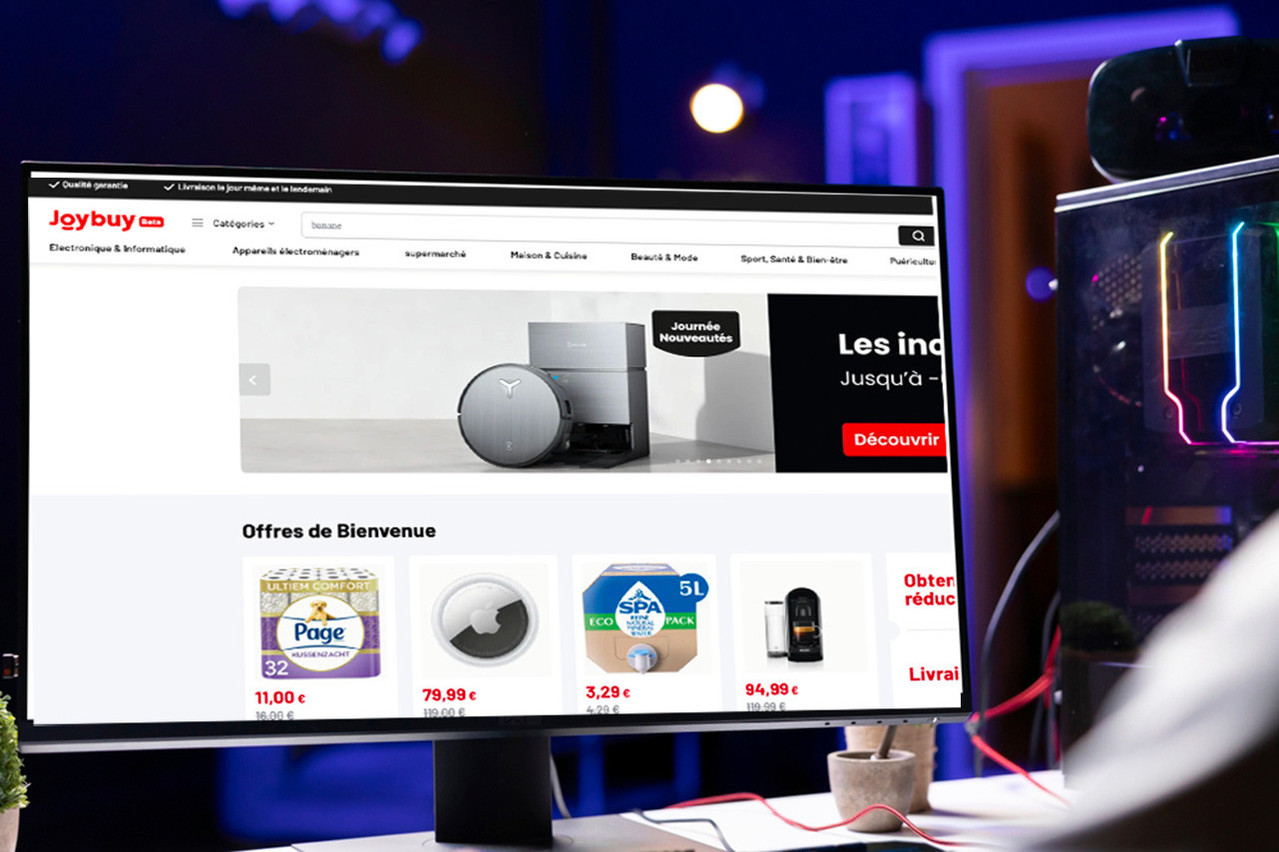
On the screen, the Joybuy interface appears like a familiar shop window. Smartphones, wireless headphones, connected hoovers, smart watches and LED lights: the selection is reminiscent of Amazon or Temu, but with a positioning that is more "techno-functional" than "extreme discount". On the home page, a Xiaomi connected bracelet sells for €27.90, a portable mini-projector for €149 and an automatic coffee maker for €69. Deliveries are advertised as taking four to six working days, sometimes longer for products shipped from China, but most leave from European warehouses. The site lists Luxembourg as a destination country, a sign that it is part of Joybuy's official test phase in Europe.
This site, launched this autumn in the UK and France, marks the offensive return of JD.com, the world's number three online retailer behind Alibaba and Temu. The Chinese company, founded in Beijing in 1998 by Richard Liu Qiangdong, started out as a small electronics components shop before becoming a digital empire. Its success is based on a simple idea: to control the entire supply chain. Where Alibaba relied on third-party sellers, JD.com chose to buy, store and deliver the products it sells itself. The result: almost total control over quality and delivery times, a rarity in Chinese online retail.
A model that even Amazon fears
Today, JD.com has more than 600 automated warehouses, nearly 600,000 employees and a logistics network that serves the whole of China in less than 48 hours. The company is listed on Nasdaq (JD) and the Hong Kong Stock Exchange, with annual sales in excess of $135 billion and a net profit of nearly $5 billion in 2024. Its hybrid model, halfway between Amazon and a physical retailer, makes it a feared player: it controls its technology, transport and customer service, while developing its own brands. JD.com is also pioneering the use of drones and autonomous vehicles for delivery, as well as operating fully robotic logistics centres.
But behind the logistical rigour, JD.com cultivates an image that is more "industrial" than "inspirational". The company does not play the glamour or storytelling card like Alibaba. Its founder, Richard Liu, describes himself as a pragmatist obsessed with efficiency and customer satisfaction. After making his fortune, he partially withdrew from operational management, leaving the reins to Sandy Xu, the current CEO, who is now in charge of international strategy. Under his leadership, JD.com is looking to move out of its saturated domestic market and into mature markets - led by Europe - with a more structured and regulated approach than Temu.
In its pilot phase, Joybuy is testing its platform in six countries: the UK, the Netherlands, Germany, France, Belgium and Luxembourg. No "Joybuy Luxembourg" company has yet been entered in the commercial register, but orders are going well, proof that the Grand Duchy is serving as a test market for the Benelux countries. Parcels are probably handled from hubs in the Netherlands or Belgium, or even via CFL logistics or Post Luxembourg, potential partners for distribution in the Greater Region.
2.2 billion for MediaMarkt and Saturn
Behind this e-commerce showcase, the ambition is wider. JD.com struck a major blow last July when it announced the purchase of Ceconomy, the German parent company of the MediaMarkt and Saturn banners, for €2.2 billion. The deal, signed in Düsseldorf, gives the Chinese firm control of a network of more than 1,000 shops in 11 European countries and 50,000 employees. In Luxembourg, where MediaMarkt has two shops - one in Luxembourg City (Avenue de la Gare) and the other in Belval - the acquisition could foreshadow a physical integration of e-commerce and retail, allowing JD.com to use existing outlets for withdrawals, returns and repairs, much like an Amazon with shop windows.
This strategy combines the digital power of Joybuy with the local roots of MediaMarkt, a hybrid model that JD.com has already tested in China: online ordering, in-store collection, express delivery from local stocks. All of this is based on the logistics technology for which the group is renowned: automated warehouses, a fleet of delivery robots and real-time stock monitoring. In Europe, the roll-out looks set to be gradual, but JD.com is clearly aiming to build a continental alternative to Amazon, less dependent on subcontracting and more vertically integrated.
While Temu is seducing customers with its low prices and social virality, Joybuy is seeking to conquer the terrain of trust and service. The sober user experience, with no intrusive advertising, is more reminiscent of a European retailer than an online bazaar. JD.com wants to demonstrate that a Chinese player can make its mark on the European market without being seen as a mere low-cost exporter. The investment in Ceconomy illustrates this ambition: to put down long-term roots in Europe, with jobs, warehouses and a network of existing shops.
Luxembourg, small but highly connected, plays the role of a discreet laboratory in this strategy. A multilingual market, well placed logistically between France, Belgium and Germany, it offers Joybuy a perfect sample to test consumer preferences, real delivery times and the tax conditions of cross-border e-commerce. As is often the case, the great offensives of global commerce begin here quietly: a website accessible, a basket validated, a parcel on its way from a warehouse in the Benelux countries. And behind this apparent simplicity lies the manoeuvring of a Chinese giant, methodically advancing into European territory.