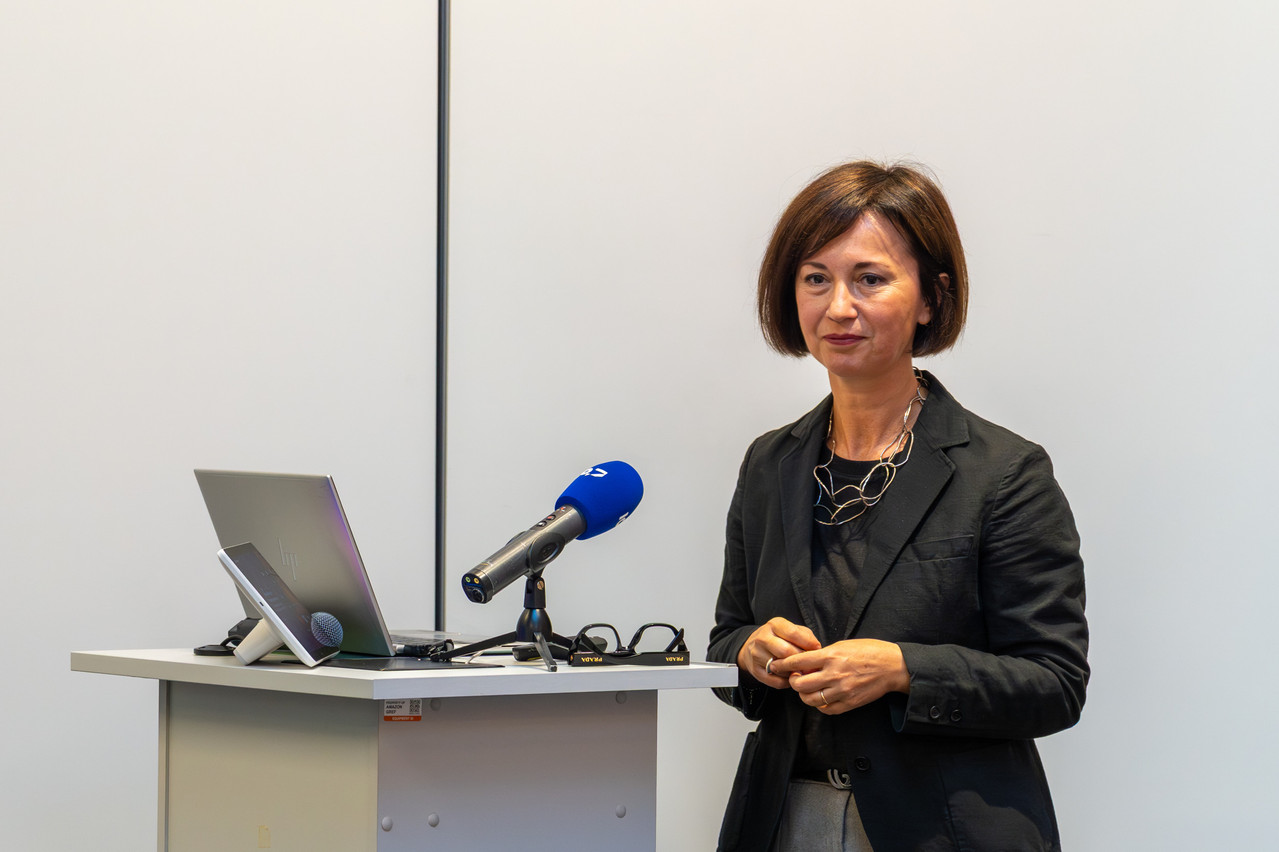
“We’re here for the long term,” said Mariangela Marseglia, who became Amazon’s vice president in charge of shops in the European Union in Luxembourg in March, having previously headed Amazon Italy and Amazon Spain. “And if you really want to have a constructive relationship with the territories in which you operate, you have to know them, respect them and have this idea of giving something back,” she continued, speaking on 19 September. “That’s very important to me. I will really push the organisation in this direction. I really like the fact that Luxembourg is so international with so many nationalities. We, as a family, really enjoy living in this country.”
For more than 20 years, Amazon has kept Luxembourg as its European headquarters, with today eight buildings in Kirchberg and more than 4,250 employees representing more than 100 nationalities. “Most of them live and work in the country and we are very proud to employ people of over 100 nationalities. The world really is here in Luxembourg, and it’s not just numbers,” said Marseglia. She emphasised the quality of the jobs: “These are highly skilled jobs, engineers, software developers, experts in artificial intelligence and machine learning. This is one of the reasons why, for the second year running, we have been recognised as a Top Employer in Luxembourg.”
The country’s fourth largest employer
According to the data presented, Amazon invested more than €1.8bn in 2024 in the country, bringing its total investment to more than €10bn over ten years. Last year alone, the company estimates that it contributed an additional €700m to Luxembourg’s GDP. Keystone Strategy estimates that around 4,900 indirect jobs and more than 1,400 induced jobs will be supported by 2024, giving a total of more than 10,500 jobs. “If we take only the jobs we create directly, we are the fourth largest employer in this country,” Marseglia pointed out. The firm’s analysis also highlights that €1 invested by Amazon generates an average of €0.73 in additional added value in the Luxembourg economy.
The impact also extends to small businesses. More than 150 Luxembourg SMEs sell via Amazon, over 90% of which export abroad. “Specifically for Luxembourg,” said Marseglia, “there are 150 small and medium-sized businesses that sell via Amazon and more than 90% of these businesses export via Amazon to more than 80 countries around the world. If you have a small business, finding customers in Japan, Korea, the United States, Germany or Italy is not always easy and often requires a lot of investment. Technology can be a great facilitator, it can really shorten the path to reach customers in many different places.” In 2024, these SMEs sold more than a million products to international customers, generating more than €45m in export sales. Their main destinations are Germany, France, Italy, the United States and the United Kingdom.
On a European scale, Amazon claims more than 230,000 permanent employees, including 150,000 in the EU, and more than €320bn invested since 2010, including €225bn in the EU. Indirect spin-offs are said to have supported more than 630,000 jobs. “We have more than 280,000 small and medium-sized European businesses that sell on Amazon and they recorded exports of €21bn in 2024 alone and that’s just exports via Amazon.”
Beyond the figures, Marseglia highlighted the company’s internal culture: “Everything we do is really guided by our 16 leadership principles. The first, of course, is our obsession with the customer. Customers are at the centre of everything we do. The last two principles added recently, ‘being the best employer in the world’ and ‘with success and scale comes great responsibility,’ are a legacy left by Jeff Bezos. Being this big makes us proud but also humble and we really need to be aware of the impact we have on society and the environment.”
Healthy Chinese competition
Two local initiatives were cited as examples. “Our colleagues at AWS recently signed a memorandum of understanding with the University of Luxembourg to promote education in STEM disciplines. We have already welcomed more than 200 students and teachers to our campus to raise their awareness of technology and the professions of the future.”
In parallel, Amazon is continuing its partnership with the Luxembourg Red Cross. “We have donated more than €300,000, supported relief efforts in Ukraine, and our employees get personally involved by assembling backpacks for students or hygiene kits for refugees.”
When asked about competition from Temu and Shein, she said, “We respect our competitors. We firmly believe that competition is good for everyone. Our objective is never the competitors but the customers. If we make customers happy, that’s the best guarantee that our business will continue to thrive.”
On sustainability, she recalled that “we were the promoters of the Climate Pledge, the aim of which is to reduce our carbon footprint to zero. We are electrifying our vehicles, we are reducing packaging, we are the largest private purchaser of renewable energy in the world. We want to get other companies on board; more than 400 signatories have already joined us.”
Finally, on artificial intelligence, Marseglia--who has her own “coach” for an hour a week--insisted on a pragmatic approach: “I’m very enthusiastic because I think it’s going to transform the way we do things. At Amazon we start from the problems that AI can solve rather than investing in technology for its own sake. We’ve been able to make our inventory cycles much more efficient with AI, avoid waste and liquidations.”
This article was originally published in French.