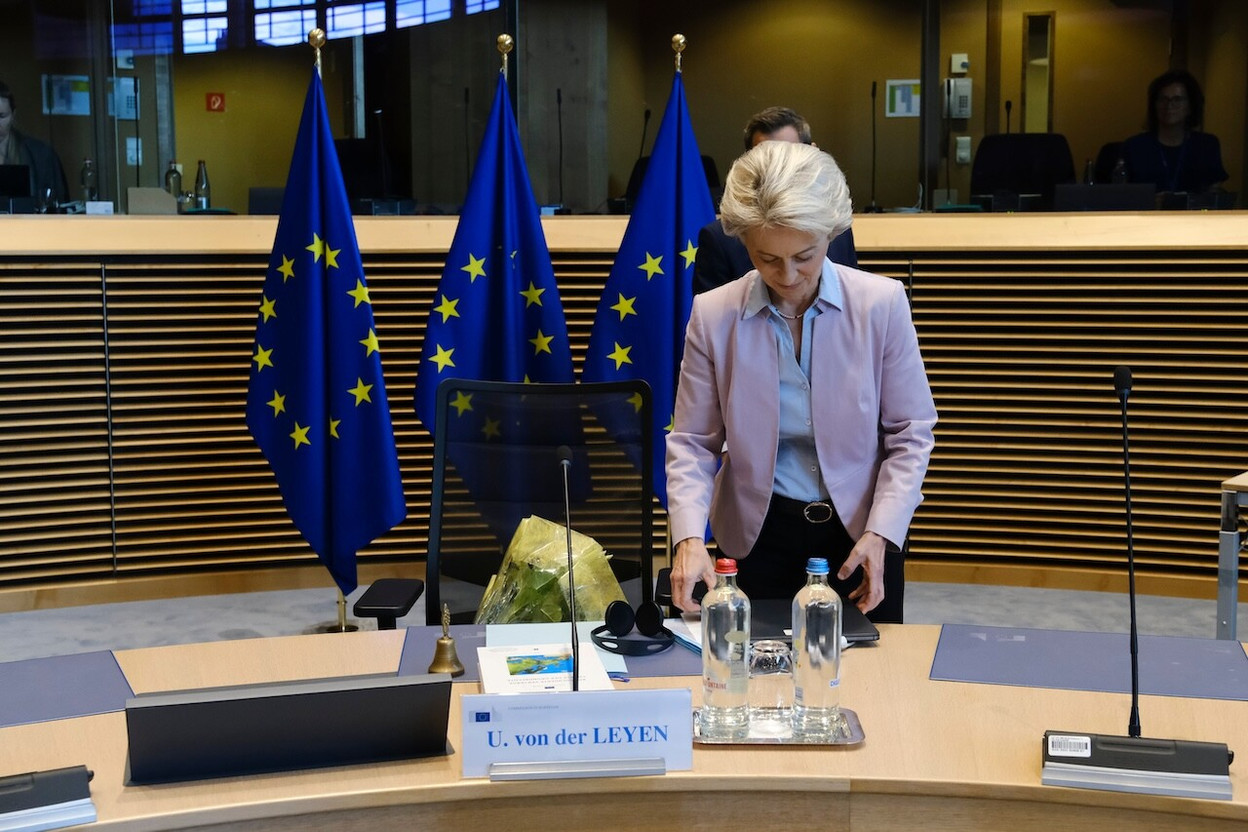
Ursula von der Leyen’s political message boils down to one conviction: in a world that has become more hostile, Europeans’ sovereignty depends on their ability to act together. In the face of war, trade pressures and technological dependencies, the Commission president presents the Union as the essential framework for regaining collective control over the future.
A conviction upon which she based her lengthy speech – nearly an hour and fifteen minutes. Reducing energy bills, securing supplies of raw materials, developing artificial intelligence and strengthening defence are all part of the same drive for independence. The economy is becoming a prerequisite for security, whilst security is becoming a prerequisite for prosperity.
Even more Europe
This line of reasoning also provides a political response to the forces that challenge European integration. Ursula von der Leyen seeks to demonstrate the Union’s value by addressing concrete concerns: the cost of living, employment, housing, child protection and border security. The European promise is thus measured by its ability to protect citizens and give them greater control over the changes they are experiencing.
This ambition, however, requires overcoming the divisions between Member States. The fragmentation of capital markets, administrative delays and difficulties in formulating joint diplomatic responses limit the power the Union could derive from its size. The speech therefore calls on governments to act consistently: European autonomy requires shared decision-making and shared resources. There was a direct reference to the budgetary issue: “The European budget, like all budgets, needs more resources,” said the Commission president, without elaborating further.
It should be noted that whilst the Commission president called on Member States to unite, she glossed over the issue of her parliamentary majority and relations with populist parties on both the right and the left.
A more collective approach to European security
The proposal to establish a European Security Council, designed to strengthen the EU’s capacity for consultation and action, marks a new stage in European defence. However, the institutional and operational details of these arrangements have yet to be finalised. The only indication is that this council will respect Nato’s prerogatives and act in concert with the alliance.
The proposal for a ‘European Article 4’, modelled on Nato’s consultation mechanism for when an ally considers its security to be under threat, reflects the desire to strengthen European solidarity. In the face of sabotage, cyber-attacks and hostile operations falling below the threshold of armed conflict, a Member State could trigger an emergency protocol to coordinate a joint response.
The challenge is to ensure that these increasingly frequent incidents (such as drones flying over European borders) become a matter of collective concern.
Support for Ukraine is part of this approach. In addition to humanitarian aid, the protection of the energy network and urgent deliveries of Patriot missiles, Ursula von der Leyen has announced the joint development of Freya, a modular air defence system. The aim is to combine Ukraine’s combat experience with European technological and industrial capabilities. The announced strengthening of efforts to combat Russia’s circumvention of sanctions rounds off this commitment.
Canada: a symbol of a new policy of alliances
The proposed move towards granting Canada the status of the Union’s first associate member, announced in the presence of Prime Minister Mark Carney, was one of the most significant proposals in the speech. Its scope remains to be defined, but its political significance is clear: to deepen ties between democracies in order to strengthen their economic security and their capacity for action. Critical raw materials, defence, space and the Arctic are the areas covered by this closer cooperation. Ursula von der Leyen was careful to point out that this rapprochement was in no way an attack on anyone – understood to mean the Trump administration – “but a rapprochement between two partners sharing the same democratic values”. “Non-negotiable values.”
This proposal illustrates a vision of European independence based on the diversification of partnerships. The trade agreements mentioned with India, Mercosur, Mexico, Australia and Indonesia are part of the same approach. The same applies to the Global Gateway initiative, which aims to mobilise €12bn in public and private investment in order to diversify supply routes and strengthen connectivity.
The economy: a tool for self-reliance
On the economic front, Ursula von der Leyen is calling for the implementation of the Draghi report to be accelerated, for procedures to be simplified and for European savings to be better mobilised. These are initiatives that are already underway, but which are stalling somewhat. The Savings and Investment Union, for example, is one such case.
A new package focused on banking competitiveness and simplification has been announced. The aim is to strengthen the banking sector’s contribution to the financing of the economy. The details are yet to be finalised, particularly the balance to be struck between supporting growth, risk-taking and the sector’s soundness. “Europe needs a banking system that serves growth, not just stability,” said Ursula von der Leyen. Any potential relaxation of prudential requirements will be one of the points to watch.
Energy is at the heart of the Commission’s plan. The target of doubling the share of electricity by 2040 is accompanied by a call for investment in generation and grids. The renewable capacity awaiting connection highlights the gap between stated ambitions and available infrastructure.
At the same time, a new alliance for critical raw materials must ensure the necessary supplies for batteries, semiconductors and defence. Underlying these measures is a shared concern: to prevent industrial dependencies from becoming a means of exerting political pressure.
Protecting citizens
In the digital sector, the discourse links economic development with protection. Europe intends to strengthen its computing capabilities and promote the use of AI in healthcare, manufacturing, agriculture and energy, whilst managing the risks associated with the most advanced models.
The draft ‘Kids Act’, which focuses on regulating minors’ access to social media, gives concrete form to this protective aim. The Commission is due to present this draft on 17 September. The Commission President has outlined its key features: increased responsibility for platforms, age-based access restrictions, limits on usage time and the removal of addictive features.
On the climate, Ursula von der Leyen reaffirms the EU’s targets and emphasises the need for adaptation: flood prevention, resilient crops, insurance cover and fire-fighting resources, including a European fleet of water-bombing aircraft.
The same concern for protection runs through the announcements on migration and democracy: an emergency measure to combat the exploitation of migration, a democratic shield against interference and disinformation, and the maintenance of the link between European funding and respect for the rule of law.
The speech thus sets out a vision of a Union called upon to take on greater responsibilities. Its impact will henceforth be judged by the extent to which these proposals are translated into decisions, funding and operational capabilities. Only then can European independence become a tangible reality for citizens.