Is economic policy really designed with micro-businesses in mind?

I sometimes get annoyed when I hear certain politicians attacking businesses, because that amounts to attacking those who dare to take the plunge. The GEM [Global Entrepreneurship Monitor, ed.] shows that in Luxembourg, new businesses are set up more out of opportunity than out of necessity. That is something to be proud of.
SME packages, for example, are particularly well suited to micro-enterprises, with a straightforward application process and a grant covering 70% of an investment of €25,000. They are easy to access and highly effective tools.
Are a company with two employees and one with 200 really comparable?
“I often see them together, as they are both concerned with the same issues, particularly that of administrative simplification.
What exactly are you doing to simplify things?
“We have developed a bottom-up approach in collaboration with the main trade federations to gather proposals directly from businesses. This has yielded 212 concrete ideas. These are being coordinated across several ministries for review and implementation. Around 20% have been finalised and 60% are still being processed. This is meticulous work, taking place at several levels. This is also why this government supports ‘omnibus’ initiatives at the European level.
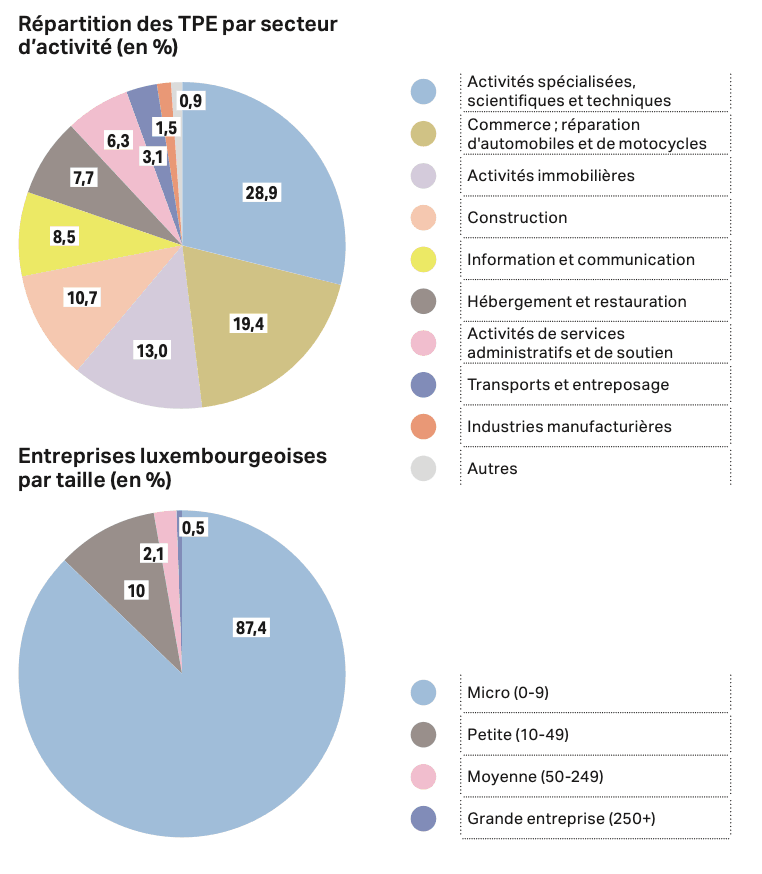
Breakdown of micro-enterprises by sector of activity and of Luxembourg companies by size. (Visual: Paperjam; source: ministry for the Economy/SME Factsheets 2026 – European Commission)
In your opinion, what is the hardest thing for the owner of a micro-business?
“It’s about constantly having ‘your nose to the grindstone’: there’s so much work to do on a day-to-day basis that it becomes difficult to take a step back to innovate, invest or keep up with developments, such as artificial intelligence.
But funding remains the key to success…
“Financing remains a major issue. Giving micro-enterprises the means to grow is essential. That is why, last year, through the SNCI, we introduced the zero-interest loan. A business that does not invest will struggle to grow. The other challenge is to raise awareness of these tools amongst micro-enterprises. Digitalisation is also essential. A business that does not embrace digitalisation today will find it very difficult to survive tomorrow.
The self-employed, micro-enterprises and SMEs contribute to the diversification of the Luxembourg economy and form its backbone.

Despite the busy period, some business owners say they are seeing their profit margins shrink. What is your response to them?
“During the Covid pandemic, I was very angry to see some people attacking the self-employed as if they were all rich. A self-employed person takes on a huge responsibility for themselves and, if they have any, for their employees. They bear their own costs and deserve to be respected for their true worth. Every large company started out as a micro-enterprise. The self-employed, micro-enterprises and SMEs create value, contribute to the diversification of the Luxembourg economy and form its backbone.
Does the reform of the status of self-employed workers mean that they are not sufficiently protected at present?
“We have learnt from the Covid crisis that adjustments are needed, particularly with regard to contributions, social security and what happens in the event of bankruptcy. Self-employed people take risks and must be afforded certain safeguards. We are aware of this and we will be presenting this package.
What can we expect?
“This will be announced shortly. There is no fixed timetable as yet. For the self-employed, this will be a positive development, aimed at providing them with greater security.
Unpredictability has become a structural feature of this era of multiple crises. Added to this are the digital transition, decarbonisation…
Is the current slow growth due to cyclical factors or a more structural problem?
“The worst thing for the economy is uncertainty and a lack of predictability. The government is trying to offer businesses as much predictability as possible, and this is also what attracts some of them to Luxembourg. Growth remains weak and has been revised downwards by Statec to around 1.2 to 1.4% in 2026. Unpredictability has become structural in this period of multiple crises. Added to this are the digital transition, decarbonisation… It is clearly not easy for businesses.
Should we rethink the model?
“The country has three major strengths: agility, speed and stability. We have also long been developing priority sectors, such as the automotive and space industries. Today, we are continuing along these lines, for example, with autonomous driving.
How do you envisage 2027?
“International uncertainties are likely to persist. At the European level, strengthening the internal market is becoming crucial. The issue of over-regulation will remain a topical one and is likely to lead to further simplifications. I hope we will retain this entrepreneurial spirit.”
Key figures
38,373. This is the number of micro-enterprises, accounting for 87.4% of Luxembourg’s businesses.
69,949. This is the number of people in employment, representing 17.4% of total employment.
€7.7bn. This is the amount of value added, representing 12.1% of the total value added by businesses.
This article was written for the October 2026 issue of Paperjam magazine, published on 16 September. The content is produced exclusively for the magazine. It is published on the site to contribute to Paperjam’s comprehensive archive. Click on this link to subscribe to the magazine.
Is your company a member of the Paperjam Club? You can request a subscription in your name. Please let us know via club@paperjam.lu.