On 28 October 2026, the Government Council approved the ‘Hy4Link – Phase 1’ project of common interest. According to the government press release, this first phase involves the construction of a hydrogen pipeline approximately 40 kilometres long between Thionville and Pétange. It forms part of the European Hydrogen Backbone, the initiative to develop a European hydrogen transport network.
The ambition extends beyond this Franco-Luxembourgish link. Hy4Link aims to connect Luxembourg, France, Belgium and Germany to transport hydrogen to the industrial hubs of the Greater Region. Creos Luxembourg Hydrogen is developing the project in partnership with Fluxys Hydrogen, the hydrogen network operator in Belgium, and NaTran, formerly GRTgaz, in France.
Supplying manufacturers
According to Fluxys, the future network must connect industrial hubs to hydrogen production centres on the North Sea coast and to the import terminals at Antwerp, Zeebrugge, Rotterdam and Dunkirk. The steel, chemicals and refining sectors are among those where the partners wish to support decarbonisation efforts.
The infrastructure is designed to transport both renewable hydrogen and low-carbon hydrogen. It also aims to facilitate the development of local renewable hydrogen production in the Greater Region.
The Hy4Link project also provides for interconnections with mosaHYc, the Belgian hydrogen network, and the H2med corridor to enable the exchange of hydrogen between these networks.
A connection to Belgium
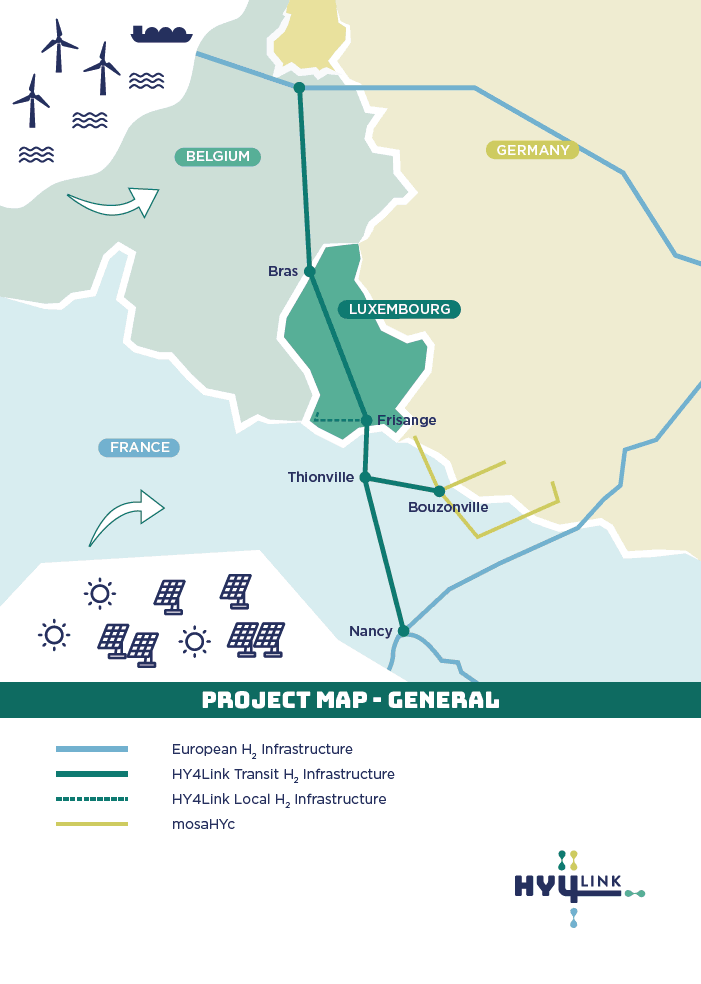
Hy4Link plans to connect Frisange to Bouzonville and the Nancy region via Thionville, as well as Luxembourg to the Belgian hydrogen network via Bras. (Illustration: Hy4Link)
In Luxembourg, Creos is also planning a section of around 80 kilometres between the Bras border crossing on the Belgian side and Frisange on the French side. This link would cross the country from north to south to connect with the Belgian hydrogen network.
The route alignments are still under review. Creos states that it is taking technical, environmental and land-use constraints into account in order to minimise the project’s impact. An environmental impact assessment and the necessary authorisation procedures must be completed before construction can begin.
Creos Luxembourg Hydrogen, a wholly-owned subsidiary of Creos Luxembourg, has been operating since 1 December 2025: the role of national hydrogen transmission network operator. Its responsibilities include the planning, construction and operation of the infrastructure.
Indicative deadlines in 2032 and 2034
In its development plan, Creos envisages completion in 2032 of the first section linking Frisange to Bouzonville and the Nancy region via Thionville. A second section, comprising the link with Belgium, is scheduled for completion by 2034. These deadlines do not constitute a specific timetable for the Thionville–Pétange link mentioned by the government.
The timetable depends, in particular, on authorisations, funding, public risk-mitigation mechanisms and commercial commitments that confirm market interest.
In their press release dated 3 December 2025, the partners announced that Hy4Link had been recognised at European level as a project of common interest. According to the press release, this status provides access to European funding instruments and simplified authorisation procedures.
The summary of the Government Council meeting of 28 October does not specify either the cost or the timetable for the Thionville–Pétange section. Nor does it provide a list of the businesses that this first route is intended to serve.