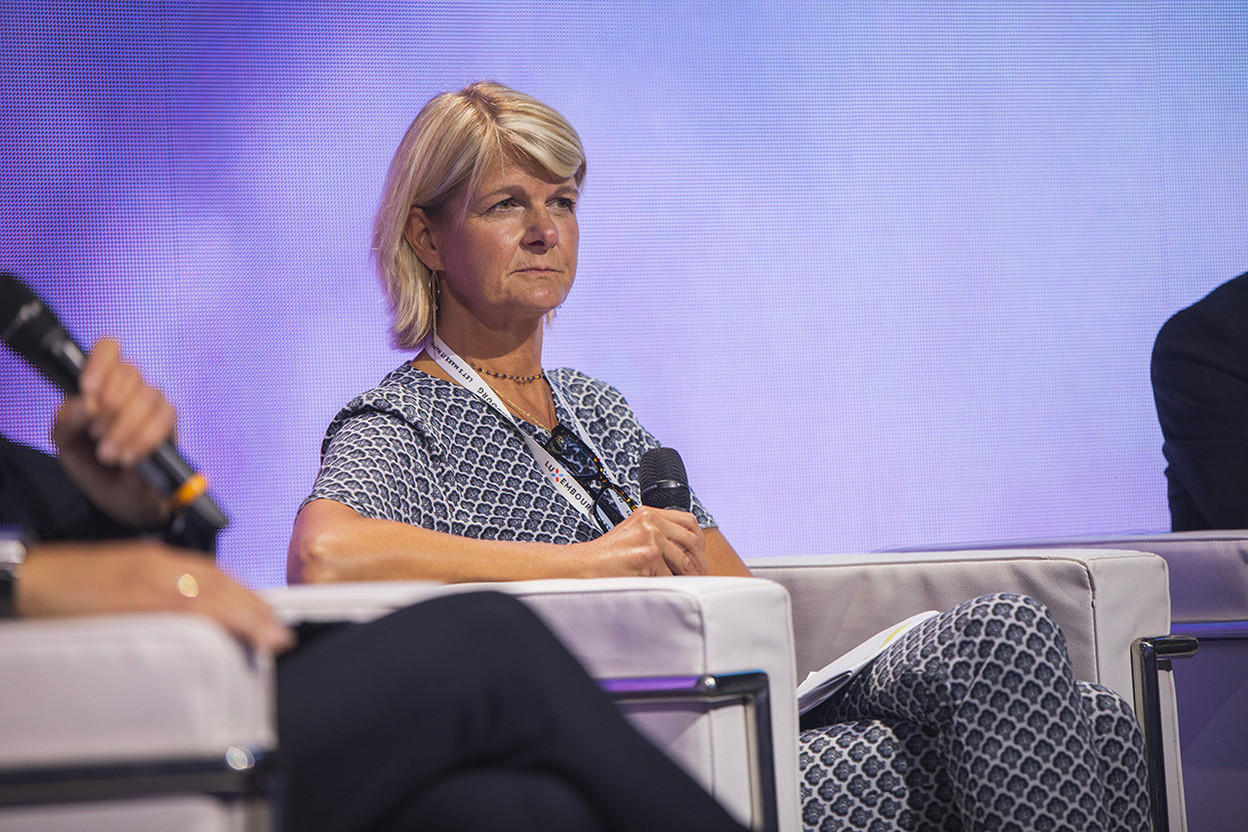
Paperjam: Do you necessarily have to wait for a call for projects to collaborate in an R&D approach?
Avit Blanchy (AB): No, not necessarily. A collaborative project for innovation purposes can in fact be carried out as part of a joint call for projects between the economy ministry and the National Research Fund (FNR), which can sometimes involve another ministry, such as the defence ministry. But for so-called “bottom-up” R&D projects, i.e. when a company meets a research institute and spontaneously decides to initiate a collaborative R&D project on a topic of joint interest with the research institute, the company can still apply to the economy ministry without this being part of a call for projects.
Why go for one or the other?
AB: The main reason for participating in a call for projects is to align agendas, because in this type of collaborative project there are two public backers: the economy ministry, which will fund the company, and the FNR, which will fund the public partner, which is generally the university or a research institute. There are therefore two separate procedures that each of the partners must go through in order to obtain funding from their respective granting authority.
Without a call for projects, there is not necessarily an alignment of agendas for the authorities’ decisions. So the company will submit its application for the part of the project that concerns it to the economy ministry, while the research institute will have to wait for an FNR call for projects, such as Bridges, specifically for this type of funding. Depending on the year, there may be one or two calls for Bridges projects, so the granting decisions will not be made at the same time. The economy ministry will then ask the company if it has confirmation that the research establishment will commit to working with it, and conversely the FNR will ask the research establishment for the same thing. The difficulty is to ensure that the decisions on both sides coincide over time. Calls for projects solve this problem, since the two granting authorities are aligned on the same agenda and make decisions at the same time. This avoids these sometimes uncomfortable in-between situations.
Should R&D be distinguished according to whether it leads to process or product innovation?
AB: The aid scheme we’ve been talking about is the R&D aid scheme. But there is also a separate aid scheme called “aid for process and organisational innovation.” This is the wording of the aid. But in an R&D project, the innovation may well concern product or process innovation. The only difference is that aid for process innovation is reserved for SMEs and is not available to large companies. And it requires a level of innovation complexity that is lower than that expected of an R&D project. So, if you’re a large company and you’re making an innovation to your process, but that innovation is complex, you can still get help through R&D aid.
For a company wanting to launch a collaborative R&D project, what is the first essential question to ask?
Youri Cillien (YC): Firstly, a company that needs to innovate in order to remain competitive needs to know what it is aiming for and have an idea of the steps involved in getting there. It needs to assess the skills it needs to get through the stages and evaluate its internal skills pool. If they are all already identified, there is little point in collaborating in reality. It will go faster on its own. So the real trigger for collaboration is to start from the premise that the company does not necessarily have all the skills it needs internally to solve the technical challenges and achieve real innovation. We don’t collaborate for the beauty of collaborating, but because we need to bring together complementary resources to achieve a common or joint objective.
Are we just talking about skills? Not financial means?
AB: It’s a real question, because there is indeed a financial incentive to carry out collaborations, insofar as the rate of aid granted by the ministry will be slightly higher and there will be a bonus for collaboration. So companies might be tempted to say to themselves, “I’ll collaborate because I’ll get more help”--but it would be a mistake to approach the subject from that angle, because, if there is a bonus, in reality it’s to provide an incentive to do something that isn’t necessarily natural and isn’t necessarily simpler. It’s almost like compensation for the difficulty and extra time it will take to coordinate with a partner. You have to bear in mind that you will also have to pay this partner in part. So the financial aspect should be seen more as the icing on the cake rather than the source of motivation for embarking on this type of approach.
Are there any sectors for which this type of collaboration is more conducive than for others?
AB: There are thematic calls for projects, which will naturally focus on strategic sectors of the Luxembourg economy, such as healthtech. In this sector, there is a clear need for collaboration, if only for experimentation. Other themes promoted to date have included defence, high-performance computing and 5G. However, there are also effective bottom-up collaborations, outside the calls for projects, often between large industrial companies and the university or research institutes, for example in innovative materials. But we also see SMEs, particularly but not exclusively in IT development, engaging in collaborative projects with public research bodies. These projects may involve the development of optimisation tools that leverage data and artificial intelligence, targeting sectors as diverse as fintech or logistics, but also for the development of new cybersecurity solutions, for example.
Can an IT development project really be considered an R&D project?
AB: For an R&D project to be eligible for support, we have to be able to demonstrate that what we want to do is really an innovation that goes beyond what solutions already on the market offer today. That’s the first element. The second is to consider that, to offer this new solution, we need to solve technical challenges that are far from trivial, involving real difficulties and a real risk of failure. Taking these two elements into account, we will be able to distinguish between developments with a view to maintaining a product (or upgrading it in relation to what the competition is doing) and what represents a new solution resulting from R&D activities.
What are the common misjudgements made by companies in these projects?
YC: A company is often faced with immediacy, urgency and the need to move very quickly towards a marketable solution. This is not the raison d'être of a research institute or a university, which are more likely to have an interest in seeking out everything that is far from a commercial solution, i.e. everything that is further upstream and more involved in research. So the partners need to find common ground, not just in terms of the end goal, but also in terms of the timeline. Committing to a collaboration with academic research means being prepared to work over a longer timescale, of the order of three years. This does not in any way rule out the possibility that new ideas may emerge during this time, but the complete solution will arrive in the longer term. Nor should the company expect its scientific partner to deliver a usable solution the very next day. The partner will not go beyond the prototype that shows that the solution is viable and can work. Then the company will have to take the necessary steps to bring the innovative product to market.
Throughout the project, how are the burdens divided? Who steers what?
AB: It depends on the project. In some cases, the initiative comes from a research institute that is working on a solution and needs a private partner, a playground to experiment with it. More often, however, it is the company that has a commercial problem and goes looking for research institutes. The company that took the initiative generally retains some control over the stages and timing of the project. But normally, the actual collaborations are materialised in a collaboration agreement that must be co-drafted, co-signed (but not before seeking help from the granting authorities) and that shares a work plan.
Is this collaboration agreement essential?
YC: Yes, for many reasons it is imperative, particularly in order to benefit from state aid. But beyond that, each party is going to invest resources in the project, whether human or financial. So there are risks to be shared, and potentially successes to be shared. This is even more important if there is a notion of intellectual property or patent registration. The agreement must establish the sharing of risks, resources and successes. This ensures that the collaboration is based on shared rules and prevents the emergence of potential disputes. But be careful, to comply with the criterion of the incentive effect of state aid, the partners may draw up a collaboration agreement, but must certainly not sign it or make a formal commitment before applying for the financial aid.
Should performance indicators be clearly defined beforehand?
AB: As part of the application for aid, the company and the research institute must give the objectives of the project and therefore the KPIs. If the objectives are not achieved, this is not a problem, because, by definition, R&D can fail.
Beyond the pure R&D aspect, what can make a project fail?
YC: There are various reasons. The main one is staff turnover. Theoretically, there may also be cases where the partners no longer agree to work together. There can be tensions between partners, but these are always resolved.
Resources
Research-industry-collaboration.lu: this platform, run by Luxinnovation, highlights all joint-calls. It is a mine of resources and information for companies seeking information on various aspects: finance, optimising strategic projects and mastering the various R&D and innovation funding instruments. They can find a toolkit and frequently asked questions to help them get to grips with a potential collaborative R&D project. The platform also offers a matchmaking tool that lets you showcase your idea and create links with a view to collaboration.
Since 1 May, a new call for joint projects is underway in the fields of high-performance computing and/or artificial intelligence.
This article, originally published in French, was written for the innovation & research supplement of the June 2025 edition of Paperjam published on 21 May. The magazine content is produced exclusively for the magazine. It is published on the site to contribute to the full Paperjam archive. Click on this link to subscribe to the magazine.
Is your company a member of Paperjam Club? You can request a subscription in your name. Let us know via club@paperjam.lu.