1. Is the private sector reaching its limits? Could municipalities hold the key?
The return of the public sector: how the state and municipalities are taking back control of the housing market. This “return” is taking shape through several reforms. The first concerns Article 29bis of the Housing Pact 2.0, which entered into force on 1 January 2026. It simplifies and harmonises the rules for reserving affordable housing in PAP “new neighbourhood” development plans, with reservation rates ranging from 15% to 30%, depending on the size of the project.
The aim is to mechanically increase the stock of affordable housing with each new urban development by providing greater support to developers. According to the government, the reform could generate several thousand additional homes in the years ahead.
Beyond these quotas, the new rules also ease certain urban planning constraints. Affordable housing will no longer be subject to the same density limits as those set out in the PAGs, and municipalities will be able to derogate more easily from parking requirements. In addition, landowners who transfer land for affordable housing will benefit from an “automatic” 10% increase in building potential.
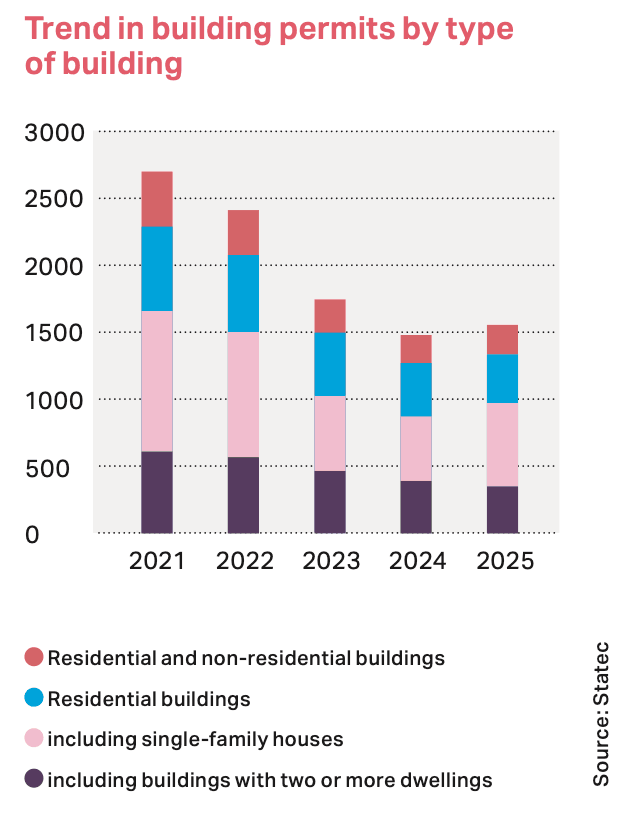
Trend in building permits by type of building. (Visuel: Paperjam; source: Statec)
At the same time, the government wants to adapt the Housing Pact 2.0 in order to strengthen municipalities’ capacity for action. Housing Minister 
New financial allocations would also be introduced to reward the creation of affordable housing, the development of priority housing zones and the mobilisation of vacant plots. The state plans to devote around €560m to this between 2027 and 2036.
Rather than resorting to sanctions, the government favours a system of financial incentives designed to encourage municipalities to become central players in housing production. Bill 8589, tabled on 24 July 2025, is awaiting the opinion of the Council of State.
Taken together, these two reforms appear to foreshadow a new model, in which housing policy would move from supporting the market towards larger-scale public housing production.
The key figure
6,000. This is the lower end of the estimated stock of affordable rental housing in Luxembourg, with the upper end standing at round 8,000 units.
2. Could a rent register be introduced before the end of the parliamentary term?
The rent register is still awaited. Mapping means representing space in order to better understand it, navigate it and make decisions. That is precisely the purpose of the rent register that Claude Meisch hopes to introduce before the end of the parliamentary term. The problem is that this register is associated with genuine rent regulation, a subject that gives rise to controversy, reluctance and delays. To date, no bill has been adopted by the Government Council.
In the meantime, the Housing Observatory has published the results of two surveys labelled as a “rent register”, conducted by Liser. The first aims to measure the rents actually paid during ongoing leases; the second paints a portrait of the typical landlord.
What can be learned from them? First, that the rental market is marked by a phenomenon of temporal stratification. In other words, long-standing tenants are shielded from the current pressure on the market. In practice, a tenant who moved in before 2010 pays an average of €14.01 per square metre, while a lease signed in 2024 or 2025 reaches €24.44 per square metre, an increase of 75%.
And this could worsen. Researchers have identified a “spectacular” gap between existing contracts and prices advertised by estate agencies. At national level, the gap stands at 84%. The average rent under an ongoing lease is €21.59 per square metre, while the average advertised rent reaches €39.66 per square metre.
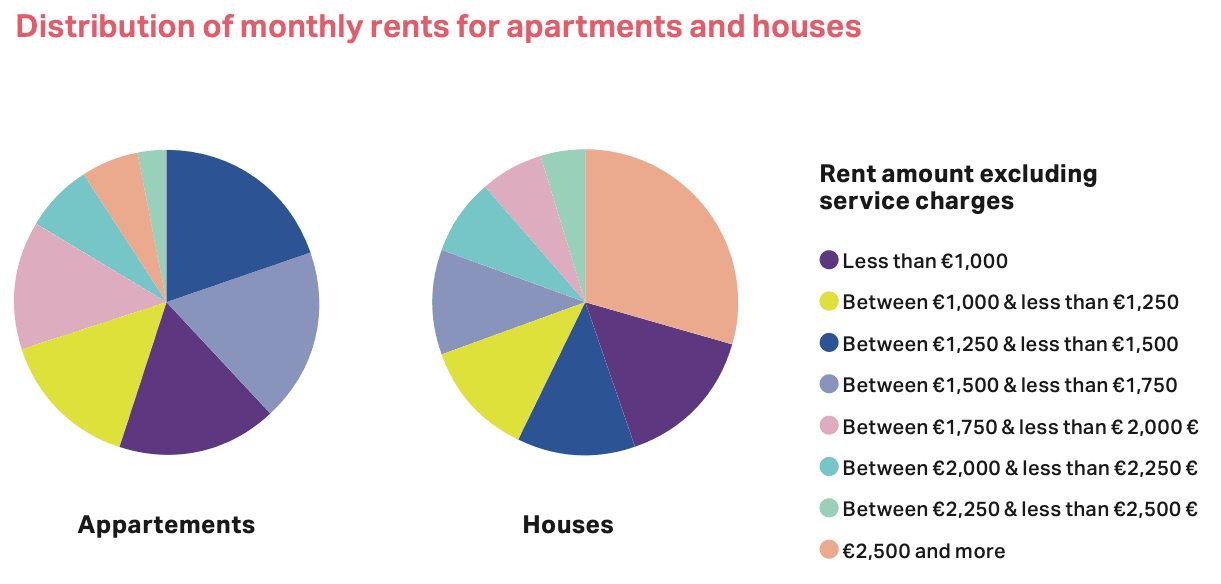
Distribution of monthly rents for apartments and houses. (Visual: Paperjam; source: Housing Observatory)
As for the profile of the typical landlord, the survey shows that he is male - 60.7%, compared with 50.4% of the total population – , over 55 years old - 64.1%, compared with only 27.3% of the overall population – , of Luxembourg nationality – 82.1%, whereas Luxembourgers account for 52.8% of the total population – and firmly rooted in the country: 97.6% live in Luxembourg and 63.4% have at least one parent born in the country.
In terms of motivation, rental activity appears, above all, to be a long-term wealth-building strategy. 72% of respondents say that rental income accounts for less than a quarter of their total gross income. The main reasons given for owning a rental property are, in order, long-term investment for retirement, the desire to leave an inheritance to their children and the prospect of regular rental income.
The key figure
€21,59. This is the average rent per square metre observed in Luxembourg, a figure that varies significantly depending o. the size, location and age of the property.
This article was written for the 13th edition of the Expat Guide, published by Paperjam, on 8 July. The content is produced exclusively for the magazine. It is published on the site to contribute to the full Paperjam archive. Click this link to subscribe to the magazine.
Is your company a member of the Paperjam Club? You can apply for a subscription in your name. Please let us know via club@paperjam.lu.