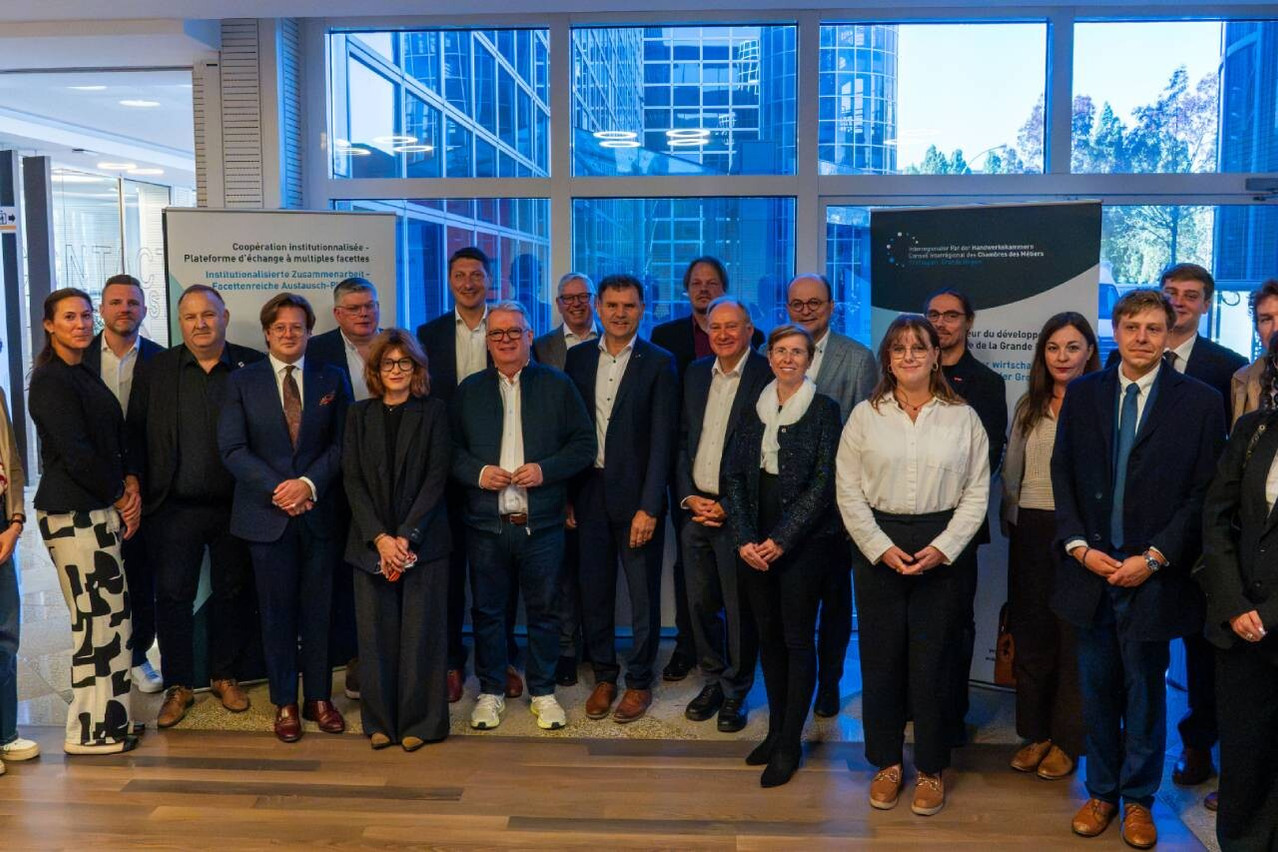
Helmut Zimmer succeeds Philippe Fischer as President of the Interregional Council of Chambers of Skilled Trades and Crafts (CICM) of the Greater Region. The handover took place at the general assembly on 23 September 2026 in Luxembourg. His term of office runs until 2030.
Founded in 1989, the CICM brings together eight organisations representing the craft sector in Saarland, Rhineland-Palatinate, Luxembourg, Wallonia and Moselle. It represents their interests in dealings with the authorities and promotes cooperation between the regions. Its headquarters are in Luxembourg, where the Chamber of Skilled Trades and Crafts houses its general secretariat.
Philippe Fischer is stepping down as president after four years. The Council has awarded him the title of “honorary president”. Helmut Zimmer, a master roofer and carpenter, also chairs the Saarland Chamber of Skilled Trades and Crafts.
Work placements across borders
During his term of office, Helmut Zimmer aims to strengthen vocational training. The CICM is planning to set up a network of training and mobility advisers for SMEs, as well as “Partnership Days” in the Greater Region. He also wishes to encourage apprenticeships in neighbouring regions.
The Council intends to bring the needs of craftspeople to the attention of policy-makers. According to its figures, the craft sector in the Greater Region comprises 300,000 businesses, 890,000 employees and 32,000 apprentices. On the subject of sustainability, Helmut Zimmer states: “Sustainable action is not a trend, but a fundamental part of our identity and our values, which have developed over the centuries.” In particular, the CICM aims to launch initiatives centred on “circular construction”.
AI is one of the priorities
In Luxembourg, the general assembly also discussed the use of artificial intelligence (AI) in craft businesses. In its recommendations to the Greater Region Summit, the CICM calls for more training, support for SMEs and facilities where they can test these tools. It calls on the Walloon and Luxembourg presidencies to discuss “AI and cybersecurity” at an interregional level.
Finally, the Council intends to address the barriers to cross-border craft services, in particular the differences between national rules and the formalities relating to the posting of workers.