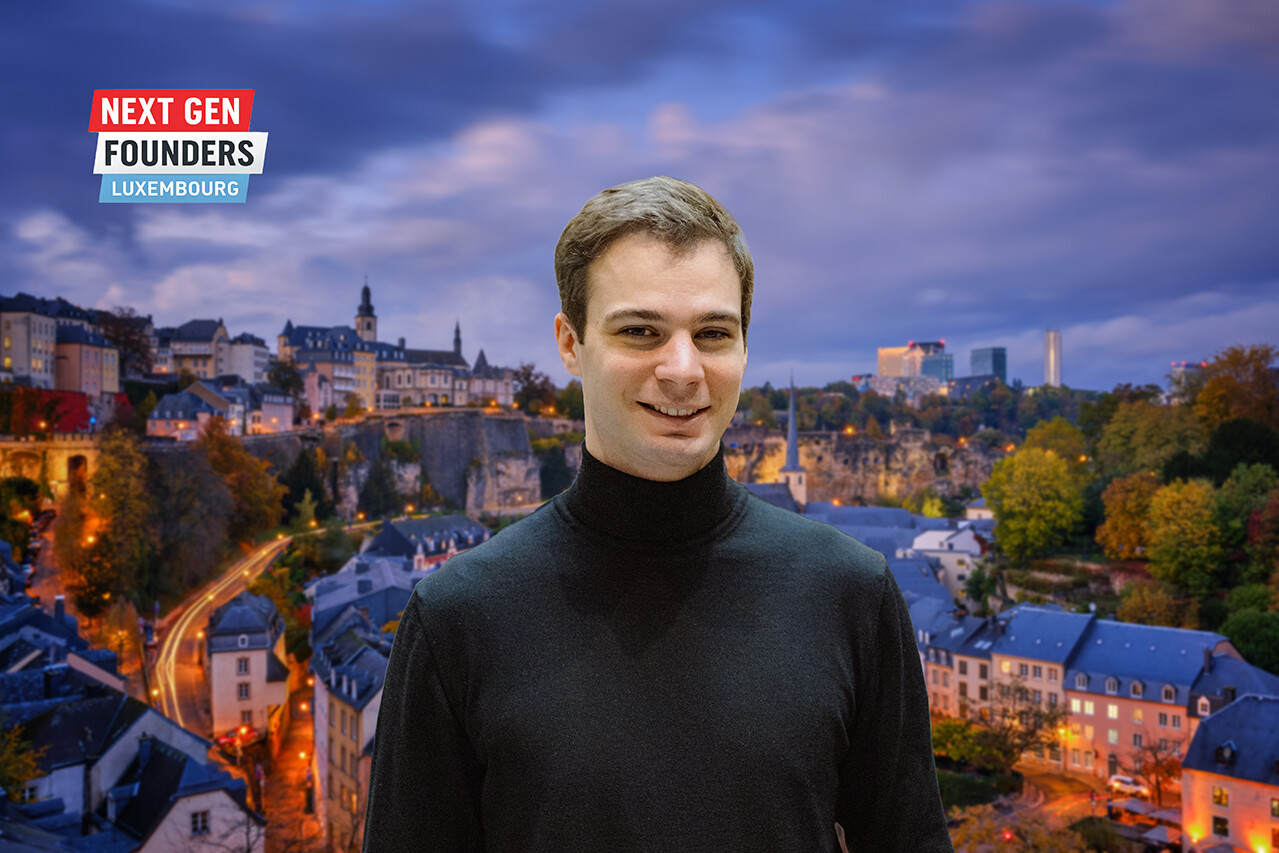
In 2021, at the age of 27, Grégoire Genest co-founded Albert School in Paris. Five years later, the school has grown from 33 to 650 students and has established branches in Paris, Marseille, Milan, Madrid and Geneva. The project was born out of a simple intuition: “It’s a bit like the school I would have wanted to attend.”
From a very young age, the entrepreneur excelled in mathematics. Having attended Lycée Vauban and then the International School, he recalls: “I was part of Luxembourg’s maths team. We went to the International Mathematical Olympiad.” But this scientific path was soon complemented by another interest: “I’ve always been interested in the world of business, companies and how they operate.”
Between mathematics and business
When it came to choosing his course of study, he had to make a decision. “I had to choose between business school and engineering,” he explains. “I chose engineering.” A logical decision, but an incomplete one. This tension shaped the rest of his career. In New York, where he started out in algorithmic trading, he thought he’d found that balance. “I told myself that trading was where I’d find both maths and business.” The reality is more nuanced. “As for the maths, I wasn’t disappointed. As for the business side of things, in algorithmic trading there’s actually very little of it: we pay little attention to companies; we mainly look at signals.”
He then launched a start-up in mobile payments, which he sold to BNP, before moving into private equity. It was at this point that his intuition became clearer. “I realised that I wasn’t the only one like me,” he explains. “There were lots of students like me who loved maths but wanted to go into business.” At the same time, he also noticed a gap on the corporate side. “Companies increasingly needed people who understood business well, but who could also grasp technology.” Few courses actually met this need. “Few, if any, schools offer this kind of programme,” says Grégoire Genest.
Setting up a hybrid school
It was this realisation that led to the creation of Albert School. “I was crazy enough to say to myself: I’m going to launch this,” he says. He then co-founded Albert School with his business partner, Mathieu Schimpl. “I set this up with a friend who attended HEC, so he has a business background. Whereas I, having attended Polytechnique, have an engineering background.” A complementarity which, in his view, reflects the very DNA of the project: “We complement each other in setting up this school, which aims precisely to sit between the two worlds: half business, half engineering.”
But the gap between the idea and reality is a considerable challenge. “The first six months were the hardest.” The aim was to open within a year. “We announced the school’s existence at the end of January so we could start the new term in September. We had no name, no website, no curriculum, no teachers, no pupils – nothing.”
Our mission is to train the leaders of tomorrow’s economy.

But behind this rapid launch, the project is underpinned by a clear conviction. “The mission is to train the leaders of tomorrow’s economy.” For the co-founder of Albert School, this economy is already undergoing a profound transformation driven by technology and artificial intelligence. “You can’t prepare for the economy of tomorrow with a business school that doesn’t incorporate this technical dimension,” he insists. But beyond the tools, it is also the role of companies that is evolving. “Today’s economy is largely being reinvented by businesses.” Hence a teaching approach designed to be as closely aligned as possible with the business world. “From the very first year, after A-levels, our students work on eight business cases with companies,” he explains. The lecturers, for their part, are often practising professionals. “The students love it because it’s practical.”
Build credibility
Beyond the actual construction, the key issue is credibility. “The questions we were getting were: how can we be sure it actually exists? How can we be sure it’s not a scam?” At that point, there was only a website. To win people over, he got personally involved. “I spoke to half the applicants on the phone,” he explains. Out of around 500 applicants, 33 joined the first intake. A decisive step. “Getting things off the ground in the first year is incredibly tough.” All the more so because, in this sector, the decision is a big commitment. “It’s not an impulse buy; it’s not like buying shoes.”
To build this credibility, Albert School has relied on high-profile backing from the very start. “We’ve managed to convince leading entrepreneurs to support us,” he explains, citing in particular the CEOs of Free, Xavier Niel; LVMH, Bernard Arnault; and the shipping company CMA CGM, Rodolphe Saadé. Credibility also depends on academic partnerships. Albert School has developed joint programmes and dual degrees with several renowned institutions, such as the École des Mines de Paris, Edhec and the Politecnico di Milano. “Often, if you want to judge a school’s reputation, you look at who its partners are,” the entrepreneur points out.
Then the snowball effect kicks in. “The first lecturers attract the next ones. Companies come because their competitors have snapped up our students.” Over time, a virtuous circle takes hold. “It gets easier and easier every year.”
Schools will change more in the next ten years than they have in the last 100.

Although the school was founded in Paris, part of its DNA comes from Luxembourg. He describes an environment that is “very business-friendly, very cosmopolitan”, which left a lasting impression on him. “It encourages you to question lots of things, to form your own ideas,” he says. The contrast with France also inspired him. “The French system is much more structured, more conservative.” Paris, however, stands out as the starting point. “We came here to address a frustration,” he explains, namely the demand for a school that is more innovative and more connected to the business world.
Expanding internationally
The name was chosen with an international perspective in mind. ‘Albert’ refers to Albert Einstein, but was also chosen because it works in all languages. “We immediately envisaged the school as a global institution.” This expansion is based on a simple observation: “Most Italians study in Italy, most Spaniards in Spain, and most Luxembourgers in Luxembourg. So, if we really want to be a global school, we need to have campuses in several countries.”
This growth has also transformed his daily life. “My life four years ago, when there were 33 students, is very different from my life now,” he admits. “But my mission remains the same.” He now leads a team of around 40 staff members and relies on nearly 200 lecturers. Nevertheless, the school remains focused. “We’re not here for everyone,” he asserts. “We offer the best programme in business and data.” The range of courses remains deliberately limited: one bachelor’s degree and four master’s degrees. The idea is not to cover every segment of higher education, but to consolidate a clear specialisation.
Like many entrepreneurs, he identifies recruitment as one of the main challenges. “We’ve hired people who are no longer with us,” he admits. “Not the right people at the right time.” A classic mistake, but one with far-reaching consequences. “The further I go, the more I hope to make these mistakes less often.”
Another reality: the impossibility of stopping. With 650 students, the nature of the responsibility changes. “It’s often tough, but stopping is impossible,” he says. “We can’t just leave them in the lurch.”
Establish a European benchmark
In the long term, the vision is clear: “To create a kind of European Stanford.” A school that would embody innovation, entrepreneurship and technology in Europe, just as Stanford does in the United States. In ten years’ time, he envisages “10,000 students and 15 campuses across the globe”.
But beyond the figures, it is also the very nature of the project that drives him to carry on. “When I was a child, I never imagined I’d set up a school,” he confides. “I wanted to be a trader and I became a trader; then I wanted to be a tech entrepreneur and I became a tech entrepreneur.” At every stage, however, something was missing. Today, he feels he has found his place in a sector “where we have a massive impact” and where “there’s a lot to be done over the next ten years”.
“Schools will change more in the next ten years than they have in the last 100,” he believes, convinced that artificial intelligence will profoundly transform the way we learn and teach. And he is already looking to the future: “I can easily see myself still here in 30 years’ time.”


