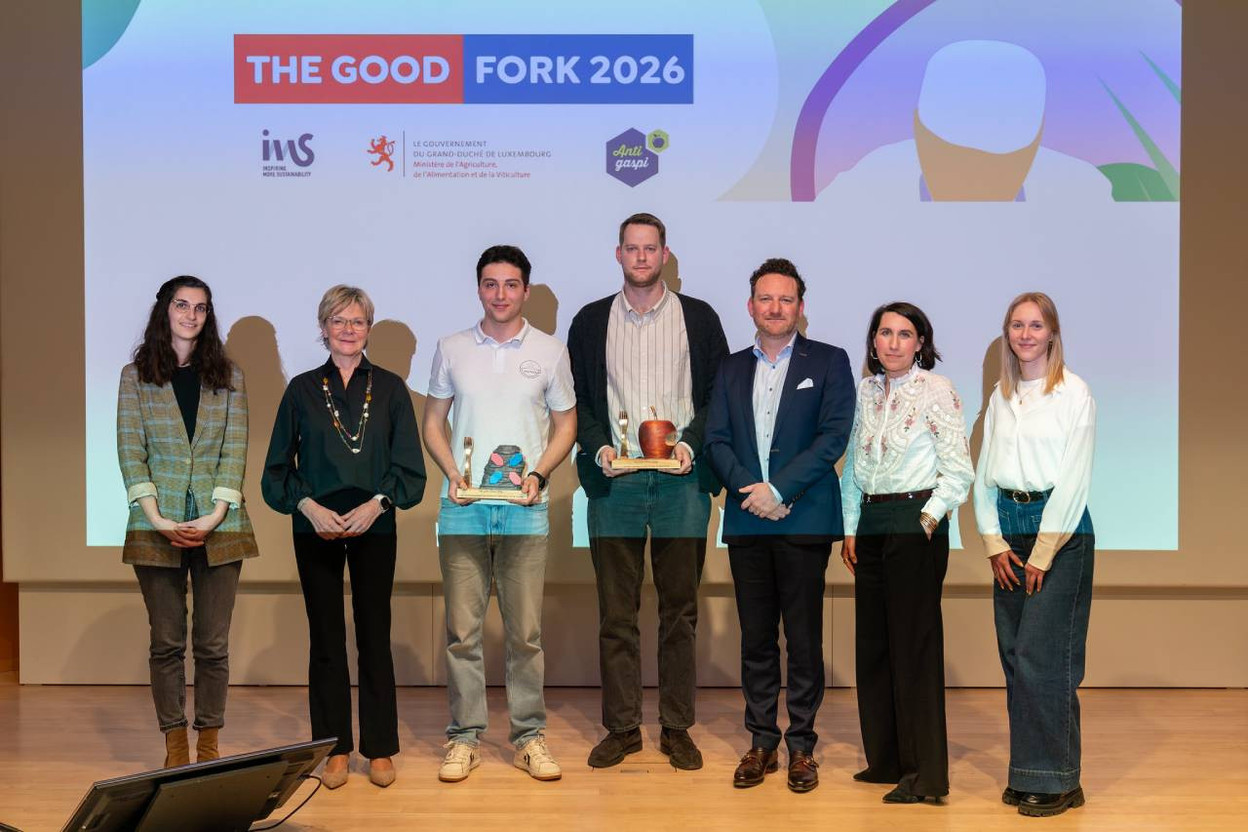
At the age of 18, Liam Bahbout took his A-levels whilst developing Leftlovers, a platform launched a year earlier with his co-founders to enable retailers to resell their unsold stock. A year after the launch, the team was working on an app to automate some of the operations, particularly stock management, which was still being done manually.
The project stems from a real-life observation. Elie Bertrand, one of the co-founders, works in a bakery and sees food being wasted on a daily basis, despite the existence of initiatives such as Foodsharing. “A lot of food still ends up being thrown away every evening,” explains Liam.
At the same time, the team discovered Too Good To Go in Belgium and identified a model that was already working elsewhere. “We said to ourselves, ‘OK, you know what, we’re going to set up Too Good To Go here in Luxembourg, tailored to the local market’.” The idea then took shape within a group of students. “We’re all in the same class,” he explains. Over the summer, they decided on the name, the concept and how the platform would work.
From the ‘Mini-Businesses’ programme to a real-life project
Leftlovers was launched as part of Jonk Entrepreneuren Luxembourg’s ‘Mini-Entreprises’ programme, which enables students to set up a business in a streamlined environment. “It’s like a real business; you have to build everything yourself, from scratch,” explains Liam. The project quickly gained momentum within this framework. The team came third out of 117 projects in Luxembourg, then second in a European competition in Albania.
But beyond the results, it is the way the project is used that proves its worth. “We’ve realised that our customers aren’t our family or our mates; they’re people we’ve never met.” He adds: “We’ve found that there’s a genuine demand and therefore a real problem.”
A model based on unsold stock
A year after its launch, Leftlovers has 14 partner retailers and has recorded several hundred sales. “We’ve already sold over 450 bags in just under a year,” says Liam.
The scheme works via a website where retailers offer their unsold stock in the form of mystery bags. Users buy online and collect their orders at the end of the day. “Retailers can sell off their surplus stock at reduced prices in the form of mystery bags,” he explains.
Three sizes are available, priced at €6, €11 and €16, with a minimum value requirement. “The aim is for the shopkeeper to put in goods worth at least twice the price of the bag.” The average price is around €12, for an estimated value of at least €24.
The model is based on a commission taken from each sale. Leftovers takes 20%, a rate that Liam describes as lower than that of some comparable players. This structure is designed to remain attractive to retailers.
In a country where, according to him, more than 90,000 tonnes of food are thrown away every year, the project is part of a recognised issue. Based on an estimate of around 500 grams per bag, the 465 bags sold represent 232.5 kg of food. “For us, one sachet equals one meal saved,” explains Liam.
Running a start-up whilst studying for A-levels
Within the team, roles are defined but remain flexible. Liam focuses on business development and financial matters. “I’m the one who has to find retailers,” he explains. He sums up his role as follows: “Officially, I’m the CFO and a salesman, but unofficially, I do a bit of everything, just like the others.”
In practice, he also helps out with operations, replies to emails and manages social media. “As we’re a small team, everyone has to do a bit of everything,” he adds. This way of working still relies heavily on manual tasks. “You have to do everything manually,” he explains, particularly when it comes to stock management.
This workload comes on top of the school workload. “Every second or minute you spend on school or on Leftlovers has to be used to the full.” Over time, certain tasks become quicker. “Updating stock levels, adding a new trader to the site or speaking to a trader – we can do all that much more quickly now.”
The next step: implementation
The team is now preparing for the next stage by developing an app. “We’re currently looking into developing an app to make the whole thing more user-friendly,” explains Liam.
The aim is to automate operations, particularly stock management, and to develop the project. A marketing campaign is planned to support the launch.
Raising awareness beyond the product
At the same time, Leftlovers runs awareness-raising campaigns on food waste. “We’ve done quite a few podcasts,” adds Liam. The team also posts content on its social media channels and takes part in various external initiatives.
A partnership is being developed with the Ministry of Education and Youth on the topic of ‘Sustainable Entrepreneurship’.