While his story may resemble a long journey back in time, that same journey does not lead very far. No further, in fact, than the neighbouring town, which is part of its charm.
As if to underline the point, 
Two lives. Two careers just a few miles apart. A single destiny. “If I hadn't been a sportsman before, I wouldn’t have done all the things I did afterwards,” he admits.
So it was in Mamer, just next door, that this story took shape. Back in the days when he was walking the streets as a child, the town’s leisure facilities could be counted on the fingers of one hand. “A football club, a table tennis club, a local brass band…” Schonckert opted for football. “And with my brothers alone, we already made up a third of the team,” he smiles. “We lived in a one-way street, so not many cars went by. I wasn’t the best dribbler. I was more of a go-getter.”
I never gave up. I worked hard.

If you want to go for it, you go for it. When he was a teenager, invitations to play for the Luxembourg national team and youth teams were pouring through his parents’ letterbox. “Apparently, I had a certain talent. The year he finished his A-levels, Schonckert--a fan of Ajax Amsterdam and English football--left Mamer and signed up for Union Luxembourg (which has since become RFCU Luxembourg). “I wanted to progress and I was ambitious. Apart from my A-levels, football was a way of letting off steam. I loved it, it wasn’t a burden. I was 18-19, playing alongside guys in their thirties. To me, they were old men. I sat on the substitutes’ bench all winter. Had I made the right choice with this transfer? I never gave up. I worked hard. In the spring, the door opened. We went up from the second division to the first. I stayed in the starting line-up. And at one point, I took a turn against my will…”
A metal screw in the tibia
At the memory of the scene, his face tightens, his eyelids close for a moment. Then Schonckert waves his hands again. This time to mimic the impact. It was the late 1970s, and Luxembourg’s under-20s were playing their Portuguese counterparts. On one occasion, Schonckert “pushed the ball a little too hard.” An opponent lunged at him to pick it up.
Now imagine the sound of spiked studs crashing unchecked into a leg. Schonckert is on the ground, drunk with pain. His tibia is broken, despite the fact that he is wearing the regulation protection under his socks. “I had a metal screw put in. It was months before I was able to use it again. I’d lost my muscle mass. The screw was in the way. It was hard to come back. I was a hard-working midfielder who wasn’t afraid of anyone. But overcoming that…”
Without this injury, would he have been able to break into the professional game, as some people dreamed he would? “I don't know. I don’t think so. In any case, I wouldn’t have made a great pro,” he replies wisely. “And if I hadn’t broken my leg, would I have gone to university?” As well as playing football, Schonckert did a double degree at Nancy University, in economics (master’s degree) and law (bachelor’s degree). He worked on his courses during the week, returning home to play for the Union over the weekends.
Stretching all the way to the respectable age of 34, his career was peppered with brilliance. Schonckert ended his career with a third national championship title to add to his personal honours list, which also includes three Luxembourg Cups... and six finals.
“Football gave me a lot of things. I loved the game, I loved competition, I loved winning of course, maybe I’ve had that since birth. But I also learnt to lose, and I sometimes say this to my teams at Cactus when things don’t turn out exactly as we'd hoped. When you lose a match, it’s not the end of the world; you have seven days to get back on your feet. It’s the same here, you can’t give up. You know, the Luxembourg Cup finals were the first three I ever lost…”
With football, I’ve also learnt to lose. And I sometimes say that to my teams.

1984 marked a double turning point. This time, the twists and turns were much happier than an broken leg. First, on the pitch. At the age of 26, Schonckert was called up to the Luxembourg national team for the first time--with the big boys.
His inaugural match took place against France, the fledgling European champions.In the opposing camp was the Zidane of the 80s, a certain Michel Platini. As for his studies, events were also gathering pace. As part of an internship for his dissertation, Schonckert knocked on the door of the Cactus group, a sponsor of the club he was playing for. “Apart from a grandmother who ran a retail business, I didn’t really have any connections. My course of study meant I was more likely to join a Big 4, the insurance industry or a bank... But I had done a work placement in a bank and I had to be honest with myself: it didn’t suit me.”
Like a team captain
At Cactus, “I was lucky to find an atmosphere and a team that matched my temperament. Founder Paul Leesch trusted me straight away. He believed in me. A lot of it is down to luck. You have to be in the right place at the right time. A bit like a goalscorer... At the end of my placement, the personnel director said to me: ‘If you’re interested in coming back, give me a call.’” Spoiler: Schonckert called him.
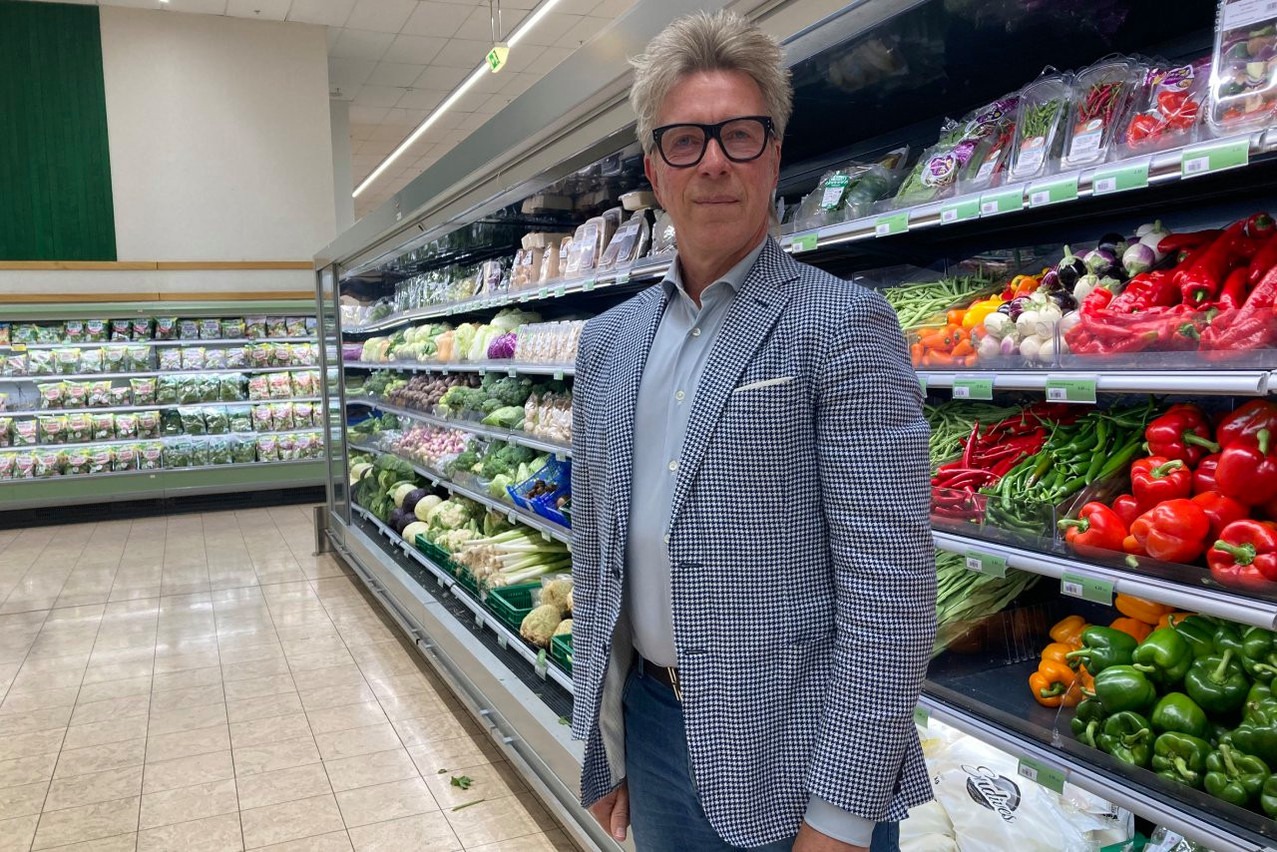
Forty years later, he manages a workforce of around 4,300, including some 350 at La Belle Étoile, the head office site. In the aisles of the hypermarket, he says “Moien!” and all the employees greet him. “People respect me because I respect them. Team captain? That’s a big word. Let’s just say that I'm the connector between everyone, and I’ve also become a corporate memory bank. A lot of things haven’t been written down, and it’s my duty to pass them on.”
I have a taste for surpassing myself. Football taught me that too.

Passing on, then. Just like in the old days on the pitch. The analogy is never far away. Schonckert says he gets straight to the point: “I’m there to solve problems and find solutions. It’s a tough job, at all hours, seven days a week. I’m not saying that I’m in the shop on Sundays, but I’m not saying that I don’t work on Sundays either... In any case, I have a taste for surpassing myself. Football taught me that too. We used to drool over it during pre-season physical training. It toughens you up.”
Schonckert was appointed managing director in 2001. Now 66, he says he is “in good health, not worn out.” “There’s still a lot to do, but I still have the desire, and I also have the confidence of the Leesch family and my managers,” he assures us. “I’ll be retiring in the not-too-distant future, but I’m not dreading it.”
Stay tuned for part 2--Lydie Freitas (Potentia)--coming tomorrow.
This article was originally published in French.