How are sustainable development issues tackled at the level of a group like Post?

What’s an example of a negative impact caused by Post’s activities?
“To operate, Post needs a lot of energy--almost 2% of the electricity consumed in Luxembourg every year. Two-thirds of this is needed to power our data centres. We also have a large car fleet, which generates CO2 emissions. Assessing these impacts, becoming aware of them, enables us to explore ways of reducing them.”
Ultimately, this energy is the energy consumed by your customers. Isn’t it necessary for the services you provide, some of which are essential to society?
“Yes, but that shouldn’t stop us from exploring ways of reducing our impact. We have a duty to set an example to all our stakeholders, especially our employees and customers. Our ambition is to aim for inclusive and sustainable growth. The difficulty is that we have to deal with sometimes contradictory injunctions. In our ICT & telecom business, for example, the demand for connectivity is constantly growing. As far as mail is concerned, consumers want to be able to receive their parcels earlier and earlier. Competitiveness, on the whole, means that we have to keep up the pace. So on the one hand, you’re being asked to be responsible, to reduce your environmental footprint and to look after the well-being of your employees. On the other, you have to go faster and further...”
Is it possible to reconcile today’s business models with the challenges of sustainable development?
“At the moment, we realise that it’s complicated. Society and the economy as a whole have to make a transition. Regulations such as the Corporate Sustainability Reporting Directive (CSRD) are pushing us in this direction. It requires all the players involved to anticipate the economic models of tomorrow, and to integrate a range of constraints. We are in an environment of transition. Adopting a sustainable approach, through a better understanding of emerging risks, should help to strengthen our resilience in the face of various crises, whether environmental, social or economic.”
In its 2023-2027 strategic plan, Post states that it no longer wishes to make trade-offs between profitability and responsibility. What does this mean?
“The strategic plan is a continuation of what we have been doing for many years. To continue our development, in particular by diversifying our activities. There’s nothing new here. What has changed is the way we approach our projects. From now on, everything we do must meet the criteria of responsibility and profitability, without us having to arbitrate between these two concepts. In other words, everything we do must be both profitable and responsible.”
Adopting a sustainable approach should help to strengthen our resilience in the face of various crises.

Isn’t profitability a key issue in sustainability?
“There’s no reason to pit responsibility against profitability. Profitability is a means. It guarantees the company’s long-term future. If you’re not profitable, you can’t be sustainable and contribute as a company to the creation of value for society. Maximising profitability doesn’t work either, especially if it involves irresponsible exploitation of natural resources, generates pollution or is done at the expense of employee well-being. In today’s world, this kind of approach leads to customers and employees turning their backs on the company. So we need to strike the right balance between profitability and responsibility. This is the commitment we have made, and it lies at the heart of our strategy.”
How are ESG issues integrated into the company’s strategy?
“Through a responsible approach, the company must seek to contribute to the various Sustainable Development Goals set by the United Nations. There are 17 in all. At group level, we wanted to make a series of commitments to those where we can have a direct and significant impact. This does not mean that the others, such as the fight against world hunger or the preservation of the oceans, are less important. It’s just that the impact we can have on these objectives, which are further away from our core business, is less.”
What themes have you chosen?
“We have chosen three main ones. The first is reducing our environmental footprint. Another key theme, linked to our core business, is to promote a responsible digital transformation, for example by revaluing technological equipment or making better use of data to respond to environmental or social issues. Finally, the third point, which is very close to my heart, is inclusion.”
What are the challenges associated with this commitment to greater inclusion?
“Inclusion has several dimensions. With regard to our customers, the public, it is above all a question of offering products and services that are accessible to all. As a company, through our public service missions, this dynamic of inclusion is written into our DNA. Post Finance, for example, ensures that everyone has a bank account, so that they can deposit money, have payment cards and make payments. But inclusion also means being able to offer job opportunities to everyone, whether they are qualified or not.”
“It also means enhancing the employability of the people who work in our teams, supporting them as their jobs change, sometimes profoundly. Technology, for example, is making certain functions obsolete. Some jobs may disappear. Our responsibility to the people affected by these changes is to provide them with career prospects within the group, enabling them to acquire new skills and benefit from opportunities for internal mobility. This means investing heavily in training, so that everyone can fulfil their potential.”
Can we come back to the energy issue: what are the levers and the commitments made to optimise your consumption?
“The first lever is to reduce the energy needs of our buildings, by moving towards passive energy. There is also an opportunity to reuse heat, particularly that produced by our technical installations, to heat other buildings or support other applications. For several years now, for example, the heat produced by the Kayl data centre has been used to heat the neighbouring building housing several of our subsidiaries.”
“The Helix building, opposite the central station, is heated by the heat emitted by the technical centre next door. Our new head office also has an ice accumulator as an efficient source of heat and cold. Other projects aimed at recovering heat for various needs are being studied. Our buildings can also accommodate renewable energy production units, such as photovoltaic panels. So reducing energy needs is an important part of our property strategy.”
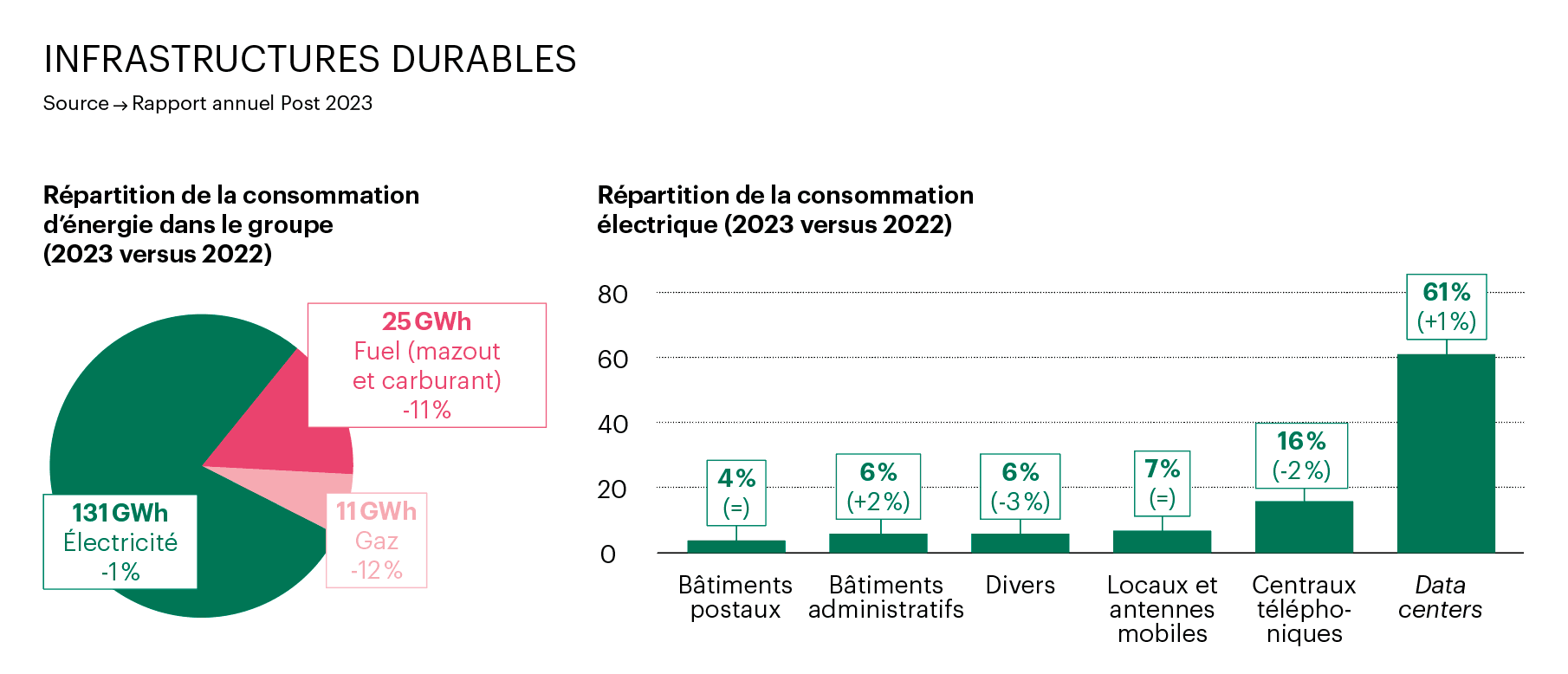
Sustainable infrastructure. Source: Post 2023 annual report
Are there also operational levers to work on? What can the business units do?
“Another major project is the electrification of the vehicle fleet. A major project is also underway to optimise daily travel. At present, Post teams travel the equivalent of around the world every day. By rethinking the logistics circuits, we can considerably reduce travel without compromising service quality. We have also reinvested considerably in telecoms networks, deploying technologies that consume less energy and speeding up the decommissioning of old-generation networks.”
The CSRD directive is coming into force. What does this mean for a group like Post?
“As a public institution, Post is not directly affected by the directive. Only two of our subsidiaries fall within the scope of the directive. However, as we wish to act as a responsible company, and in view of our duty to set an example, we wanted to apply the requirements set by these regulations to the whole group. In fact, we did not wait for this directive to introduce a responsible approach. As far as 12 years ago, we published a non-financial report even though we were under no obligation to do so.”
What does the CSRD actually require?
“The CSRD requires us to be transparent and, as a result, to put in place a set of indicators and to report a range of non-financial data with the same rigour as that required for the processing of financial data. In order to be ready to meet these requirements in 2025, we began preparatory work several years ago, enlisting the help of specialists in these issues. The efforts we have made can already be seen in our annual report.”
What will this directive achieve? How does this exercise support the adoption of a sustainable model?
“The approach will make it possible to identify the precise environmental or societal impacts on subjects that are relevant to Post and the ecosystem in which we operate. The dual materiality analysis that we are currently carrying out will enable us to identify and establish key indicators that we can monitor over time. This transparency exercise should enable us to make commitments and assess the efforts we have made to improve our social, environmental and good governance performance. It is important to note that all these indicators will be audited.”
“In this context, it becomes difficult to engage in greenwashing. Beyond declarations of intent, it is important that commitments are translated into directly measurable results.”
What are the main challenges involved in integrating these new requirements?
“It’s a complex transformation, which first and foremost involves a major training effort. The members of Post’s board of directors and management committee have undertaken a certified training course in sustainability at the Solvay Business School in Brussels. Developing skills in sustainability is not limited to senior management. It’s important that everyone throughout the company be able to appreciate the challenges and understand the approach. We have therefore acquired skills and increased our efforts to raise awareness by organising training courses and workshops. To commit to a continuous improvement approach, everyone has to be able to take part in it, so that the issues are understood and guide decisions taken at all levels.”
To what extent does a strong commitment to CSR create opportunities for a group like Post?
“More than opportunities, the approach is already a prerequisite for signing certain major contracts. The majority of players are called upon to join this dynamic. Major customers expect us to be able to demonstrate the efforts we are making to respond to social and environmental issues. This is one of the specifications we receive. If we fail to support this transition by aligning ourselves with all our stakeholders on these major challenges, we run the risk of being excluded from the market. As far as employees are concerned, a company that does not commit to this approach will find it increasingly difficult to recruit.”
But these new constraints can also bring new opportunities. How do you see this?
“The transformation we have to undergo means we have to leave our comfort zone, rethink our processes, our offering and our business model. In this case, constraint feeds creativity. With our employees and our partners, we need to find solutions and ways of meeting our objectives differently. Saving energy contributes to the climate challenge, but also to reducing operating costs. Supporting responsible digital transformation also means rethinking our business models.”
“This is reflected, for example, in the recovery of electronic equipment, such as smartphones or decoders, in order to recondition them or give them a second life by entrusting them to associations working for digital inclusion. In another example, Post has become the first European telecoms operator to obtain permission from Apple to repair iPhones in-house. Repairing rather than replacing helps to reduce waste. Our technicians, who have been trained to serve our customers with smartphone-related problems efficiently, are particularly proud to be part of this approach.”
You are also a major digital player. How can technology support a more sustainable approach?
“This is another major opportunity linked to this transition. Our technological expertise in data collection and processing, and in cyber security, means that we can innovate to meet our needs and those of our customers more effectively. In a context of transition, the drive for innovation is helping to optimise the use of energy. It also integrates ethical issues, linked to the responsible use of data and the security of exchanges.”
Three CSR priorities
As part of the process of drawing up its 2023-2027 strategy, Post has carried out a review to define the areas in which the company wishes to take priority action.
1. Reducing its environmental footprint: This mainly involves minimising energy consumption and, at the same time, CO2 emissions.
2. Promoting responsible digital transformation: By reducing the environmental footprint of the services it offers, Post aims to support the reuse of the technical equipment it deploys and to help its customers adopt responsible practices.
3. Supporting inclusion: This involves providing products and services that are accessible to all. It also means offering employment opportunities to everyone, whether qualified or not, and guaranteeing employees long-term employment prospects.
Supporting diversity
Since 2012, Post has been a signatory of the Lëtzebuerg Diversity Charter, a national commitment to promoting and managing diversity within signatory organisations through concrete actions that go beyond legal obligations. For Post, diversity is a key lever in achieving its sustainable development objectives. It is a source of wealth and contributes to a better understanding of the challenges ahead. Although there is still progress to be made, particularly in terms of the representation of women in positions of responsibility, Post seeks to improve diversity and the representation of all categories of the population within its teams, at all levels.
An electrified fleet
Post Luxembourg is transforming its vehicle fleet. The aim is to have 90% electric vehicles by 2026. These vehicles, powered by low-carbon electricity, should help to reduce the carbon footprint associated with mail and parcel delivery in particular. In 2023, electric vehicles represented 30% of the fleet and covered 20% of the total number of kilometres.
This article was first published in French on Paperjam. It has been translated and edited for Delano.
This article was written for the ESG supplement of the July 2024 edition of Paperjam, published on 19 June. The content is produced exclusively for the magazine. It is published on the website as a contribution to the complete Paperjam archive. Click here to subscribe to the magazine.
Is your company a member of the Paperjam+Delano Business Club? You can request a subscription in your name. Let us know via club@paperjam.lu