
Europe's leveraged loan market staged a remarkable recovery in the second quarter of 2026. New issuance accelerated sharply after a hesitant start to the year, making it the busiest quarter since early 2025, noted Pitchbook in its latest European Credit Markets Quarterly Wrap report. Borrowers rushed to refinance existing debt as spreads compressed to levels not seen since before the global financial crisis, helped by exceptionally strong investor demand.
Yet the headline figures concealed an important reality. Much of the activity came from repricings, refinancings and maturity extensions rather than fresh investment (see chart 1) . More than two-thirds of institutional loan activity this year has been linked to existing debt, while new-money issuance remains below last year's pace. Companies are taking advantage of favourable financing conditions, but corporate expansion and acquisition activity have yet to recover meaningfully.
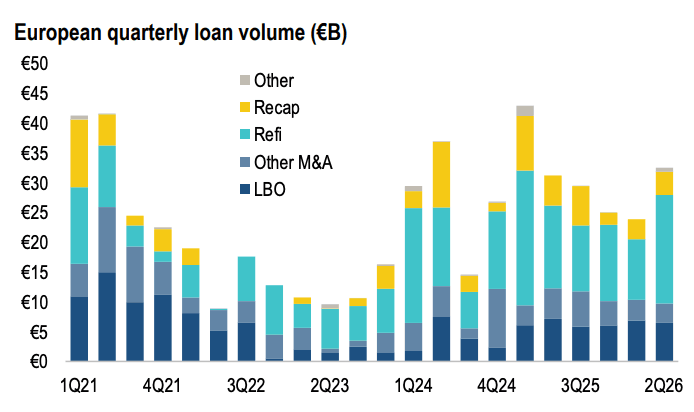
Chart 1: European quarterly loan volume (€B): Loans post busiest quarter since Q1 2025 Source: Pitchbook | LCD • Data through June 30, 2026
Demand outpaces supply
The engine behind this rally was technical rather than economic.
Collateralised loan obligation (CLO) issuance continued to run at record levels, creating sustained demand for leveraged loans at a time when new supply remains scarce. European institutional loan supply has remained negative for years, but the imbalance has become particularly acute in 2026 as investors compete for a limited pool of assets.
This imbalance has handed pricing power to borrowers. Average single-B loan spreads have fallen to pre-2008 levels even though benchmark interest rates remain higher than in previous refinancing cycles. Investors are accepting tighter margins because cash continues to flow into the asset class faster than new loans are being created.
High yield enjoys a record year
Europe's high-yield bond market experienced a similarly strong revival.
The second quarter delivered record issuance, driven by refinancing transactions and an increasing number of first-time borrowers (see Chart 2). Nearly one-third of issuance this year has come from debut issuers as companies diversify their funding sources or replaced floating-rate debt with fixed-rate bonds before rates potentially move higher.
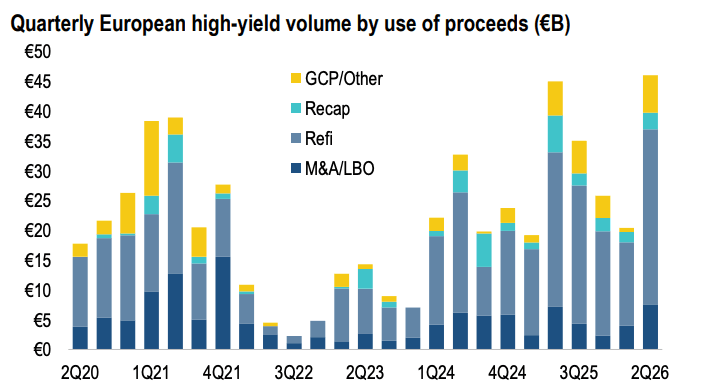
Chart 2: Quarterly European high-yield volume by use of proceeds (€B) Source: Pitchbook | LCD • Data through June 30, 2026
The market has also proved remarkably resilient to geopolitical shocks. Following the disruption caused by tensions in the Middle East earlier this year, spreads widened briefly before quickly retracing. Investors appear increasingly willing to look through short-term volatility, provided recession risks remain contained.
A widening quality divide
Perhaps the defining characteristic of Europe's credit markets is growing bifurcation.
More than half of leveraged loans now trade above par, while a meaningful minority continue to trade at distressed prices. Investors have become increasingly selective, rewarding resilient credits while penalising sectors facing structural uncertainty.
Software illustrated this divide (see chart 3). Artificial intelligence has prompted investors to reassess software business models, sharply differentiating companies viewed as mission-critical from those considered vulnerable to disruption. Similar patterns are emerging across private credit, where lenders increasingly distinguish between premium assets attracting fierce competition and transactions that struggle to secure financing.
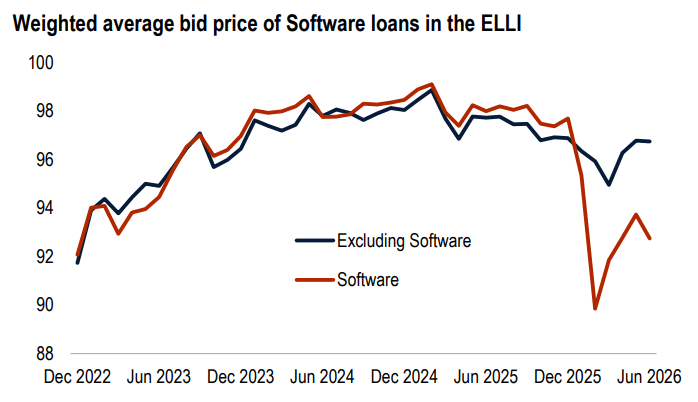
Chart 3: Weighted average bid price of Software loans in the ELLI Sources: Pitchbook | LCD; Morningstar European Leveraged Loan Index TR LCL • Data through June 30, 2026
Private credit loses momentum
While public credit markets have accelerated, private credit has slowed.
Direct lending activity fell to its weakest level since 2024, with both deal volumes and transaction numbers declining significantly from last year (see Chart 4). Market participants pointed to greater caution among investors following geopolitical uncertainty and AI-related concerns, alongside reduced capital commitments to direct lending funds.
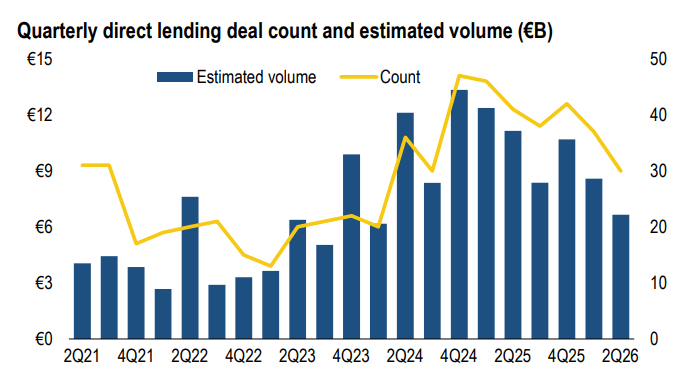
Chart 4: Quarterly direct lending deal count and estimated volume (€B): Private credit activity retreated to 2024 lows Sources: Pitchbook | LCD • Data through June 30, 2026. Deal count is based on transactions covered by LCD News
However, this is not a story of disappearing capital. Fund managers consistently reported substantial liquidity, but deployment has become far more selective. Competition remained intense for high-quality borrowers, while more marginal transactions faced longer execution timelines and tougher negotiations.
Europe's next test
Europe's credit markets enter the second half of 2026 from a position of considerable strength. Liquidity remains abundant, refinancing risks have eased and funding costs are attractive by recent standards. CLO issuance continues to underpin demand, while bond investors are absorbing record supply with little difficulty.
The bigger question is whether technical momentum can eventually translate into stronger corporate activity. Until mergers and acquisitions recover meaningfully, Pitchbook argued that refinancing will continue to dominate issuance and the shortage of new assets will persist. For now, Europe's credit boom is less a story of economic expansion than one of extraordinary investor demand overwhelming limited supply – a combination that continues to reward the strongest borrowers while leaving weaker credits increasingly isolated.