
The Emea loan market has spent three decades evolving from a largely bank-led business into a sophisticated, multi-trillion-dollar financing ecosystem. Now, according to the Loan Market Association’s latest report, “2040: The Future for Emea Loan Market”, it faces its biggest transformation yet.
The next decade will not simply be about extending more credit. LMA argued that it will be about financing the energy transition, digital infrastructure, defence spending and economic competitiveness while navigating geopolitical uncertainty, technological disruption and a more fragmented regulatory landscape.
For lenders, investors and borrowers alike, the challenge is no longer whether capital exists, but how efficiently it can be deployed where it is needed most.
From growth to transformation
The report suggested that Emea loan markets are entering a new phase of maturity. Over the past 30 years, they have expanded dramatically in scale, diversity and sophistication. Banks are no longer the sole providers of capital. Instead, private credit funds, institutional investors, insurers and alternative lenders have become integral parts of a broader financing ecosystem.
This diversification has strengthened market resilience. Even after successive shocks—including the global financial crisis, the pandemic, geopolitical tensions and rapid technological change—the market has continued to adapt. The LMA believes the defining characteristic of the next decade will therefore be evolution rather than expansion, with lending becoming increasingly international, technology-enabled and collaborative.
Financing tomorrow’s economy
Demand for capital is expected to accelerate significantly as governments and businesses invest in decarbonisation, digital transformation, infrastructure renewal and defence capabilities, argued its CEO, Scott McMunn.
Meeting these financing needs will require deep and efficient capital markets capable of mobilising large pools of funding across borders. The report stressed that transparency, robust standards and effective risk management will become even more important as lending structures grow more complex and more participants enter the market.
Despite current macroeconomic uncertainty, surveyed respondents remain optimistic over the longer term. While sentiment for the coming 12 months is cautious, confidence rises markedly when participants consider the next five years, reflecting strong belief in the structural fundamentals of the market (see Chart 1).
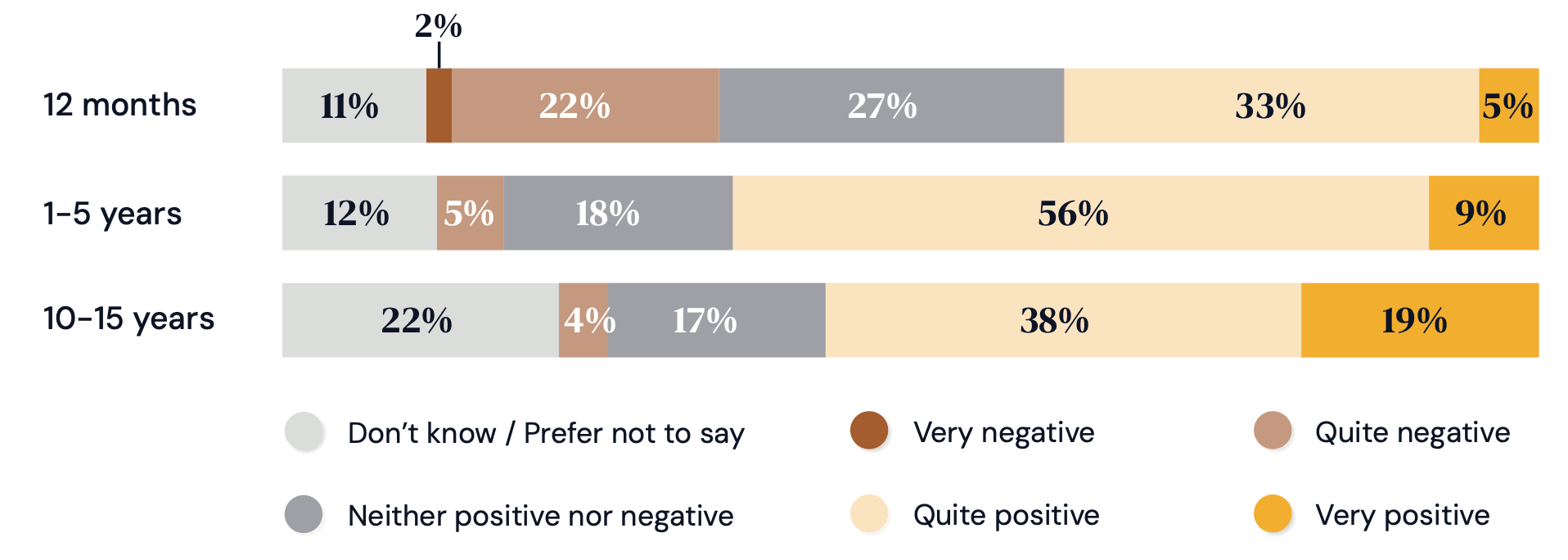
Chart 1: Market sentiment over next 12 months, 1-5 years, 10-15 years (All survey respondents) Source: 2040: The Future for Emea Loan Market. Loan Market Association
Technology reshapes lending
Artificial intelligence and automation are expected to redefine every stage of the lending lifecycle.
The report highlighted AI, digital documentation, data standardisation and workflow automation as major opportunities to improve efficiency, transparency and risk management. Rather than replacing financial expertise, technology is expected to reduce friction, accelerate decision-making and improve the quality of information shared across increasingly complex lending networks.
However, unlocking these benefits will require significant investment, common standards and close collaboration between market participants. Without shared approaches to governance and interoperability, technological progress risks creating new inefficiencies rather than eliminating existing ones.
Regulation needs to catch up
As lending becomes increasingly cross-border, regulatory fragmentation is emerging as one of the industry's biggest obstacles.
The LMA argued that greater alignment between jurisdictions is essential if capital is to flow efficiently throughout Emea. Diverging rules increase costs, complicate transactions and reduce the ability of lenders to support international investment.
The report did not advocate lighter regulation. Instead, it called for greater consistency while preserving resilience and appropriate market oversight. Achieving that balance will become increasingly important as alternative lenders continue to gain market share alongside traditional banks.
Sustainability becomes mainstream
Environmental and social considerations are no longer viewed as niche additions to credit analysis. Instead, sustainability is becoming embedded in mainstream lending decisions, stressed LMA.
The report suggested that transition finance will become a core component of future loan markets as businesses seek funding to decarbonise operations while maintaining commercial viability. Developing practical, credible frameworks that support both sustainability goals and market integrity will therefore become a strategic priority for lenders.
Rather than representing a separate asset class, sustainability considerations are expected to influence pricing, risk assessment and capital allocation across virtually every segment of the market.
A broader capital ecosystem
One of the report's strongest messages is that diversity has become a source of resilience.
Private credit has emerged as a permanent complement to traditional banking rather than a temporary alternative. Institutional investors, insurers and specialist lenders now provide additional capacity that allows financing to continue even during periods of market disruption.
This broader investor base has increased flexibility while enabling larger financing requirements to be met more efficiently. It also reflects how loan markets have evolved from a relationship-driven banking activity into a recognised global asset class capable of supporting increasingly complex financing needs (see Chart 2).
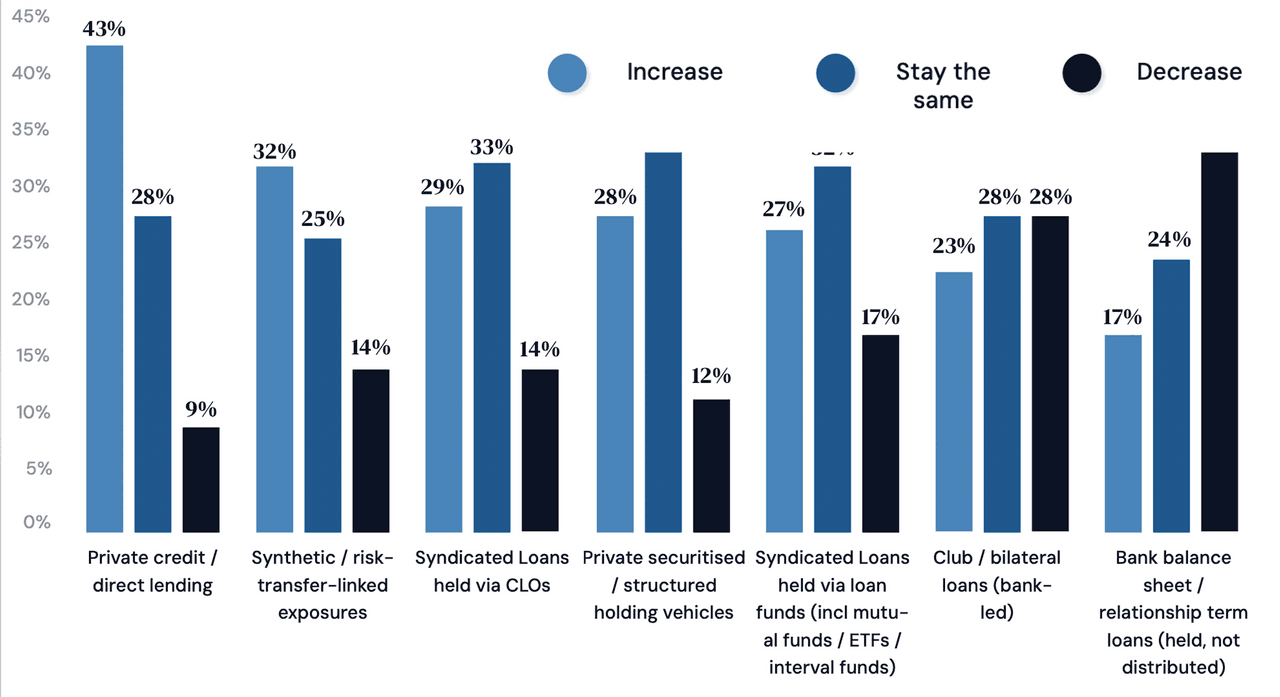
Chart 2: By 2040, expected change in relative share of lending by credit exposure (All respondents, chart does not show those selecting ‘don’t know’) Source: 2040: The Future for Emea Loan Market. Loan Market Association
Confidence with conditions
Despite near-term uncertainty, the LMA concluded that the long-term outlook for Emea loan markets remains overwhelmingly positive. The market has repeatedly demonstrated its ability to adapt to structural change, and respondents believe that capacity for innovation will continue to underpin future growth.
Success, however, will depend on three priorities: embracing technology, achieving greater regulatory coherence and embedding sustainable finance throughout the lending ecosystem. If those conditions are met, loan markets will play a decisive role in financing Europe's economic transformation over the coming decades.
As the report concluded, the defining constraint on the next phase of growth may not be ambition, but access to finance. The institutions capable of mobilising capital efficiently at scale will ultimately shape the future of corporate finance across Emea.