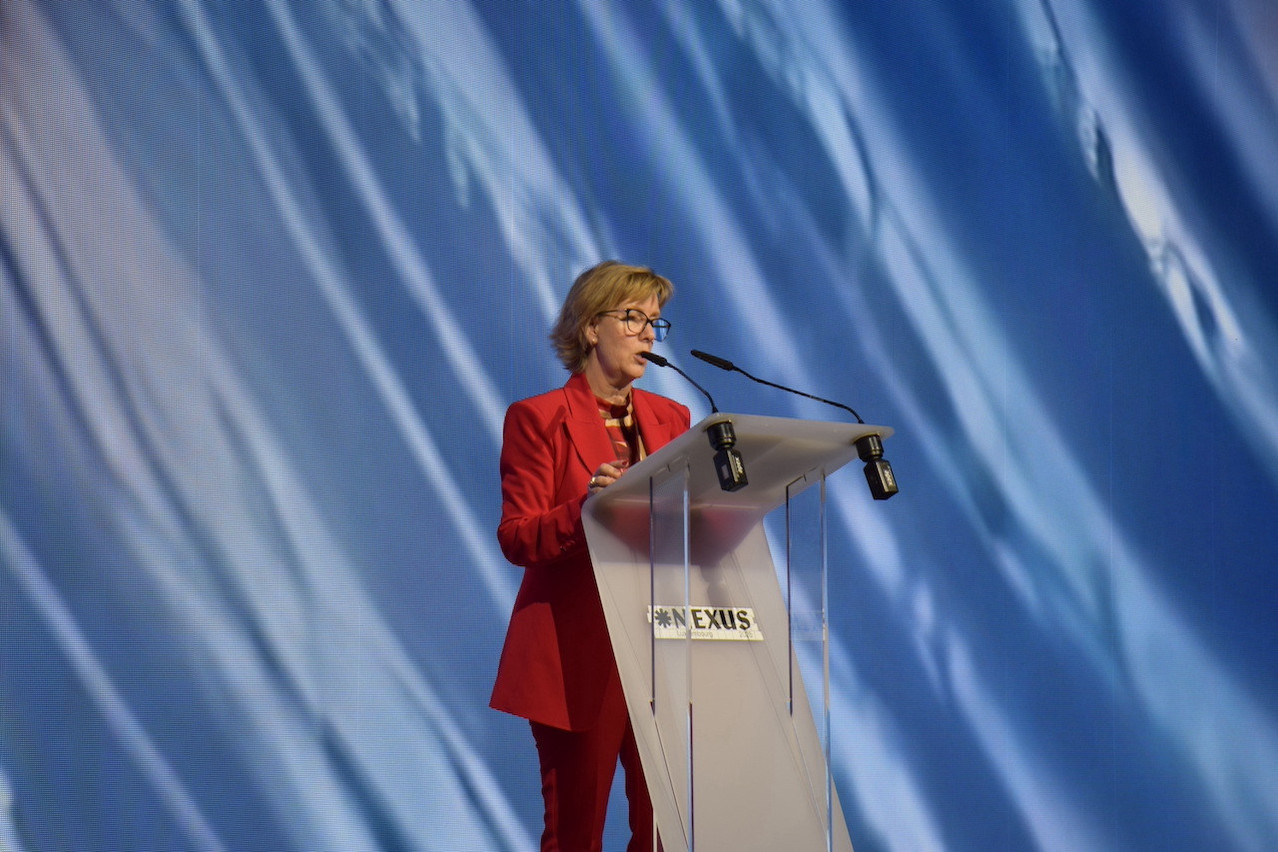
Maria Luis Albuquerque is European Commissioner for financial services. In this capacity, she is responsible for the savings and investment union. She has four objectives: to facilitate access to financial markets; to stimulate investment; to strengthen competitiveness; and to create a virtuous circle in which citizens benefit from better returns on their savings while supporting economic growth and job creation. It’s a vast programme, and its implementation is causing concern among professionals, not least because of the possible centralisation of supervision. Whilst in Luxembourg to preside over the closing ceremony of Nexus Luxembourg 2025, she answered Paperjam's questions about her vision of the savings and investment union, her hopes and the resistance it is currently encountering.
Paperjam: One of your ambitions is to ensure that European savings--around 70% of which are in the form of bank deposits--are channelled into products that would have a greater impact on the European economy. Why would a single savings union be the best way to achieve this?
Maria Luis Albuquerque: This great propensity that Europeans have to place their savings in bank products is due, in my opinion, to the lack of opportunities offered to them to make their money work more effectively, not least because there is no truly European product. When people have access to suitable products, their behaviour changes.
Take Sweden, for example. Their savings and investment account model encourages people to invest their long-term savings in the capital markets. This has enabled them to create a functional financial ecosystem. When we talk about the difference between savings and investments in Sweden, they always say, “what do you mean by savings and investment? Here, all our savings are invested.”
So what are the obstacles preventing the Swedish model from becoming the European model?
First, there is the fragmentation of markets, which prevents them from being as efficient as they should be. Then, there is a combination between the lack of opportunities offered by the market and the actions of public authorities who do not put in place the policies that would encourage such development. This is what we want to correct with the savings and investment union project.
One of the pillars of this project is to increase investor protection in order to develop the confidence that is lacking today and that encourages savers to favour simple banking products. The feedback we are getting from the financial community and professionals is that this new layer of overproduction risks having the opposite effect by forcing them to restrict the products they could offer their customers. Is this fear well-founded?
I understand this fear. The current framework is the regulatory response to the last financial crisis. The main concern at the time was to prevent a recurrence and, therefore, to better protect investors against the risk of loss. In my opinion, this framework focuses too much on the “no risk” aspect. The current tradeoff between risk and return needs to be recalibrated in favour of return.
That said, the framework remains good, but certain aspects relating to the protection of retail investors need to be rethought so that they can access real opportunities. I think we’ve pushed their level of protection a little too far by not allowing people to take risks in traditional financial products when they do in other assets like cryptocurrencies.
You are currently touring member countries to gather feedback from all stakeholders. In Luxembourg, what is their main concern?
Supervision. Faced with this concern, I reaffirmed that we have no intention of proposing a single supervisor. We don’t think that's the most effective way of doing things. What we want is a single supervision, which is not the same thing. It is conceivable that in certain parts of the market, a single supervisor would make sense. But for most activities, the right way to act is to use existing convergence tools, or even to create new ones, with the aim that in the end the same question will get the same answer wherever you ask it in Europe. This is not the case today and we need to work on this to find the solution that would lead to this result. We launched a public consultation which ended last week. We will now examine the responses and take them into account.
The key word at the moment within the European institutions is “simplification omnibus.” In the financial centre, the hope is that future omnibuses will simplify the administrative burden, reduce regulatory contradictions and enable private savings to be mobilised more effectively to finance the economy and the transition, without hampering the competitiveness and innovation of the financial sector. What is your position on this subject?
Simplification is one of the mission statements of all Europe commissioners. But simplification is much more difficult than complexity, because it requires a higher level of compromise. It’s not just about setting the lowest common denominator, all parties have to make concessions to achieve a result that’s better for everyone.
It’s about making sure you limit yourself to the minimum necessary to achieve a set objective.
Simplicity requires a lot of effort. It starts within the European Commission with the way we develop new proposals and when we take the opportunity to reopen part of the acquis communautaire to simplify it. But it also requires a different approach from the co-legislators, the member states in the European Council and the European Parliament. And of course, downstream, all those who then have to implement this on the ground must adhere to this simplification agenda.
How would you define simplification?
It’s about making sure you limit yourself to the minimum necessary to achieve a set objective. Keep it simple, stay focused and always keep your eye on the goal.
Everyone is calling for this simplification. But not everyone puts the same things into it. What are the main difficulties you are encountering in your quest for simplification?
The main resistance is linked to the preservation of existing situations. Some established players who feel very comfortable where they are do not want things to change. Resistance to change is human nature.
Then there are the specific characteristics of the markets. The European landscape is very diverse and we must respect this diversity. But at the same time, we need to make all stakeholders understand that in common sectors, there is a huge amount of value already created and yet to be created. In Europe, we have everything we need to overcome the challenges. We have the money, we have the skills, we have the talent and we have the knowhow. We have a market of 450m people and it must truly benefit every citizen, every company, every member state.
This is our challenge. Following the motto “united in diversity,” we must achieve a better balance between union and diversity. There is much benefit and value to be gained from greater integration and more concerted action. A single financial market enables efficiency, offers more opportunities, reduces costs and will enable us to meet the challenges of investing in new technologies.
When will we see the union of savings and assistance?
Our timetable is very ambitious. The recommendations and legislative proposals will arrive before the end of the year. After that, it will be up to the co-legislators to decide how quickly they want to take the matter forward. In 2026, we will have a report on the competitiveness of the banking sector. It’s a report that could lead to other decisions and it’s a project that will take time to fully implement. But if we act together and create trust, we could see tangible results quickly.
This article was originally published in English.