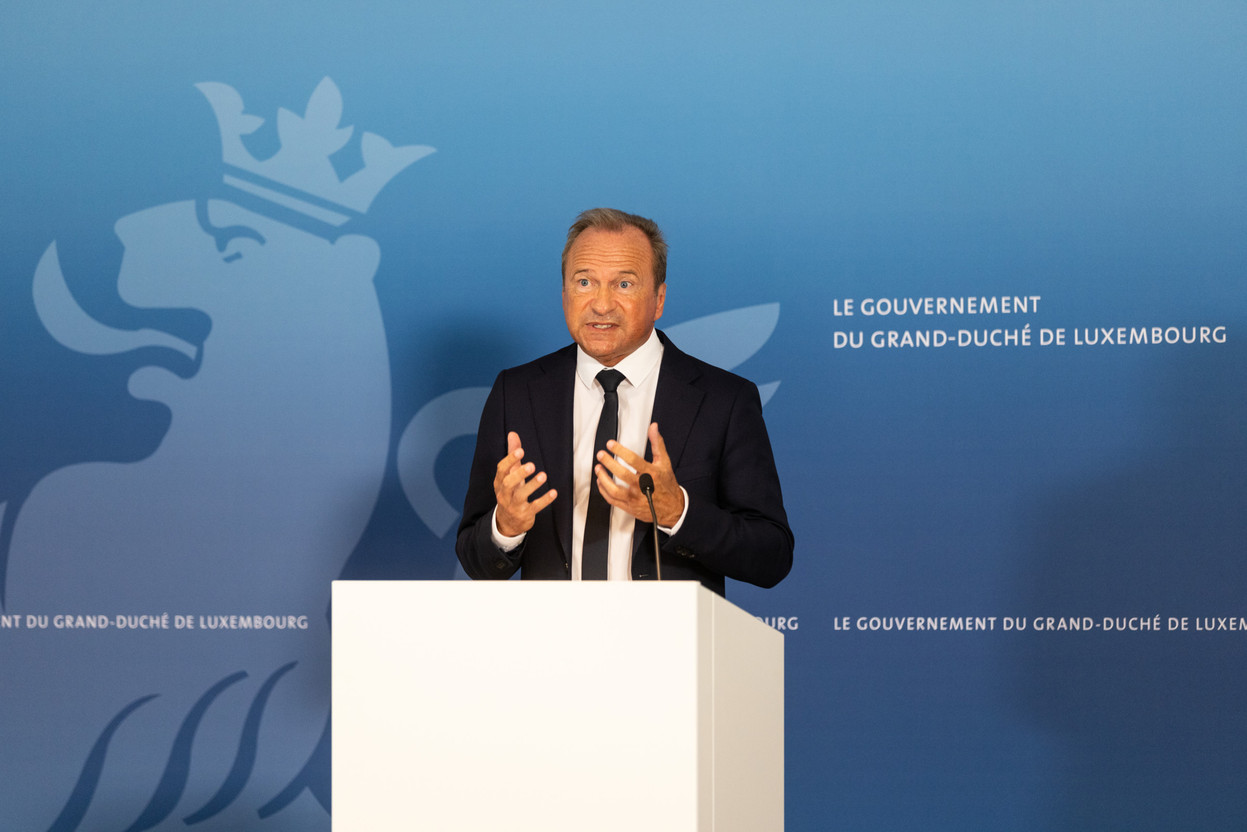
At the Nexus 2025 tech conference to present the government’s strategy for strengthening the financial sector, finance minister 
Paperjam: How can the financial sector adapt to today’s technological disruptions and geopolitical challenges?
Gilles Roth: I believe that this is the time for Europe to play its cards and take action, particularly in terms of competitiveness. And it’s also time for Luxembourg’s financial and banking centre to seize the opportunities. Last year, I initiated a number of reforms, such as the modernisation of the expatriate scheme, which exempts up to €400,000 of annual salary from tax at a rate of 50%. This scheme is very popular with startups. There have also been other reforms, such as the exemption from subscription tax for exchange-traded funds (ETFs) and the 1% cut in the corporate tax rate. In addition, we have made a considerable number of legislative adjustments, such as the law on blockchain or the transposition of the Mica directive [Markets in Cryptoassets, editor’s note], which allows us to regulate cryptocurrencies and gives us a flexible framework that protects investors whilst providing development opportunities for professionals.
Other measures have been the subject of bills, such as the creation of a tax credit for business angels, which is very important for the world of startups. We are also working on a stock option scheme for employees who get involved from the very beginning of a startup and are rewarded in part by shares in the company. The capital gains tax regime will be very competitive.
Two new features are attracting the attention of professionals this year. Can you describe them in detail?
I have just announced the introduction of a carried interest regime in order to attract more fund managers here in Luxembourg. This is a long-standing request from the industry that makes sense, especially in view of what is happening across the Channel and in southern Europe.
Today, I am also proud to announce another initiative: the Fundtech Accelerator, sponsored by the ministry of finance and other partners. This programme will support startups developing digital solutions for funds. Luxembourg is already Europe’s leading fund centre. But to stay ahead, we need to digitise our fund ecosystem from end to end. The new accelerator will bring together startups, fund managers and technology providers to co-create the future of fund services. We invite partners to join us as mentors, advisors and innovation leaders.
And there is much more to come. This government is committed to the proactive integration of AI into the financial sector. As part of our national strategy, we will host a flagship AI and fintech conference in 2026 to accelerate its adoption in finance. In this context, I welcome the establishment of an AI Experience Centre within the Luxembourg House of Financial Technology. This is designed to evolve in close collaboration with the government’s AI Factory programme.
Luxembourg is today a world leader in digital treasury listings, with public and private institutions using our legislation for issuance. To highlight the dynamics of Luxembourg’s digital finance ecosystems, the Luxembourg treasury issued its first digital treasury certificate on Monday. The digital treasury certificate offers a major advantage: it reduces processing times whilst offering investors greater security, total transparency and simplified management. Given the very positive feedback from investors, we will continue to build on this initial experience.
At a time when the commission is thinking about deepening the savings and investment market, how can Luxembourg stand out in such a large whole?
We are all in favour of making Europe more competitive, especially in the capital union. Luxembourg has some great cards to play. We are a recognised banking centre whose expertise is sought after. The flexibility and pragmatism of our regulator and the responsiveness of our government in combination with parliament to implement European regulations as a first mover are assets.
Two weeks ago, I took part in an initiative with French finance minister Éric Lombard and Spanish finance minister Carlos Cuerpo to drain savings into investments in the SME sector, which will generate profits that can be reinvested in supplementary savings schemes. Our toolbox lends itself perfectly to the launch of these new investment vehicles.
You have just mentioned the importance of supplementary private pension schemes. Will you be extending the tax advantages of such products, as the insurance industry is calling for?
I can’t divulge anything yet, but we’re working on it. But we need to improve the tax treatment of the third pillar, supplementary insurance schemes taken out by individuals. But I want to repeat that this is not intended to replace the first pillar--the legal pillar--which we will have to optimise to ensure its longevity.
You also mentioned the importance of the regulator for the attractiveness of the financial centre. What do you think of the attempts being made at European level to centralise supervision?
Luxembourg is in favour of high-quality supervision via supervisory convergence, but this is in no way dependent on a single supervisory body. What is important in terms of competitiveness is to eliminate bureaucracy in Brussels, to have a unified bankruptcy and resolution framework for financial institutions within the capital union and to have securitisation vehicles and encourage the mobilisation of private capital. And this is not just a purely institutional issue, the emergence of a single supervisor. I would remind you that one of the founding principles of the EU is the principle of subsidiarity. Our CSSF is perfectly equipped to supervise very complex structures. The CSSF’s pragmatism is an asset that I would not want to lose.
Luxembourg will be a voice of reason in Brussels and we will defend intelligent, market-friendly regulation.
This article was originally published in French.