
An effective defence sector is essential for Europe’s strategic autonomy, particularly in response to external threats such as Russia’s full-scale war against Ukraine, which is still ongoing two years after it began, and the growing tensions in the Middle East. In his report, former European Central Bank president Mario Draghi warns that the EU is “struggling to keep pace with its global competitors.”
The EU devotes a budget to defence that is only a third of that of the United States, says the report. “According to Sipri data, US defence spending in 2023 amounted to around $916bn, compared with $313bn for EU member states as a whole.” China is in third place with an estimated budget of $296bn, which could in fact be much higher. The United States and China together account for almost half of global defence spending, with the US alone contributing 37%.
This finding is all the more alarming in the current geopolitical context, raising questions about the EU’s dependence on defence. The main reason for these shortcomings? Insufficient investment by European states in defence.
Only ten EU member states devote more than 2% of their GDP to defence, according to the Draghi report, which is not enough. If all EU and Nato member states (Austria, Cyprus, Malta and Ireland are not members of the military alliance) were to reach the 2% target set in 2014, defence spending would increase by around €60bn.
This is a target that Luxembourg’s prime minister 
As a reminder, Luxembourg devoted only 0.73% of its budget to defence in 2023. Although this result is still far from the promised 2%, spending is gradually increasing: 0.37% of GDP in 2014, 0.57% in 2022, and 0.73% last year. Luxembourg is making significant efforts. Moreover, if we focus on the Nato rule, which stipulates that 20% of annual defence spending must be allocated to major equipment, we can see that Luxembourg is a rather good pupil, if Nato’s figures are anything to go by. With 50.3%, it is in third place, behind Poland and Finland, for the year 2023.
R&D: the EU flounders, but Luxembourg pulls through
Another aspect of the defence sector that Draghi believes needs to progress is research and development (R&D). Why? Although Europe has technologies that are equivalent or even superior to those of the United States--such as main battle tanks, conventional submarines, shipyard technology, helicopters and transport aircraft--weaknesses persist. According to the Italian, these include overall public spending, industrial footprint, coordination, product standardisation, international dependence, governance and... innovation.
The report shows that EU investment in defence research and innovation remains well below that of its competitors. In 2022, member states invested a total of €9.5bn in R&D. To this must be added €1.2bn from the European Defence Fund (EDF), bringing total funding to around €10.7bn. A far cry from the $140bn invested by the US Department of Defence the previous year.
A similar situation for Luxembourg? Yes and no. Although at first glance, figures published by Eurostat seem to indicate that Luxembourg is investing the most in defence R&D within the EU--with an average allocation of €661.6 per individual in 2022--this impression is only a trompe l’œil. In fact, when we look at the budget allocated as a proportion of GDP, Luxembourg ranks in the bottom half of the EU (15th) with 0.55%.
This in no way detracts from the multitude of military research projects in which Luxembourg is involved in an attempt to reach the 2% of GNI target. For example, the government has decided to fund 13 R&D projects by 2022. Add to this a budget of €23.847m voted to support research, technology and development projects and programmes with defence objectives or spinoffs, and the presence of six Luxembourg companies in European Defence Fund projects, and Luxembourg can be proud of its record compared with its European neighbours.
Lack of collaboration between EU members
Although the EU defence industry remains highly competitive on a global scale in certain areas, it suffers from major structural problems, mainly due to a lack of collaboration between alliance members. In 2022, European collaborative defence procurement represented only 18% of defence equipment spending, well below the 35% threshold agreed under the European Defence Agency (EDA).
For Draghi, this lack of coordination at EU level and the absence of product standardisation are weakening the EU’s defence industrial base. For example, Europe produces five different types of howitzer, while the United States makes just one. The same applies to battle tanks, with twelve types in Europe compared with just one in the US. In the shipbuilding sector, the largest programme in Europe builds only 14% of its fleet, the report points out.
It’s a sad commentary, especially given that when EU member states get organised and cooperate, it pays dividends. In his report, Draghi cites the example of the Airbus A330 Multi-Role Tanker Transport, a strategic transport, in-flight refuelling and medical evacuation aircraft developed through collaborative projects between the EDA and Nato. The programme has enabled participating nations to maximise the aircraft’s capabilities while sharing operating and maintenance costs. The six nations involved in the project are Germany, Belgium, Norway, the Czech Republic, the Netherlands and Luxembourg.
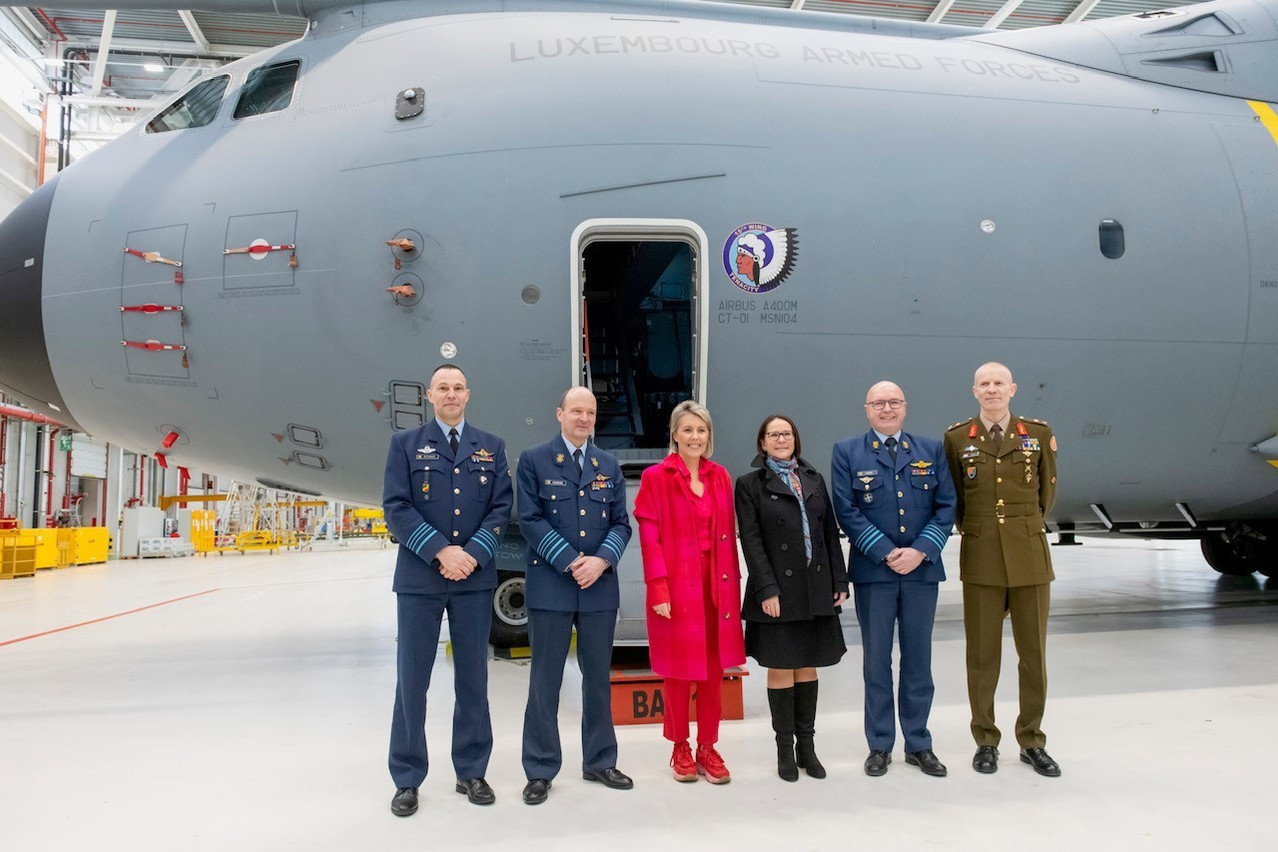
The Belgian defence minister, Ludivine Dedonder, the Luxembourg defence minister, Yuriko Backes (DP), and General Steve Thull, chief of staff of the Luxembourg Army, gathered on 20 February 2024 to welcome the A400M transport aircraft. Photo: SIP
Among the other collaborative projects in which Luxembourg can participate is another transport aircraft, the Airbus A400M, this time integrated into the bi-national Belgian-Luxembourg fleet. The grand duchy also often works closely with Belgium, as demonstrated by the declaration of intent signed in 2022 by the Belgian and Luxembourg defence ministers to create a bi-national reconnaissance battalion based in Arlon.
The problem in space remains the same
Space is also a strategic terrain for military operations, particularly for surveillance and intelligence. Although all EU member states recognise this, it was not until March 2023, with the establishment of the EU Space Strategy, that synergies between space and defence began to develop within the European alliance. The United States had already taken initiatives in this area in 2018, while China was already talking about the need to do so in 2015.
The result? Europe is lagging behind, while the United States remains the undisputed leader in space, both for civilian programmes--such as space exploration, Earth observation and manned space flight--and for defence. By 2022, defence applications will account for around 60% of US space spending, or $37bn, according to Draghi’s report.
Another complication is that of the 6,500 satellites due to be launched worldwide by 2032, only 10% will be European. This figure could fall even further if the EU did not include Luxembourg-based SES, which has a major share of the European satellite market with more than 70 satellites already in orbit.
Read also
While the European space sector is facing a number of problems, such as launchers, the real problem is the same as in defence.
In other words, a lack of investment--between 2020 and 2023, average investment by the EU, ESA and the main European countries amounted to around €2.8bn per year, compared with €7.3bn for the United States and €2.3bn for China--and a lack of collaboration. On their own, the members of the EU cannot compete with the two giants, China and the United States, but together they could, if not surpass, at least compete with these two behemoths.
This article was originally published in French.


