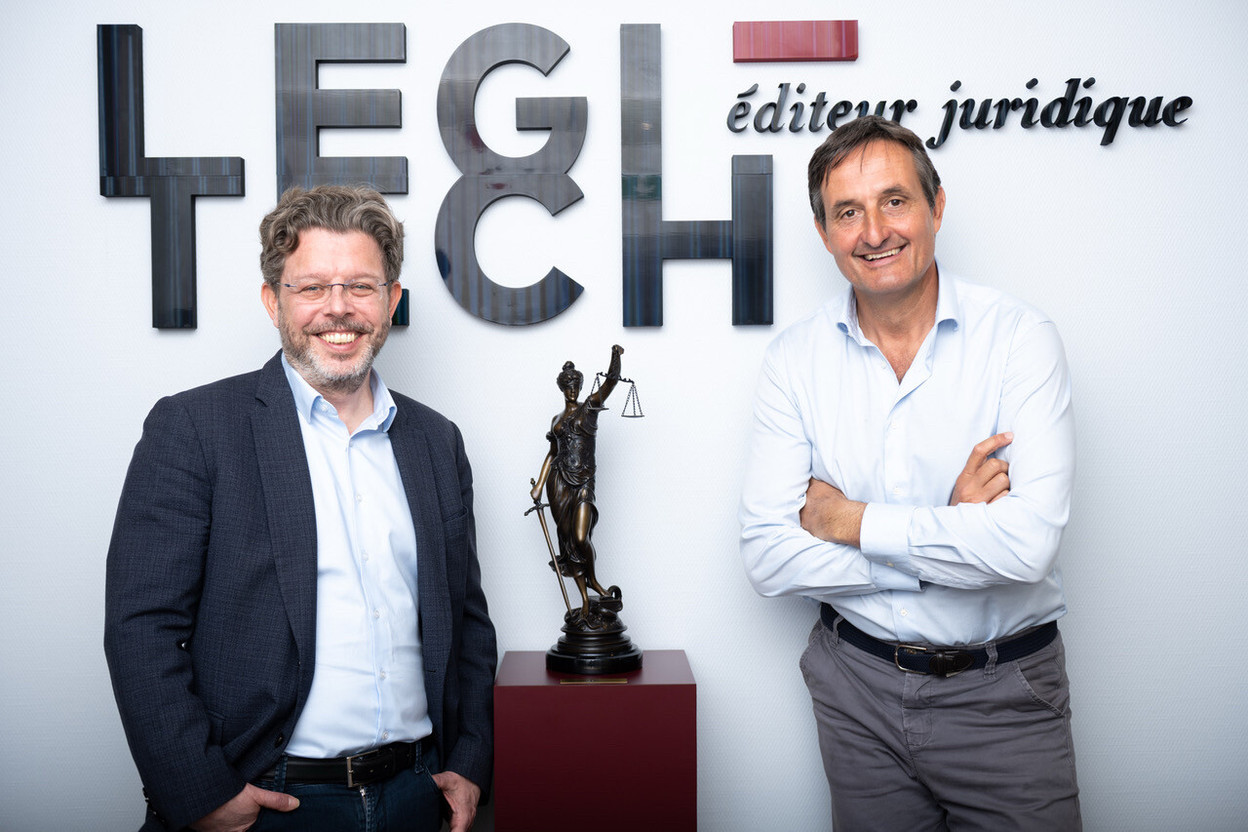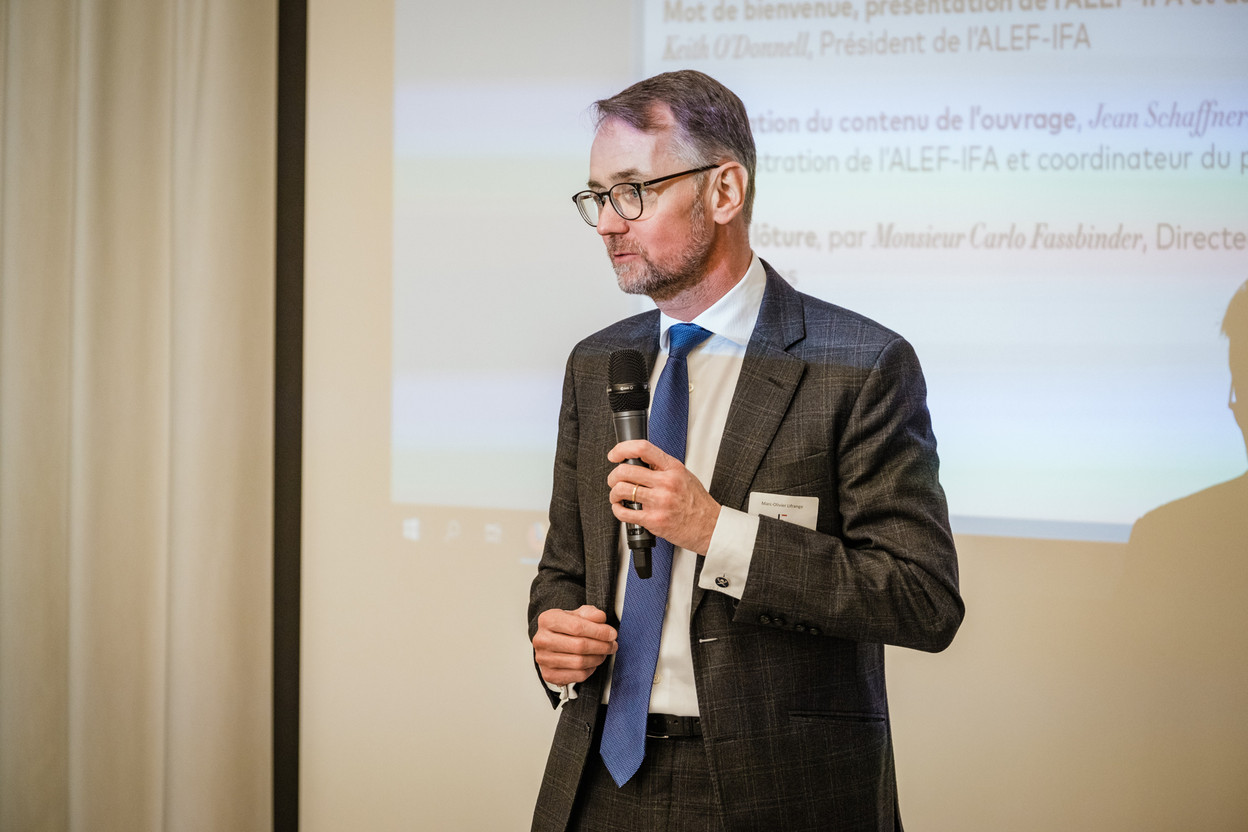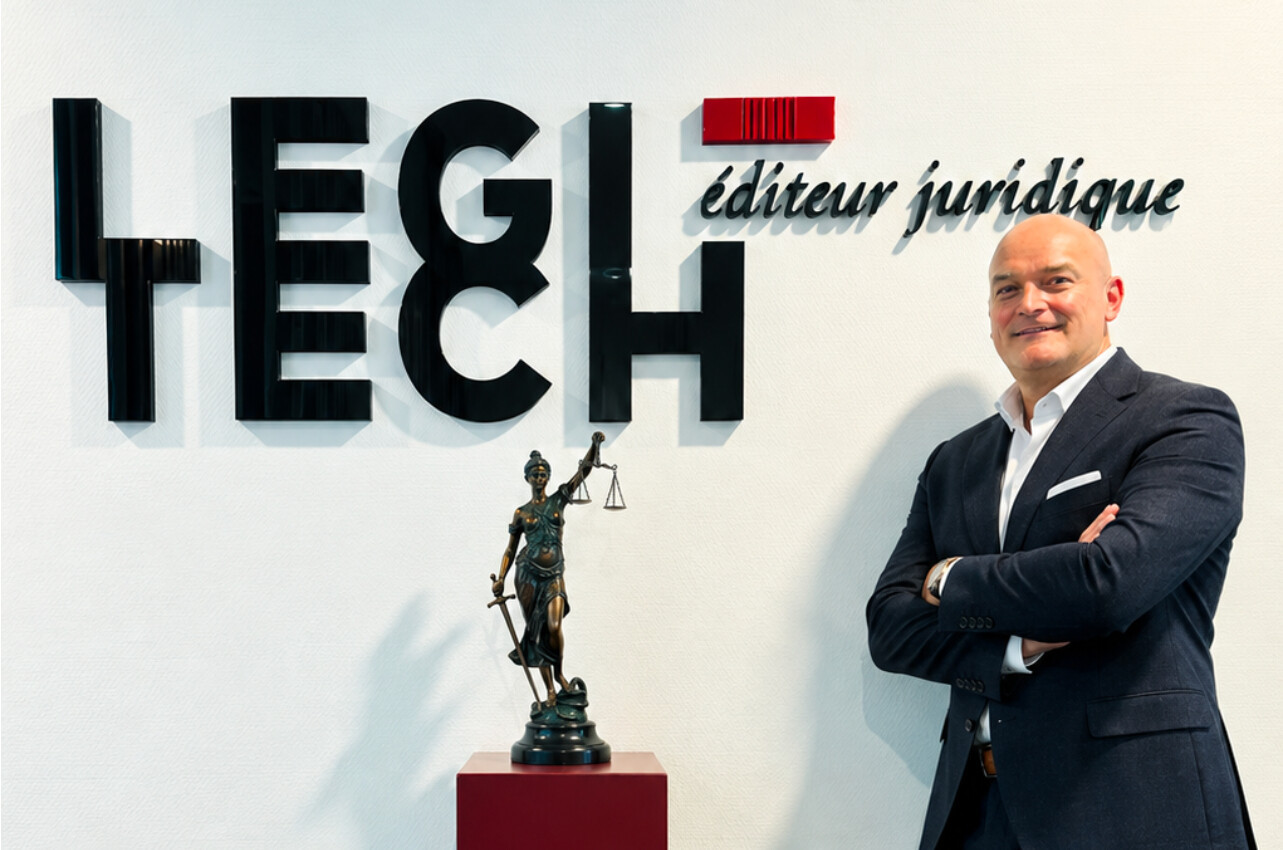
Legitech’s new CEO comes from within the company, but not from the publishing sector. A tax specialist and expert in knowledge management, Dorian Grégoire only joined the company in January 2023. Three years on, he is set to take the helm.
The current chief publishing officer admits that this promotion took him by surprise. “Unexpected? Yes, in a way, it certainly was for me,” he confides. Before joining Legitech, he was head of knowledge at KPMG Luxembourg. It was Marc-Olivier Lifrange who had come to present the publisher’s products to him – as he was a client at the time – who subsequently recruited him. Faced with the suggestion that this was an internal appointment by default, Dorian Grégoire argues, on the contrary, that the choice makes perfect sense. “I know the market, I know Luxembourg, I know the business, I know our products, our clients, our authors and our partners.” Qualifications which, he believes, placed him in a strong position to take the reins of the legal publishing house. “Sometimes, radical changes in direction are needed to breathe new life into a business,” he explains. Or, more directly, to “shake things up”.
Its roadmap can be summed up in a single name: LexNow. The platform brings together legislation, case law, parliamentary documents and legal commentary produced by Legitech. It already incorporates LexGain, its artificial intelligence (AI)-powered search tool. But the future CEO places greater emphasis on the content that feeds this technology than on the AI itself. “If you apply AI to content that hasn’t been verified, that isn’t reliable, the AI is useless,” he states categorically. Legitech claims to set itself apart in this respect: the content integrated into LexNow is checked in-house by professionals, rather than being scraped from public sources and automatically fed into a search-enhanced generation system.
Greater comprehensiveness
However, the database is not yet comprehensive. Dorian Grégoire cites, in particular, health law – a very broad field – as well as European regulations among the areas that still need to be strengthened. The aim for late 2026 and early 2027 will, therefore, be to expand the database without compromising on its verification. Artificial intelligence should also help to speed up this work.
Print will continue to exist, of course, but to a lesser extent. We are clearly moving towards digital.

This drive for comprehensiveness goes hand in hand with a transformation of the publisher’s business model. “Print will continue to exist, of course, but to a lesser extent. We are clearly moving towards digital, towards an all-digital model,” announces the future CEO. Ultimately, a LexNow subscription should provide access not only to legislation and case law, but also to Legitech’s entire body of proprietary legal commentary.
Under the current model, it is still possible to add digital magazines to a subscription separately. Dorian Grégoire wants to gradually replace this à la carte approach with a more integrated offering. Print will therefore not disappear, but it will no longer be the main gateway to the publisher’s publications.
However, simply compiling texts in a database and enabling users to search them will not be enough to set LexNow apart in the long term. Legitech is already working on a new suite of services aimed at legal professionals. The future CEO is keeping quiet about the features in the pipeline, but mentions the possibility for users to add their own documents to the LexNow environment and then make use of them by comparing them with the platform’s legal content.
Three nominations
“We’re not going to become Harvey,” he explains, referring to the US legal AI platform. Legitech wants to maintain its focus on verified Luxembourg-based content, whilst providing tools designed to support professionals in their day-to-day work.
Geographical expansion, however, is not among its immediate priorities. LexNow covers Luxembourg and has a Belgian version providing access to legislation, case law and proprietary legal commentary in that market. Despite the frequent links between Luxembourg, Belgian and French law, an expansion into France “is not currently on the agenda”.
For Dorian Grégoire, the small size of the Luxembourg market is less a weakness than a barrier to entry. He believes that a French or Belgian publisher cannot simply adapt its product for the Grand Duchy. Legitech’s close ties with local authors, trainers and clients should enable it to withstand the consolidation of the sector around more powerful international groups.
My aim is to let others take the lead.
The change of CEO will be accompanied by a reallocation of responsibilities. Three directors are to be appointed on 1 October: Christian Brookman for LexNow and digital content, Dorothée Pirson for publishing and training, and Michaël Tabard for sales and marketing. Dorian Grégoire intends to give them considerable freedom to act. Legitech has around twenty staff members in Luxembourg. The new CEO wants everyone to be able to suggest improvements based on discussions with clients, authors and staff members. “My aim is to let others take the lead,” he explains.
Training, another pillar
Training will form the other pillar of this strategy. Legitech organises more than 100 sessions a year, mainly on tax, company law and employment law. Launched at the end of 2025, the Forma platform brings together recorded sessions and scheduled training courses accessible via subscription. The publisher aims to extend access to small organisations and self-employed professionals.
At the age of 50, Dorian Grégoire is thus taking the helm of a company facing the same challenge as the professional publishing sector as a whole: transforming editorial expertise into digital services without diluting the value of the content. His approach relies less on a race to develop the most powerful AI model than on an asset that is harder to replicate: comprehensive, up-to-date documentation on Luxembourg, verified by specialists.