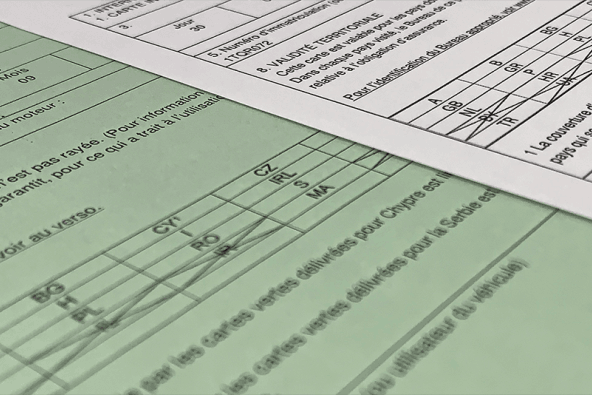
On Friday 28 November, the Government Council of the Grand Duchy of Luxembourg approved the possibility for insurers to issue motor insurance certificates in electronic form from 1 January 2026, in addition to the traditional paper format. This measure also provides for the acceptance by the relevant authorities of dematerialised certificates submitted by national and foreign motorists. The stated aim is to align with international standards and improve interoperability in cross-border traffic, according to the government press release.
In an official statement, the Minister for Mobility and Public Works, 
As a reminder, all vehicles travelling or parked on the public highway are still subject to compulsory third-party motor insurance. The certificate remains a compulsory on-board document that must be produced in the event of an inspection, particularly by the police. The switch to digital technology does not therefore call into question the requirement for immediate proof of insurance, but changes its medium.
In practical terms, this change represents real progress for motorists resident in Luxembourg, particularly in a context of daily cross-border mobility. However, experience in other European countries shows that acceptance of the digital format is not yet completely uniform across the continent. When travelling outside Luxembourg, particularly to countries where legislation or control practices remain more conservative, keeping a paper version remains a common-sense precaution.
From an operational point of view, several situations can complicate the presentation of a dematerialised document: a discharged telephone, technical malfunction, lack of network or reading difficulties during a check. In the event of an accident abroad, the paper format is still the one most universally recognised by the police and insurers.
The government's decision nevertheless marks an important step in the modernisation of the administrative framework relating to motoring in Luxembourg. It brings the country closer to the practices already in force in several European countries and meets a clear expectation on the part of policyholders for simplification. In the short term, the coexistence of the two formats appears to be a pragmatic compromise between digital innovation and legal certainty for road users.