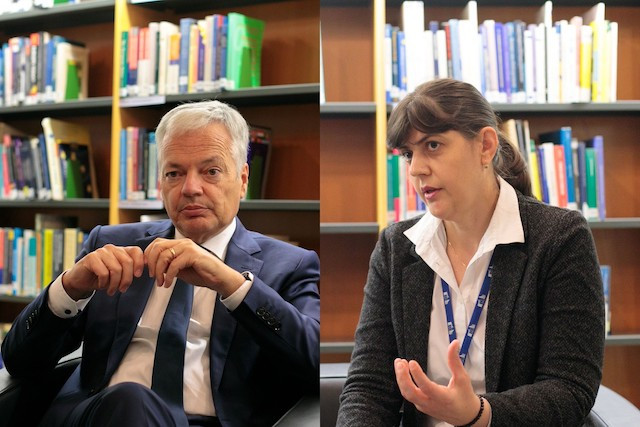
Laura Codruta Kovesi unpacked her boxes this summer... but not for long. Covid-19 means the five floors (eight in the long run) which must accommodate the European Public Prosecutor's Office in the tower B of the door of Europe are not yet ready. The EPPO - in European jargon - has therefore taken up residence in the historic Hemicycle of the European Parliament, in the European Convention Centre, until the end of December, and is using the Schuman building for meetings of the College of Prosecutors.
It was there that Didier Reynders joined the Romanian delegation at the beginning of October for an interview ahead of a Council of Justice Ministers meeting during which he intended to remind member states of their commitments to the EPPO. “I wrote to them again to point out two problems: either delays in the transposition of the directive issued three years ago, or difficulties in the negotiations with the Chief Prosecutor concerning the deputy prosecutors,” the former Belgian foreign minister told Paperjam.
Indeed, it is planned that 140 deputy public prosecutors will be appointed to carry out investigations in each participating member state related to fraud on the EU budget. They will report to the college of 22 European public prosecutors based in Luxembourg around Ms Kovesi. “The 140 delegated prosecutors are a prerequisite for the European Public Prosecutor's Office to get off to the best possible start,” Reynders said.
This additional scope is accompanied by an increase in the budget from €13 to €37 million, which Reynders would like to see further increased to €55 million in view of the task awaiting the new European fraud gendarme. “The college has indicated that the number of staff should be further increased, so I have proposed an additional package. The subject is on the table of the Parliament and the Council. Everything depends on their discussions. I have proposed that we start with €37 million, with an assessment of needs” in the medium term.
“The stakes are huge: with the multiannual financial framework on the table and the NextGeneration EU programme (€750 billion), we will spend more money, faster and with more flexible rules. This means of course that the risks of fraud and abuse will be all the greater. We must be able to start the European Public Prosecutor's Office when the multiannual financial framework comes into force.”
The European Office for Combating Administrative Fraud (Olaf) estimates that in 2019 fraud against the European budget will amount to €500 million per year--although this is only the tip of the iceberg. “The European Public Prosecutor's Office should justify a return effect,” Reynders said. “When you set up an institution, it costs money, but it should allow you to recover the misappropriated sums, largely justifying the initial cost,” he explained. “And I am convinced that the European Public Prosecutor's Office will have a preventive role”, dissuading fraudsters from operating with the risk of being detected.
Behind the figures, an obligation of result and credibility for the new European institution. “The Public Prosecutor's Office must be able to work not only with the 22 member states that participate in it, but also with the others,” Reynders insists, since it will detect criminal operations affecting several member states as well as partner countries. The EPPO must have the means to command respect from its interlocutors.
At its head is a figure in the hunt for corruption. Kovesi has made a name for herself and many enemies in her country, Romania, to the extent that it was Bucharest that was most opposed to her appointment as head of the European Public Prosecutor’s Office. “She comes with her reputation, and this must be reflected in the functioning of the Public Prosecutor's Office,” Reynders said, indicating that he had “full confidence” in her.
When it comes to high ambitions and demand for means, the Commissioner is on the same wavelength as the Chief Prosecutor. Appointed at the end of 2019, after six months of arm wrestling between the European Parliament and the Council, Kovesi has already made herself heard at the beginning of 2020, judging that the staff recruited--25 for human resources, IT and budget, but only four lawyers--would not allow the European Public Prosecutor's Office to carry out its delicate mission. In the corridors of the institutions, it was also said that the location in Luxembourg of the new judicial body dissuaded many Olaf agents from applying for well-known reasons (high cost of living, distance from European decision-making centers).
In the meantime, the head of OPPE has been successful. In addition to the 22 European Public Prosecutors--one per member state participating in EPPO under enhanced cooperation--who surround her in Luxembourg, she has seen her staff grow to 122, with 70 recruitments to be finalised by December. “We have received more than 100 applications for the current recruitment, from Olaf, Eurojust, Europol and also from Member States,” Kovesi says.
Reynders also supported her request for real teams around the deputy prosecutors, while some of them were only assigned on a half-time basis. Hence this armada of 140 deputy prosecutors for whom the requirement is also high. “They must have experience in financial fraud, VAT fraud, cross-border crimes and international cooperation,” Kovesi insisted. “And above all, they must be independent and have great integrity.” Kovesi also oversees the appointment process for deputy prosecutors and its transparency, a guarantee of credibility for her future arms in the member states. “The independence of prosecutors and judges is not a privilege for magistrates, but a fundamental principle of the rule of law. We must prove that the law applies equally to everyone.”
Meeting since the summer, Kovesi and her college of European prosecutors have been working hard on the internal workings of the new institution. Methodology, procedures, everything has to be created. “It's true that it's a challenge to find a common solution when we come from 22 different states with 22 different criminal procedures,” admits Kovesi. “But we face the same problems there as prosecutors. We came up with the best solution to make sure that all the prosecutors are working in the same way.”
Kovesi was finally sworn in at the EU Court of Justice on 28 September. “A very beautiful ceremony, very solemn,” she commented. She said she was “honoured” to be inducted by the Court's judges in the large courtroom veiled in gold, and more determined than ever to obtain the means to achieve her ambitions.
This article was originally published on Paperjam in French.