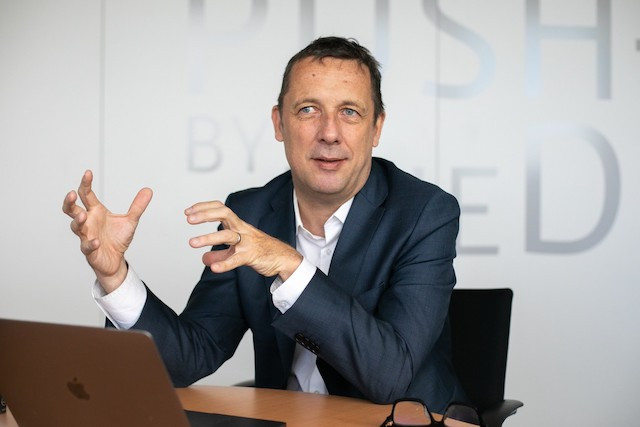
Pierre Pailler: Numerous tracing strategies have accumulated over time in Luxembourg. What are they?
Ulf Nehrbass : First of all, there is the classic screening of people with symptoms. In fact, Luxembourg was already one of the countries that has tested the most in Europe, and I suppose in the world.
At the same time, many additional strategies have started. The 'Con-Vince' study looks at how the virus spreads through the population. It also looks at how immunity is built up and how it is present in the population.
Another study, called 'Predi-Covid', is a clinical investigation that tries to understand why in some patients the disease is so severe, while in others it is not.
Mass screening is a public health measure, different from others. There is no need to have symptoms to come in for testing, because the idea is that covid-19 is specific since an infected person can be completely asymptomatic.
PP: What is the specificity of this virus?
UN: The problem with this virus is that contact tracing is very difficult. When you have a positive case, you have many other infections without symptoms.
For example, with other coronavirus pandemics, such as SARS, the mortality rate, at 10%, is very high, but you become infectious only three days after the onset of symptoms, which are very serious. With MERS, 30% of people die, but you only become infectious when you are almost dead. So, these are very worrying viruses, but in terms of epidemiology, it's very obvious because you can always trace the contacts.
Covid-19 is different. It's highly infectious, yet you have no symptoms. So, the main challenge is managing contact tracing.
PP: How did the idea of this large-scale screening strategy come about?
UN: The idea became clear when we realised that the rate of asymptomatic people was very high among those who were infected. For every person with symptoms, there are between 5 and 10 without symptoms. In addition, the incubation time is extremely long, taking up to two weeks. And it was clear that immunity took a long time to develop, and that an infected person could be re-infected.
So, it was obvious that we had no way to control the situation without including the asymptomatic, because anybody could be infected by an asymptomatic person at any time. That's why the situation became so out-of-control.
So, if you have few people with symptoms, and many asymptomatic people who are infected, then there is only one way to control the situation: you have to test everyone. Hence the strategy of mass screening, which identifies the asymptomatic immediately, then isolates them and breaks the chains of infection.
The question is: who can actually organise this? Very few countries. But Luxembourg can, because it's a very well-organised country, with resources and also small in size.
PP: Putting this strategy into practice is complex. Can you explain it?
UN: We have divided the population into three categories. The first is that of high-risk people, who have a high risk of being infected and of infecting others. These are people who, in their work, have a lot of interaction with others every day, such as in restaurants, hairdressing salons or the police. These people are tested every two weeks, over and over again, so that there is no risk that a chain of infection could appear without our knowledge. Of course, not everyone is going to come back every two weeks. But one out of every two people will go to a testing session every week.
Then there are the occupational sectors, because it is very important for the economy that people can return to work as safely as possible. We then take whole sectors, such as schools or banks. In the banks, for example, there are 60,000 people, which we divide into five groups of more than 10,000 people. They have to be representative: in each bank, in each office, one person in five is tested every week.
And for the rest of the general population, those who do not have a NASS code, these people will also be invited. Within this framework, one person in ten is tested every week in each group.
PP: What is the objective of this strategy?
UN: Imagine, in the banking sector, in your office, where you work: every week at least one in five people goes for testing. What we're actually doing is not testing one country, we're testing cells of five. These are virtual cells because they are statistical. If someone has an infection, how long does it take us to spot it? A week. It's a very tight net that's deployed.
There's no room for the virus to circulate and create a hotspot. Can we stop the infections? No. Can we detect infections early? Yes. So, by doing so, we allow people to continue to live an almost normal life.
Of course, people will continue to be infected individually, so we must continue to wear masks and respect the protective gestures to minimise the risks. But this strategy does not concern individuals; it is an act of solidarity. And if everyone participates, it will keep the country safe.
PP: This screening is voluntary. People are invited but may not come. Do people who are invited come to get tested?
UN: When we started, there were 2,000 people coming for testing every day. Now we are close to 8,000 a day, with a maximum capacity of 20,000 a day. Out of the number of invitations sent out, we are expecting a 50% response rate, which is a good result.
Now we are improving communication and we expect these figures to increase. We are starting an information campaign, we explain more in the invitation letters, we participate in interviews. And what we can see is that participation is already increasing. People are beginning to understand that this is a good thing, that the test, which is done through the throat and not through the nose, is not painful, and that it is very quick.
PP: How long will mass screening continue?
UN: At first, what was announced was that everyone was going to get tested, which was true. But people also understood that everyone was going to be tested within six weeks, which didn't help. Because if you get infected after six weeks, what's the point?
As long as there's a virus, there's no reason to stop. The first phase lasts until the end of July. If we stop at the end of July, the virus doesn't care--it's rather opportunistic. After the end of July, we will have a tool that works for when the second wave comes.
PP: Are you expecting a second wave?
UN: I think that's probably what's going to happen. People are going to go on holiday and then come back. There's going to be more interaction in closed spaces. Our fear diminishes, our ability to be disciplined too, while the virus is still there. It would be very strange if it didn't come back.
Iran has a very bad second wave, worse than the first. In the United States, in some states, it's coming back. In Beijing, there is a second wave. I do not see why, in Luxembourg, we would not have one. But if we have the tools in place, we do not have to be too scared.
PP: Can the screening strategy adapt to an increase in the number of cases?
UN: It will work. If you intercept the virus early enough, if you can track individual contacts, trace them, you can understand and streamline the chain of infection and stay on a containment strategy.
As long as the number of infections is low, the net should not be too tight. If it rises, then it will have to be tightened. It depends on the reproductive rate of the virus, the R-value: if the R-value goes up, then people need to come in for more testing.
If I were to plan a second phase of testing, I would certainly do it at a reasonable rate, 1 in 10, or 1 in 20. But with the ability to go back to 20,000 tests a day if a second wave comes in and it becomes necessary.
It's projected that with mass screening, we can keep a second wave flat. What we need to calculate now is how many tests are needed to keep that curve flat, and how many people need to be in the virtual cells to keep the curve as flat as possible.
This article was translated from a story published on Paperjam.lu