Where do you draw your inspiration, whether you’re composing the dishes for the Paperjam Top 100 gala evening on 10 December, or putting together the menu for Ma Langue Sourit?

But how can you be sure of your own tastes, and therefore that what will please you will also please others?
That’s not the question. I ask myself: what would people not like? If I try something a little more original, with a risk taken with the product, all the staff are invited to try it, from the waiter to the pastry chef. Everyone has a palette in mind. When everyone comes to the unanimous conclusion that it’s great, there’s a 98% chance that it will also appeal to customers. The leap into the unknown is the tricky thing about a menu. But when people come to your place, you tell yourself they’re not closed, they’re open.
So you’re banking on the fact that the customer also has some work to do on their side?
I claim to be a creative chef. Creative, but thoughtful. I don’t want to go too far, I don’t want intellectual cuisine. I’m all about the pleasure of eating, being gourmand, and I want that to be reassuring. However, there needs to be a little thought given to how we feel and what we experience. When they eat a dish, people compare it to other dishes, other experiences or other products. It’s this exchange that interests me. Not technicalities. We don’t care about technicalities. That’s not what I’m here for. I want my dishes to be easy to read. In some restaurants, it can be so complex that when you leave, you don’t even know exactly what you’ve eaten.
This simplicity you speak of, I suppose it’s the hardest thing to achieve...
It’s very hard to make a memorable “simple” dish. Really hard.
You used painting as an example at the beginning, and I’ll continue with literature. Does the fear of the blank page exist in cooking?
Yes, in the same way. Those moments when you can’t do it, when nothing comes out of you. And you don’t know why. To create, you have to be absolutely calm, relaxed and serene. But in this profession, it’s impossible to be serene, it never happens. So you have to create those moments of serenity for yourself.
What do yours look like?
I’ve designed a lot of menus in my car. I live in Belgium, I drive a lot and I listen to a lot of music. Snow Patrol, Stereophonics, but also Gainsbourg, Aznavour... I’m hypersensitive, all music touches me. When I’m at the wheel, I’m focused and nobody disturbs me.
Is a dish created with Stereophonics in mind the same as one created while listening to Gainsbourg?
Probably not. Music takes your imagination away, you let yourself be carried towards something. I compare a plate to a flash of light. I often “see” a dish before I’ve even prepared it. I haven’t eaten it yet, but I can “feel” it. And the day it’s on the plate, it’s exactly what I had in mind. That’s a great feeling.
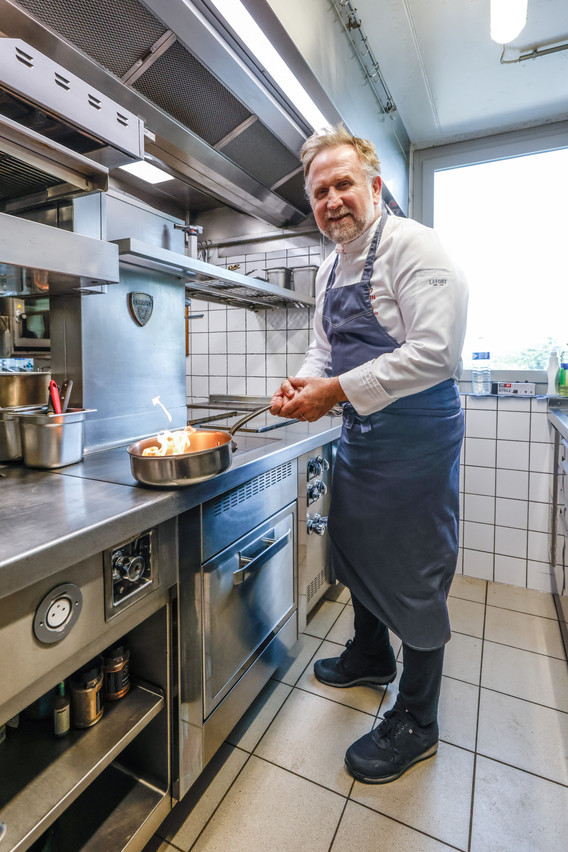
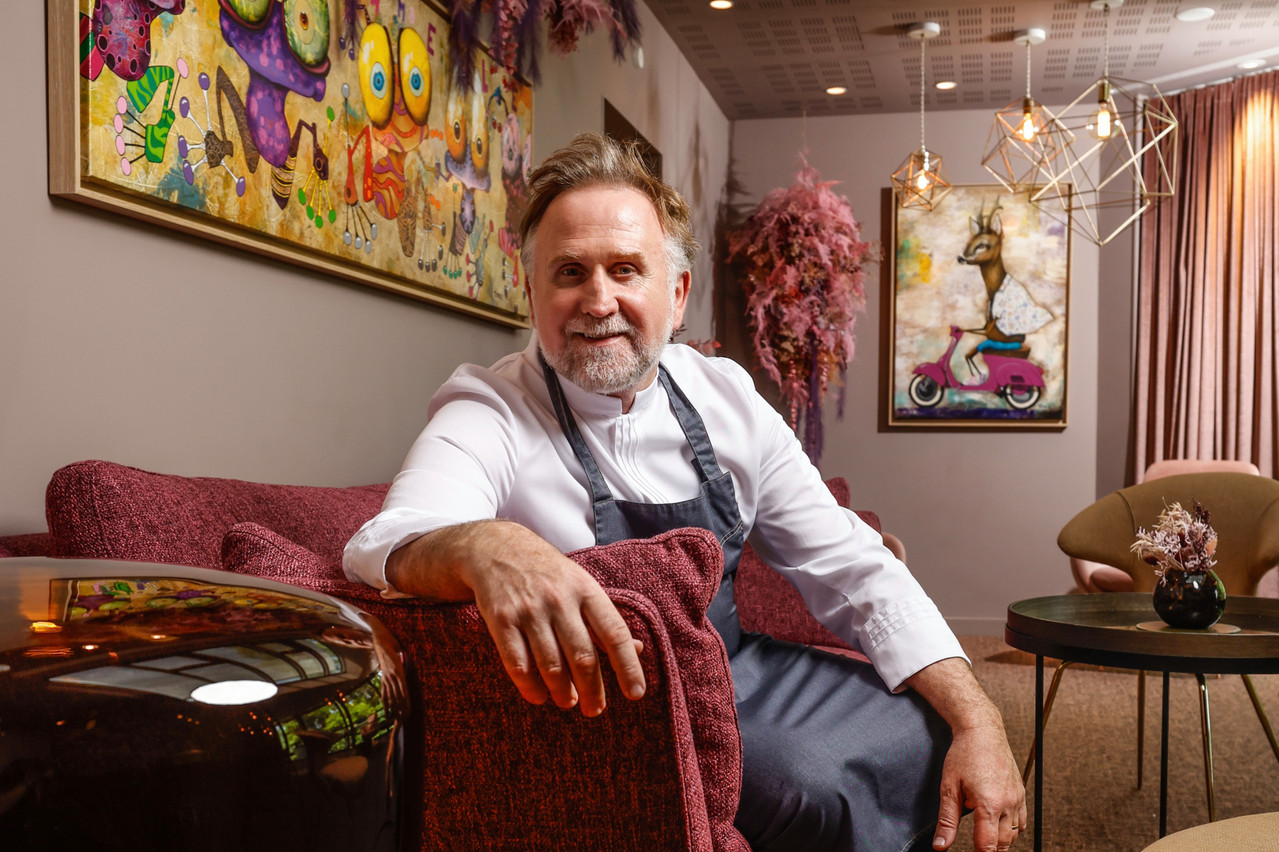
“I see my job as a marathon,” explains Cyril Molard. Photo: Guy Wolff/Maison Moderne
At your level of excellence, are there any dishes that still stand up to you?
There are some dishes that we haven’t managed to put together, but that’s not a worry. If it doesn’t work, it doesn’t work. I work on the principle of progress, without looking back.
How much doubt is there in this job?
I doubt everything. All the way, all the way, all the way... It’s a daily suffering, destructive, because you’re never serene. But it’s what has enabled me to progress since I set up here in Luxembourg. When chef Pierre Gagnaire explains that in the kitchen, doubt is as necessary as good fat, he’s got it right. The idea is to continue to go a little further with the knowledge I’ve built up.
How do you protect yourself from the destructive side you mentioned?
By taking a step back. People expect a lot from you, their coming is a moment of celebration for them. But for you, it’s just an extra service; basically, there's nothing exceptional about it. So, yes, of course there are evenings when I don’t feel like it. But never mind, we have obligations. So you have to be ready, give it your all and be at your best.
What are the pitfalls to avoid in a career?
Self-centredness is one of them. I’m not one of the most media-friendly chefs, but you have to guard against that, because you can quickly go off live. In the kitchen, they call you “chef.” Outside, you’re the “chef.” When a photo is published, it's the “chef's” kitchen... Everything revolves around you, and that can be dangerous.
What do you think about behind a saucepan?
I’m from the Vosges and I love Northern Europe: at times, all I want is silence. A house in the forest where I can be alone. I think about that. I often fish in Belgium, alone, in the middle of nature. I need these moments.
Isn’t this tension linked to the fact that a chef tends to aim for perfection, but that perfection, in the kitchen as elsewhere, doesn’t exist?
Exactly. In a gourmet restaurant, people need to feel that not everything can be perfect, but that there is heart and depth. When customers say that to me, it’s the nicest of compliments.
Do your dishes tell a story about you, Cyril Molard?
I mean it. Because I’m very attached to it, I pay a lot of attention to it. And because I’m present. I go and see people and we talk. I’m not a 2 or 3 star chef who says that gluten-free or lactose-free isn’t possible at home, when asked. With me, everything is possible. I’m a chef, you have to be flexible.
I’ve designed a lot of menus in my car. At the wheel, I’m focused.

Would you compare a service to a sprint or an endurance race?
I see my job as a marathon. I’ve always been a hard worker, moving at my own pace, slowly, without changing course. I’ve never changed course. I followed the advice of great chefs: “Cyril, you follow the direction you want, but never get off the train.” I never got off, and that’s what kept me going.
When did you realise that you had a little something extra?
If I had to make an analogy, I see myself more in the shoes of a Zinédine Zidane, whose talent exploded thanks to hard work, than a Lionel Messi who, from the age of 14, was considered a prodigy. For me, it’s all about hard work, reflection, observation and curiosity. In itself, it’s fairly easy to create a dish. What’s really hard, however, is repetition. Consistency. Being at your best in every match, without slacking off. I’ve worked very hard.
What is your physical discipline?
I get up every day at 7am, and every day I go home at 1:30am... And I've been doing that for 15 years. I know that not everyone can do that. In my case, maybe it’s genetic. My father was a pork butcher. I saw him work like a madman all his life. Of course, sometimes I’m really tired, but this pace has become my habit. I’ve learnt to put up with it.
Where does the pleasure come from?
The pleasure is the team, the great people I work with. I’ve always had teams that are close to me, who are very supportive of my achievements. And then the pleasure comes from the customers for whom... we give pleasure. It’s for them that we work, we can’t forget that.
What would a young Cyril Molard think of the man you’ve become at the age of 54?
Before I bought Ma Langue Sourit, I was at the Royal in Luxembourg. Very young executive chef, car, salary, parking space, 40 cooks, I come when I want, I leave when I want... I was one of the hotel’s executives. A very comfortable position. But it wasn’t my home. And what I wanted, in terms of myself, my family, my mother, my future and my two children, was to be able to look back on something that I had built. I think the kid I was would be proud. He’d even be surprised: the second star, Les Grandes Tables du monde, 18.5 in Gault&Millau... I’d never in my life envisaged anything like that. Everything has come together. I’m proud of it. But I’m also cautious. Because it’s all fleeting.
Would you recommend this profession to your two sons, Jules and Louis?
They are 16 and 19 years old. I’m very close to my boys, and there’s a real closeness between us. They’re proud of what they’ve achieved, but they won’t be doing the same job. They told me so openly. The notion of life is different for them. In the past, it was about working first and then living. Things have changed. Perhaps they’ve already understood certain things that I didn’t understand until later. When I was younger, my parents gave me a lot of freedom. I travelled a lot, I was able to do what I wanted. I was incredibly lucky. I want my sons, in turn, to be free in their choices. Without imposing anything on them. It’s a house that’s firmly in place. When it’s no longer me, it will be someone else, and life will go on.
What would you like people to say about you on the evening of your final service?
That I didn’t get off the train. People may like me, or not like me, but we have to admit that the company has always progressed. A quiet force.
Are you dreading this day?
No, I won’t be unhappy. What I’m experiencing here is an adventure. And Ma Langue Sourit is an exceptional interlude. The staff, the post-covid situation, the finances, the economic situation... It’s very hard, as I said, and I ask myself a million questions every day. But it’s an adventure that will come to an end with no regrets. Let’s talk about sport again. I loved the way a player like Bixente Lizarazu left football. The next day, he was playing another sport and had already turned the page. It’ll be the same for me. I’m not going to wait until I’m 65 to catch the stars. When it stops, it’ll stop cold. I’ll move on to something else. And if possible at my best, like a Zidane. That would be magnificent.
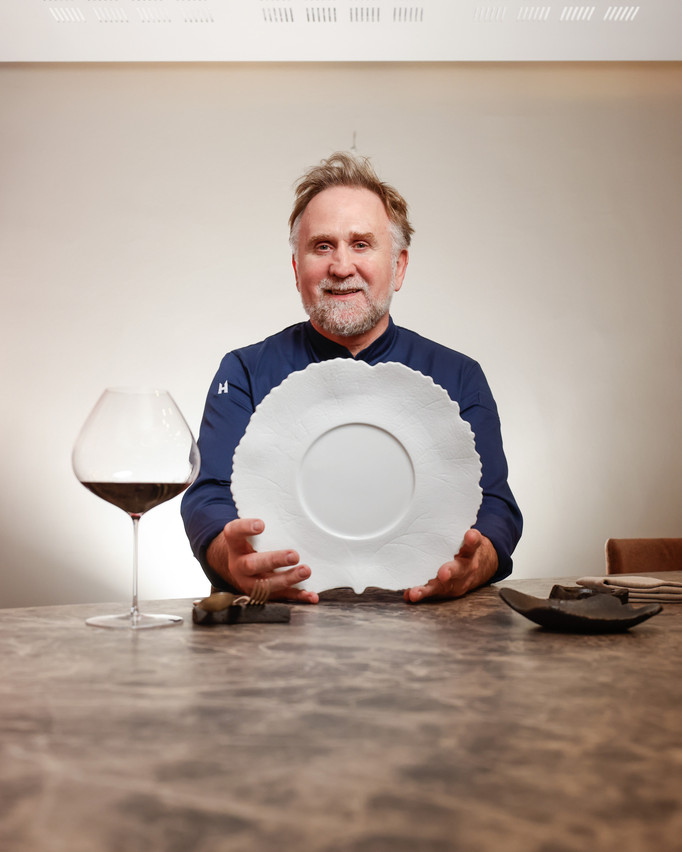
Cyril Molard has two Michelin stars and was voted Chef of the Year in 2020. Photo: Guy Wolff/Maison Moderne
A taste for simplicity
The owner of Ma Langue Sourit is already working on the dish he will serve to guests at the Paperjam Top 100 gala evening in December. Cyril Molard has agreed with Tom Steffen, CEO of the Steffen Group, to work with a Galician veal chuck from “a magnificent farm.” “A noble and interesting product that people don't always know about,” says the chef, who is obsessed by this quest for goodness and beauty. “Cooking isn’t just about caviar, foie gras and turbot. It’s also about taking risks by cooking simple things, or things that seem simple, and demonstrating that with a chuck of lamb, a sardine, a mackerel or a courgette, you can create something top-notch.”
2008
Ma Langue Sourit, which Cyril Molard and his partner Anne-Sophie opened in 2008, was awarded its first Michelin star in its first year of existence, before picking up its second ten years later, in 2018. For 2020, Molard was also voted Gault&Millau Chef of the Year in Luxembourg.
This article was originally written in French for the August and September 2024 edition of Paperjam magazine, published on 9 July. The content is produced exclusively for the magazine. It is published on the website as a contribution to the complete Paperjam archive. Click here to subscribe to the magazine.