The minister for the Environment, 
A wide-ranging programme that benefits from new resources and takes a fresh approach.
This represents an investment of around €92 per person per year.

A further €100m
The government has therefore allocated a budget of €320m for the next five years. This represents an increase of €100m compared with the 2021–2025 period. By way of comparison, the country’s first ICF budget was €120m for the 2014–2020 period.
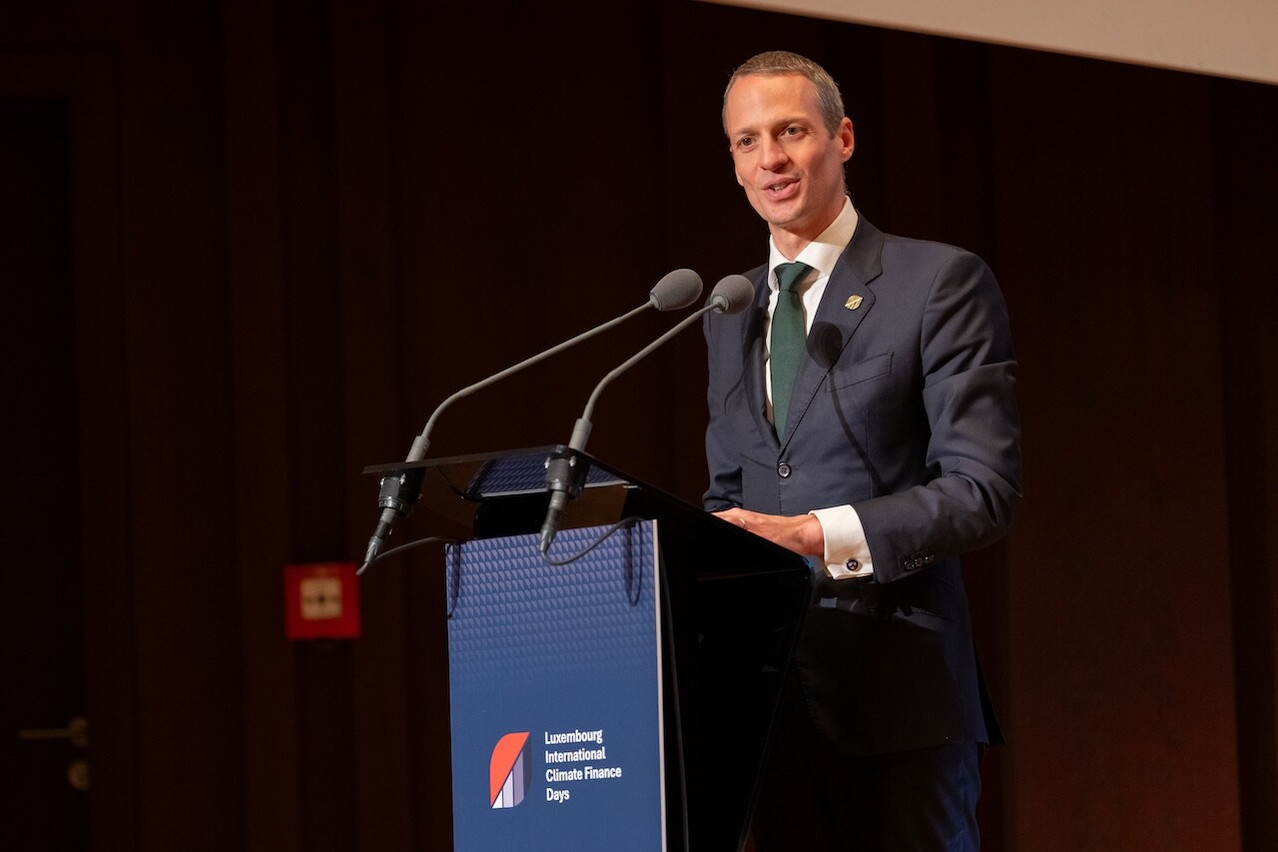
“This represents an investment of around €92 per person per year,” the minister explains. He adds that these funds will be in addition to the traditional development aid budget, rather than replacing it. This funding will be spent through contributions to multilateral funds, global programmes or bilateral programmes.
€320m is both a lot and a little. Especially when you consider that the ICF – a term referring to the public, private and multilateral financial resources mobilised to help developing countries implement mitigation measures (greenhouse gas reduction) and adaptation measures in the face of climate change, and which lies at the heart of global climate negotiations – has set a funding target of $1.8trn per year by 2030.
Engaging the private sector and financial innovation
That is why one of the cornerstones of the programme lies in using the financial market to mobilise private capital. Via the Luxembourg Stock Exchange, of course – “the leading stock exchange for green and sustainable bonds”, as the minister points out – but above all by further developing the platform launched jointly in 2017 with the European Investment Bank (EIB): the Lux-EIB Climate Finance Platform (LCFP). The latter is based on a “blended finance” strategy in which public funds are used to absorb the initial risks (“first loss”) to encourage private investors to commit to climate projects in developing countries.
Since its inception, two agreements have been signed for a total of €70m. These have generated €17.71bn in funding. “That’s a multiplier effect of 353,” explains Serge Wilmes, who hopes to open this platform to other countries “to broaden the donor base”. This expansion will not mean a reduction in the government’s commitments. Whilst the proportion to be allocated from the €320m budget for the LCFP has not yet been finalised, it is expected to remain at least at its current level. “But whatever the commitment of the new donors, our ambitions will not be scaled back,” confirms the minister.
The “Nexus” approach linking biodiversity and land management
In addition to the increase in financial commitments, the strategy’s key innovation lies in the adoption of an integrated approach known as the “Nexus” approach. It involves no longer treating climate change in isolation, but linking it closely to biodiversity and land management. This approach is based on two pillars: the recognition that these issues are interconnected – “biodiversity loss and climate change influence each other; climate change accelerates species extinction, whilst the destruction of nature weakens the planet’s ability to regulate the climate” – and the integration of the three Rio Conventions on climate change, biodiversity and combating desertification.
The aim is to move away from a silo-based management towards a coordinated policy that puts nature at the heart of the process.
“The ‘Nexus’ approach aims to create synergies between the three Rio Conventions: climate, biodiversity and the fight against desertification. The aim is to move away from silo-based management towards a coordinated policy where nature is placed at the heart of interventions,” the minister continued. In short, this approach, when applied to biodiversity, seeks to maximise the impact of investments by funding projects that generate simultaneous benefits for the environment, ecosystems and vulnerable communities.
Priority for vulnerable areas and populations
The strategy maintains a strict 50-50 balance between climate change adaptation and emissions mitigation. It prioritises the least developed countries and small island developing states. The geographical distribution focuses on Africa (accounting for 40% of the credits), with key areas such as Senegal, Benin, Kenya and Rwanda; Asia and the Pacific (20%), including Vietnam, the Philippines and Fiji; and the Latin America and Caribbean region (13% of the funds), notably Costa Rica and Colombia. Serge Wilmes highlights the social aspect, “a crucial aspect”. “Our strategy adopts an inclusive approach targeting the most vulnerable groups, such as women, young people, indigenous peoples and local communities.”
Efficacy measurement included
This new roadmap is designed to be rigorous. To measure the actual impact of its investments under the new FCI strategy, Luxembourg relies on several mechanisms for monitoring, evaluation and scientific guidance. Firstly, the strategy was developed on the basis of a comprehensive external evaluation of the previous period (2021–2024). This task was entrusted to an independent institute based in the Netherlands, Trinomics, “in order to learn from the past and optimise future interventions”.
Funding decisions will be guided by scientific evidence and data.
This strategy is also based on the ‘theory of change’, a methodological framework designed to ensure that each investment is not merely an expense, but actually contributes to systemic and sustainable transformation in the target regions. “Funding decisions will be guided by scientific evidence and data, with the aim of achieving a decarbonised and resilient transition,” the minister assures us. And to guarantee the integrity of the climate impact, clear criteria have been defined to exclude any investment that is not compatible with the strategy’s objectives, such as projects linked to fossil fuels.
Finally, to measure the tangible impact of investments – and to counter any criticism at a time when funding is scarce – the strategy incorporates specific KPIs (Key Performance Indicators) that enable the implementation of projects to be monitored and the results achieved on the ground to be quantified.