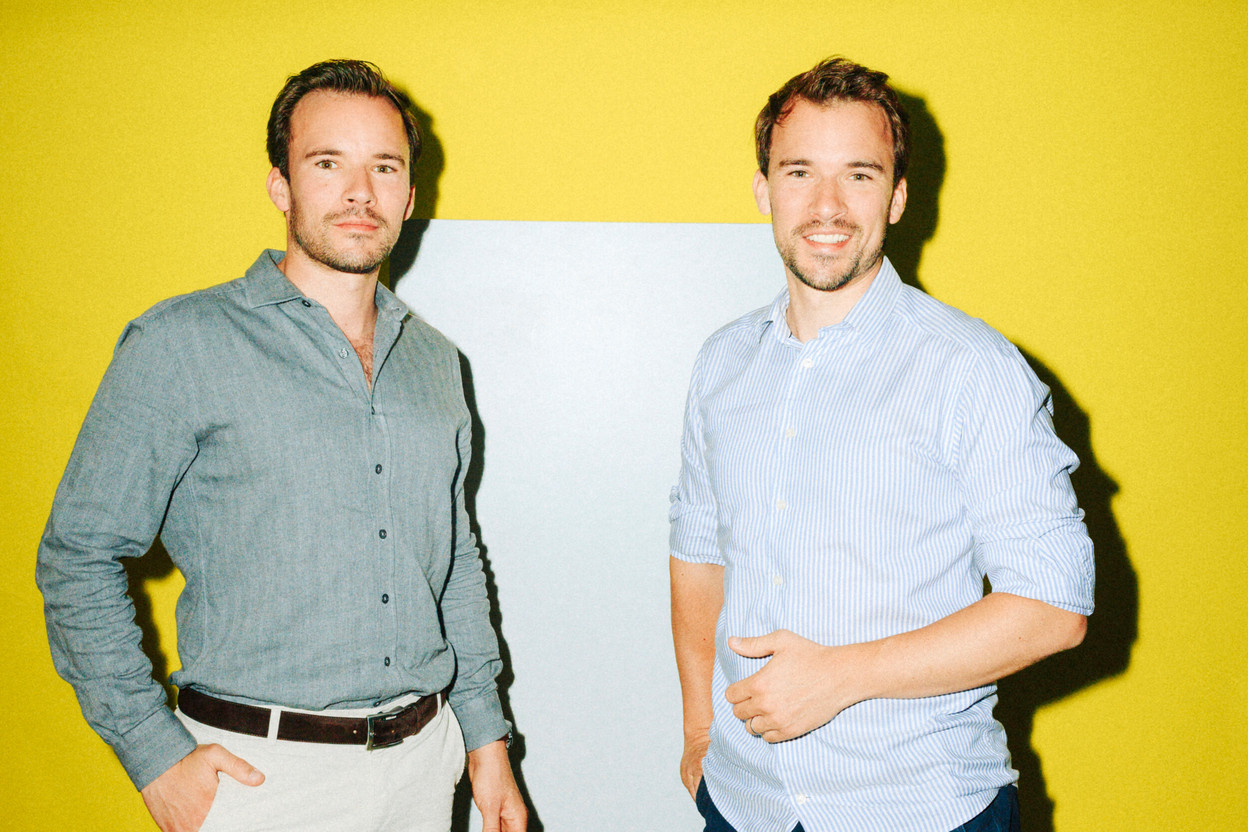
How did your brother Kevin get started, and why did you join him?
Chris Ribeira. – “Kevin set up the company in 2017 and I joined him at the start of 2022. I went into business with my brother. What’s interesting is that we complement each other: he handles all the sales and interior design, whilst I manage the rest, including logistics, human resources, accounting and finance.
What motivated you to join him and go into business with him?
“I wanted to help Kevin grow the business. He’s more of an artist. He’s not really interested in all the paperwork, cash flow or finance. As for me, I have a Master’s degree in finance. I’m more focused on business development and analysis. Before that, I worked in finance. I also set up a company in 2015 specialising in bespoke language training. I’m continuing with that business alongside this one.
Does the family aspect give the business an extra edge?
“Of course. We know why we get up early every morning. Kevin and I rarely work fewer than 12 hours a day, and sometimes at the weekend as well.
Our business is very hands-on. Customers come to us for a new kitchen or a new piece of furniture. We take care of everything, from design to installation by our own joiners. What’s particularly interesting is seeing the project first in 3D, then watching it come to life on site. Customer satisfaction remains our top priority.
You mention 12-hour days: when you’re an entrepreneur, does that necessarily mean you have to stop keeping track of your time?
“You shouldn’t keep track of your hours. There is, however, a certain amount of flexibility. Some days I’m more tired. If I’ve finished what I’d planned, I can go home early or pick up my children.
But, on average, eight hours a day aren’t enough to do a good job. This is particularly true at the start, when you’re starting from scratch. Kevin started in 2017 and I joined him in January 2022. Since then, we’ve grown. Growth like this requires a whole strategy behind the scenes. In particular, we need to think about how to raise the company’s profile. We do a lot of work on social media.
When you set out on your own without coming from a family of entrepreneurs, there are bound to be fears. How do you learn, and how do you keep making progress?
“There are fears, but if you’re going to embark on an endeavour of this sort, you mustn’t be afraid. Otherwise, you won’t go ahead with it.
We learn from our failures. Out of a hundred decisions, ten might not be the right ones. We learn from them and move on. That’s also what’s so interesting about working with Kevin: we complement each other. When one of us is going through a tough patch, the other can give them a boost, and vice versa.
My brother and I never take our holidays at the same time.

We never take our holidays at the same time: one of us is always in the office. For the first three years, when Kevin went on holiday, the business would close for two weeks in August. Nowadays, we’re open all year round, except on Sundays.
Apart from interior design, what other services do you offer?
“Interior design mainly involves fit-out projects. Clients come to us with plans for a flat under construction or wish to renovate a home they have been living in for several years. We take charge of the entire project, from start to finish.
However, bespoke furniture and kitchens account for around 95% of our turnover. These are truly bespoke, from design through to installation. We offer nearly 240 wood finishes. This is what sets us apart from our competitors, as does our responsiveness.
Is there a lot of competition in your sector?
“Yes, even though the last two or three years have been difficult for the market. Interest rates rose sharply, then fell, before rising slightly again. Some competitors have gone out of business.
What are the different roles within the company?
“We have joiners, interior designers and a 3D designer who produces highly detailed models. The team also includes two plasterers and painters who can step in when projects require, for example, the installation of partition walls.
Apart from your responsiveness, what qualities set you apart in a highly competitive market?
“We’re very versatile. In the showroom, interior designers also take on a sales role: they welcome clients and work with them to develop projects.
Languages are also an asset. Some members of the team speak Spanish, Italian, French, Luxembourgish, English or German. And then there are other secrets, but those aren’t obvious.
Are you feeling the effects of the housing crisis in your own life?
“To be honest, not much. We were well prepared. I saw interest rates start to rise in 2021 and 2022. We were planning to take on one or two more people at the time, but I suggested to Kevin that we wait.
We have a good team. I’d rather clients received their project in four months than in two or three, but that we could keep this team together. Our speed remains one of our key strengths: depending on the finish, it usually takes one to two months at most between signing the quote and the installation of a kitchen or a piece of furniture. With many of our competitors, lead times tend to be three, four, five or six months.
Will your profession or line of work change over the next ten years?
“There are two opposing schools of thought. Some believe that everything should be computerised and that we should use headsets to visualise projects in 3D. Honestly, I don’t think this will become the norm over the next ten years.
Our customers are, on average, between 40 and 50 years old. We offer high-end products: they’re not luxury items, but premium products, aimed at those with a certain budget.
I prefer to use AI with a human brain behind it, which remains capable of thinking and exercising control.
The cheapest kitchens we offer cost around €30,000; the most expensive can reach €100,000 or more. We already present all our designs in 3D on a screen. Customers appreciate this technology, but I find it hard to imagine people aged 70 or 75 wearing a headset. Perhaps that will change in 20 years’ time. In my view, human contact will remain essential.
Customers visit the showroom because they want to see and feel the materials.
Do you use artificial intelligence or similar tools?
“Not at the moment. Even our 3D models are created by a designer. It might be a bit more expensive, but I’m not yet fully convinced by artificial intelligence.
At first, tools like ChatGPT are fascinating. As you use them, however, you realise that their answers are not always accurate or verified. I prefer to use AI with a human mind behind it, one that is still capable of thinking and exercising control.
It can save us time, for example when proofreading an email and correcting mistakes. But I don’t really use it to grow the business. That’s my current view.
Beyond the technology, we are hearing more and more that smaller homes need to be built in Luxembourg to meet demand. Is this a trend you are taking into account?
“Of course. Our design and planning department aims to make the most of every space. Many flats have just one bedroom, or are even studio flats measuring 38 or 40 square metres.
For example, we offer fold-away beds fitted with a proper mattress. They fold out and can then be completely tucked away in a cupboard 60 centimetres deep. We sell a lot of them because they save a huge amount of space.
Our bespoke furniture can also extend right up to the ceiling. Even though the highest spaces aren’t intended for everyday items, they do provide extra storage.
In Luxembourg, we don’t really have any other choice anyway. The population will continue to grow. Property prices are stagnating or have fallen slightly, but I think this trend towards more compact homes will continue.
Agility is one of the advantages of small businesses. Conversely, what obstacles or disadvantages are associated with their size?
“First of all, you need to have sufficient capital to finance your working capital. Certain times of the year are quieter, and a crisis can always arise. You need to be on a sound financial footing, and that is something you build up gradually.
In the early years, we weren’t earning huge salaries. When you start out, it’s not necessarily for the money. We try to set aside the profits we make, build up reserves and move forward that way.”
This article was written for the October 2026 issue of Paperjam magazine, published on 16 September. The content is produced exclusively for the magazine. It is published on the site to contribute to Paperjam’s comprehensive archive. Click on this link to subscribe to the magazine.
Is your company a member of the Paperjam Club? You can request a subscription in your name. Please let us know via club@paperjam.lu.