Sylvain Barrette: Is it a good deal?

Europe has a trade surplus on goods with the United States. It is not that we did not have strong points to bring against the United States, but Europe had more to lose in such a bilateral relationship.
Could the EU argue its deficit in the service sector?
Yes, but you need them to be substitutable. However, many of these services are in the technology sector. I think European negotiators made concessions on what was possible and went as far as they could reasonably do.
What are the wins for the EU?
It is undeniably a victory for the United States, and it is reflected in the strengthening of the dollar. It is a victory for transatlantic trading, and Europe must protect its commercial and geopolitical relations.
Will that deal go through in national assemblies, with France, Spain and Hungary giving initial indications that they may reject the deal?
We are used to seeing Hungary being the little stone in the European shoe. Spain already expressed opposition during the recent discussions on Nato [on additional spending], whereas the government in France is confronted with the left, from which it needs support to push forward budget discussion.
For as long as they do not agree on everything, they agree on nothing

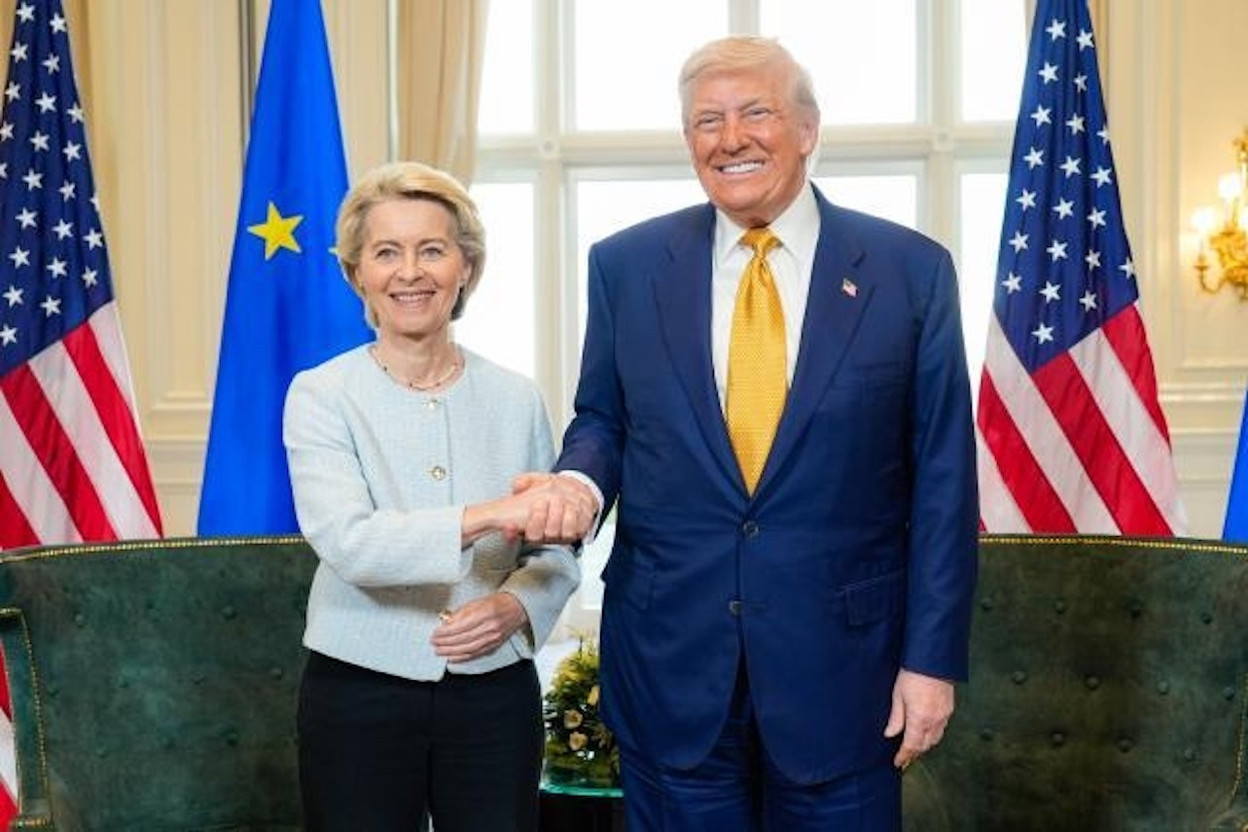
I think that [European Commission president] Ursula von der Leyen went to Scotland with a clear mandate from the member states, and she stayed firmly within that mandate during the negotiations. Consequently, the communications from these various countries are largely about political posturing.
It is certain that the weekend deal will be subject to interpretation, as observed after the deal was announced between Japan and the US. For as long as they do not agree on everything, they agree on nothing. There are still commissions reviewing sector-specific issues. There is an agreement on a general framework, and then obviously there are still ongoing discussions on many important details to integrate the opinion of certain member states.
Will the EU really invest €600bn in the US and buy as much as €750bn in energy products over three years?
I would say that numbers seem significant, but it doesn't seem unrealistic. On energy, it is certain that we have been sourcing more from the United States in recent years. But we obviously continue to be dependent on the Middle East, and even Russia.
It does not seem excessive to rely even more on the US given that they expend their port infrastructures.
According to the Bureau of Economic Analysis in the US, the latter invested $3,974bn in Europe in 2024, whereas Europeans invested $3,642bn in the US. Even under Trump 1.0, European auto manufacturers such as BMW moved some SUV operations to the US, enabling them to avoid tariffs altogether, not counting the tax advantages.
Trump vowed to reduce taxes from 21% to 15% for companies manufacturing products in the US. The contents of the €600bn were unclearly defined. Does that include prior investments? It is likely given the importance of the US economy for European auto, aeronautic and pharma groups, among other industrial industries.
These investments come in addition to domestic investments, particularly in the technology industry, which are already quite significant. So, we have quite significant support from investments in the growth potential of the United States in the coming years.
Interestingly, by forcing his trading partners to adopt appropriate taxation, Trump is paradoxically stimulating investment in the United States in the coming years.