"Payment verification can help reduce transfer errors and some forms of fraud. But as soon as criminals gain access to a customer's bank account or use social engineering techniques, this security measure becomes ineffective", exclaims Paul Gries, director of the Luxembourg Consumers' Union, in a statement issued this Thursday morning, at the time of the launch of the new instant transfer and its verification corollary, which is already giving cause for concern...
In a modern version of the snake biting its own tail, the director of the ULC regrets that customers have been pushed towards e-banking, to the detriment of bank branches, which have closed a lot in recent years in Luxembourg. "It's a reversal of cause and effect", he points out. "In reality, it is the banks themselves who, by imposing high counter charges and doing away with traditional services, are forcing many people to switch to e-banking."
"Older people or those less familiar with technology are actually disadvantaged by the disappearance of traditional banking services," says the statement. "Banking services are a fundamental need. When access to cash or money transfers becomes a luxury, it is a regression in terms of consumer rights and social justice," the ULC director goes on to say, calling for fairer over-the-counter pricing, a stronger physical presence for banks, increased digital security checks and clear regulation.
6.400 cases of bank fraud in 2024
Because the ULC is also attacking LuxTrust, one of Luxembourg's trusted authorities - as they are called to say that consumers can have 100% confidence in the company indirectly controlled by the state. "The abolition of the physical token in favour of the mobile application was presented as a gain in security. However, many consumers feel that cases of fraud have since increased. Consumers' concerns are entirely understandable", he goes on to explain, accusing LuxTrust itself of not setting an example by limiting the password to six to ten characters - letters, numbers, but no special characters - to activate its token. True, but the password is only one part of the security equation... and other cybersecurity experts might argue that it is difficult to remember too many passwords. Not to mention those we store on a piece of paper, on our computer or in our wallet.
"In 2024, the Grand-Ducal Police recorded almost 6,400 cases of fraud in Luxembourg, a figure that continues to rise. Fraudsters are increasingly organised and use sophisticated methods: fake websites imitating those of banks, fake invoices, misleading sponsored links on search engines, SMS messages, phone calls from fake advisers...", said Banque Internationale à Luxembourg at the beginning of September, when it explained the hacking of which it was an unwilling victim at the beginning of the summer, when customers fell into the trap of very well-organised hackers.
Discreet servants of the State have been warning of the situation for months, right up to the High Commission for National Protection, itself under the supervision of the Prime Minister. Some of the documents are edifying about the risks facing some of Luxembourg's best-known retail banks. The banks have also been warned. Our research shows that Spuerkeess, Banque de Luxembourg, Raiffeisen and Post are also the focus of cybercriminals' attention. On the darknet, there are too many opportunities to find potentially sensitive information, and this information is relatively cheap, with some not hesitating to offer 'test offers' before a firmer purchase...
What are we talking about? It is not difficult to find four of the building blocks needed to construct a bank fraud: a fake website and SEO experts to get the distracted or hurried customer to click on the wrong site; a list of bank accounts of almost 200,000 Luxembourg customers and all that is needed; similar devices to bypass LuxTrust's security devices by taking advantage of the credibility of certain customers; and, for example, 'means' to send SMS messages to 'customers'. All for $1,000, often payable in cryptos, for the first three and a little more for the last, which makes sense. Obviously, you need solid and special skills to set up the scam and you also need them for the second part, which consists of collecting the money and redirecting it as quickly as possible away from the authorities. But the presence of such documentation on the darkweb raises questions, at least given the industrialisation of organised crime in this highly lucrative activity.
A technological, financial and even reputational nightmare that the Office of the High Commissioner for National Protection puts into perspective. Asked in another context only about the presence of potentially problematic e-mails and passwords on this hidden part of the Internet, which is heavily monitored by the Computer Emergency Response Team in Luxembourg, including GovCert for the State, the HCPN rightly points out that "it is not uncommon for identifiers (username/password) from vulnerable websites to be found. Faced with this reality, the HCPN wishes to reiterate the importance of implementing appropriate security measures. It is essential, for example, that users adopt separate passwords for each service and, wherever possible, activate two-factor authentication."
"At the same time", it adds, "increased vigilance against phishing campaigns remains essential in order to limit the risks associated with fraudulent access attempts. It is common practice for old data to be reassembled into new compilations and offered for sale on the darknet. However, this information is generally out of date and does not present an immediate risk."
This is both true and false: while it is true that data that is lying around is not always useful, when compiled over time it shows quite easily what we will call the grammar of a user's password. For example, if you always put in the name of your cat and your date of birth thinking you'll get away with it, it will be easier for criminals to try to access more important accounts, which can give them new clues about other passwords.
Two aspects to be reviewed
In the Luxembourg context, there are two aspects that could be reviewed in the short term. Firstly, the awareness campaign launched before the summer by the Minister for the Economy, Lex Delles. "A suspicious link? Don't click. Check. Alert!" doesn't seem to be going down too well. For a psychological reason: if consumers click on a dubious link, it is precisely because they are unaware that the link is dubious.
It would be better to educate them in digital hygiene: don't click on anything of this type, don't reply to text messages or emails on the subject, check the address of their bank carefully if they use the internet or prefer their banking application, where they can activate facial recognition; or even check with the hotline. Banks don't ask their customers for anything in this way.
This is what BeeSecure and others have already been doing for around ten years, but given the acceleration of the problems, it might be time to step up a gear. "Consumers need to stay alert: true safety relies not just on new technologies, but first and foremost on conscious and informed behaviour by everyone," says the ULC in its statement.
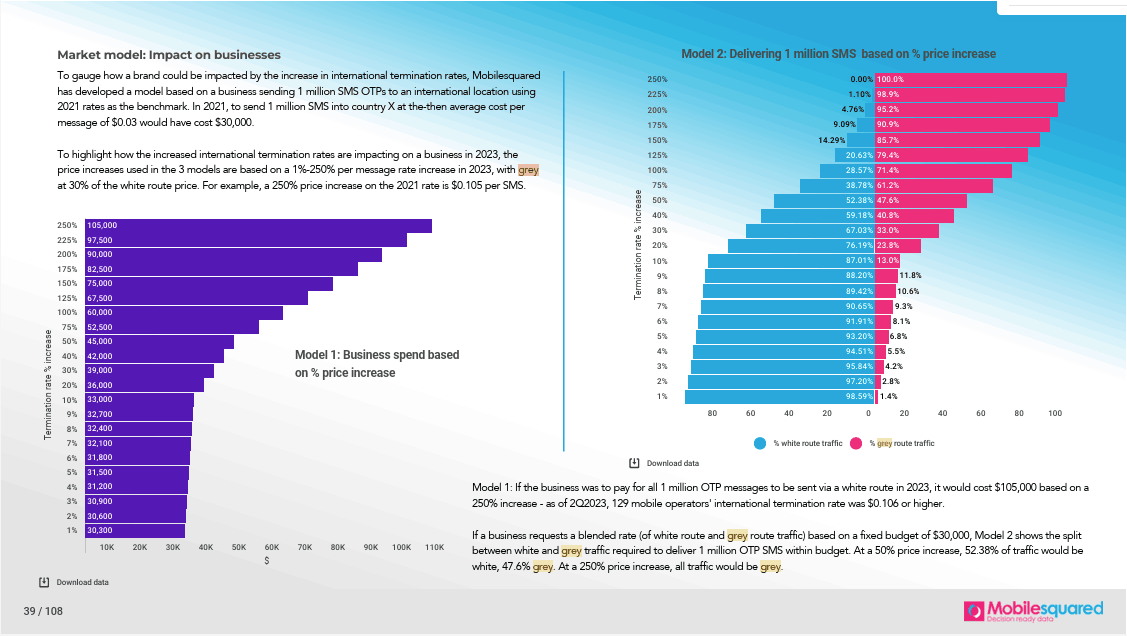
The more national operators raise their tariffs, the more grey roads criminals take. And the greater the risk for the end user. (Screenshot: MobileSquared study).
So how do fraudulent SMS messages get onto Luxembourg smartphones? While there is no doubt that Luxembourg operators are doing their job properly when it comes to routing SMS messages, ill-intentioned criminals may use so-called "grey" routes for all or part of the route between themselves and the bank's end customer, because they rely on operators who are less careful about KYC... and often cheaper than the "serious" operators. While Luxembourg telecoms operators have filters when they notice, for example, that thousands of text messages have the same kind of phrase, there is no register in Luxembourg of unscrupulous operators, who have a 'senderID', an international code, and blocking is done, say two sources, 'manually' and without a harmonised national vision. Not necessarily the most effective...
Especially if we put this in relation to other statistics: for the messaging provider Spryng, 98% of SMS messages are opened within three minutes compared with only 20 to 25% of emails, which are opened without a time limit; 45% of SMS messages receive a reply compared with 5% of emails and 83% of consumers reply within 90 seconds. As far as hackers are concerned, the risk is fairly limited, as long as you keep a close eye on their tracks. Like waves, they come and go on certain forums offering their services and fishing for obscure customers. Almost indifferent to the authorities. And to the penalties that could be imposed on them, if ever...
"In Luxembourg, any attempt at fraudulent intrusion into a computer system - whether that of the State or of a bank - is punishable under Article 509-1 of the Criminal Code", states the Ministry of Justice. "Fraudulent access to or maintenance of all or part of a data processing or transmission system (whether automated or not) is punishable by two months' to two years' imprisonment and/or a fine of 500 to 25,000 euros. If this intrusion results in the modification or deletion of data, or an alteration in the operation of the system, the penalty increases to four months to two years' imprisonment and a fine of between €1,250 and €25,000. These provisions apply to both state systems and those of private institutions such as banks, where the stakes in terms of security and confidentiality are particularly high."
On Monday, we will probably learn a little more when the Prime Minister, L