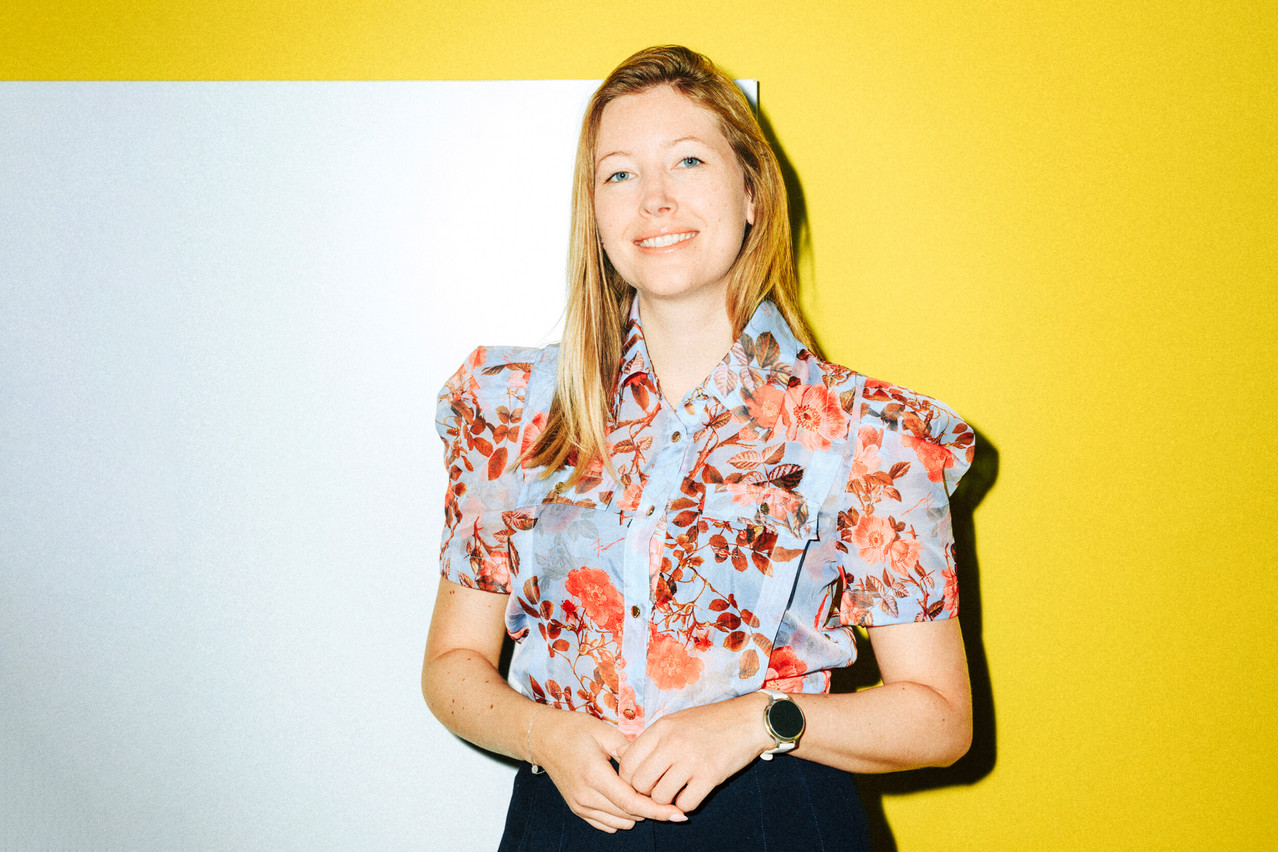
You arrived in Luxembourg in 2017. Had you already been thinking about setting up your own practice?
Aurore Jurga. – “No, that wasn’t necessarily the plan to begin with. I arrived in Luxembourg in 2017 and gradually got to know the country, how it works and the needs that existed in terms of psychological support. The idea of starting a business came later. I wanted to be able to develop my own way of working, but also to build something that could evolve in line with patients’ needs.
Two years later, in 2019, you opened your own practice. Why did you take the plunge?
“I wanted to be independent and to be able to practise my profession according to my own vision. Setting up a practice gives you that freedom, but you also very quickly realise that you don’t just become a psychologist: you become an entrepreneur. You have to manage appointments, admin, communications, finances, and the practice’s growth… These are aspects that our training as psychologists doesn’t necessarily prepare us for.
Being good at your job wasn’t necessarily enough to keep an organisation running.

Have you actually decided to study business management as well?
“Yes, because I realised that being good at your job isn’t necessarily enough to run a business. When you become self-employed, you need to understand how to run a business, how to organise it and how to develop it. This business management course enabled me to acquire skills that I hadn’t learnt during my psychology degree. It is also a way of viewing the practice as a genuine business, whilst, of course, keeping people at the heart of it all.
A few months after your launch, the pandemic turned everything upside down. How did you cope during that time?
“It has been a particularly challenging period, especially for an organisation that had only just got off the ground. Like many entrepreneurs, we had to adapt quickly. But the pandemic has also profoundly changed attitudes towards mental health. People who might never have considered seeking help before have started to talk more openly about their anxiety, isolation or difficulties. The need for psychological support has become much more apparent.
Have you noticed any lasting changes since the Covid pandemic?
“Yes. Mental health is much more of a topic of discussion than it used to be. There are still some taboos, but seeing a psychologist has gradually become more natural for some people.
We see people with a wide range of issues. Some are going through a particularly difficult time, whilst others come because they feel the need to understand themselves better or to work on certain aspects of their lives. Psychology is not just about crisis situations.
In fact, your practice doesn’t just cater for adults, does it?
“No. We support adults, but also children and teenagers. Their needs obviously vary depending on their age and circumstances. That’s also the advantage of having gradually built up a team: it allows us to bring together a range of perspectives and areas of expertise within a single organisation.
Moving from working on my own to being part of a team also changes my role.
There are now four of you who are psychologists. Was that your ambition from the start?
“No. When you set up your own business, you start by simply trying to get it up and running. The practice has grown gradually, in line with needs and demand. Today, there are four of us psychologists, which means the practice can offer a wider range of support than when I was practising on my own.
Moving from working on my own to working as part of a team also changes my role. I’m still a psychologist, but, at the same time, I have to organise and develop the organisation.
Is it actually difficult to balance being a psychologist with being an entrepreneur?
“These are two very different roles. When I’m with a patient, I’m fully focused on my work as a psychologist. But as soon as I’m working on the practice, I have to think like an entrepreneur: organisation, development, the team, investments or new projects. You have to learn to switch between the two. That’s something I’ve discovered through entrepreneurship.
What surprised you most about this adventure?
“Probably everything to do with the profession itself. When you picture the work of a self-employed psychologist, you tend to think mainly of consultations. But running a practice involves many other responsibilities. You have to build a structure that’s strong enough to allow you to then focus on what’s essential: supporting people. It’s another aspect of the profession, but it’s become important to me.
Seeking counselling can also be a form of prevention or a means of self-discovery.
Is mental health still not given sufficient attention in Luxembourg?
“Above all, I think we need to continue to normalise it. Mental health affects everyone, just like physical health. We shouldn’t necessarily wait until we’re in a very difficult situation to look after our mental wellbeing. Seeking counselling can also be a preventative measure or a way of gaining self-insight. Society’s attitudes are changing, but there is still work to be done to ensure that seeking help is no longer seen as a big deal.
What are your plans for the firm at the moment?
“The aim is to continue developing the team’s skills so that we can meet more specific needs. In particular, I would like to build on our expertise in the field of trauma. This is an area that requires specialised skills and for which there is genuine demand.
We would also like to be able to expand the range of languages in which we offer our consultations, particularly to include German and Luxembourgish. In a country as international as Luxembourg, being able to express oneself in one’s own language is particularly important when discussing personal matters.
Would you like to continue expanding the team?
“The aim is not simply to grow for the sake of becoming bigger. Above all, the firm’s development must be meaningful in relation to the needs of the people we support. If new areas of expertise can complement what we currently offer, then that may be worthwhile. What matters is maintaining the quality of our support and that human touch. Even as we expand the organisation, this must remain the priority.
Six years after the firm was founded, how would you describe your role today?
“I am, first and foremost, a psychologist, but entrepreneurship has forced me to broaden the way I think about my profession. Setting up the practice has enabled me to gradually build up an organisation, put together a team and consider how we can meet changing needs.
My aim is to continue along these lines: to develop the practice without losing touch with our patients, and to do our bit to make mental health a topic that people can talk about more freely.”
This article was written for the October 2026 issue of Paperjam magazine, published on 16 September. The content is produced exclusively for the magazine. It is published on the site to contribute to Paperjam’s comprehensive archive. Click on this link to subscribe to the magazine.
Is your company a member of the Paperjam Club? You can apply for a subscription in your name. Please let us know via club@paperjam.lu.