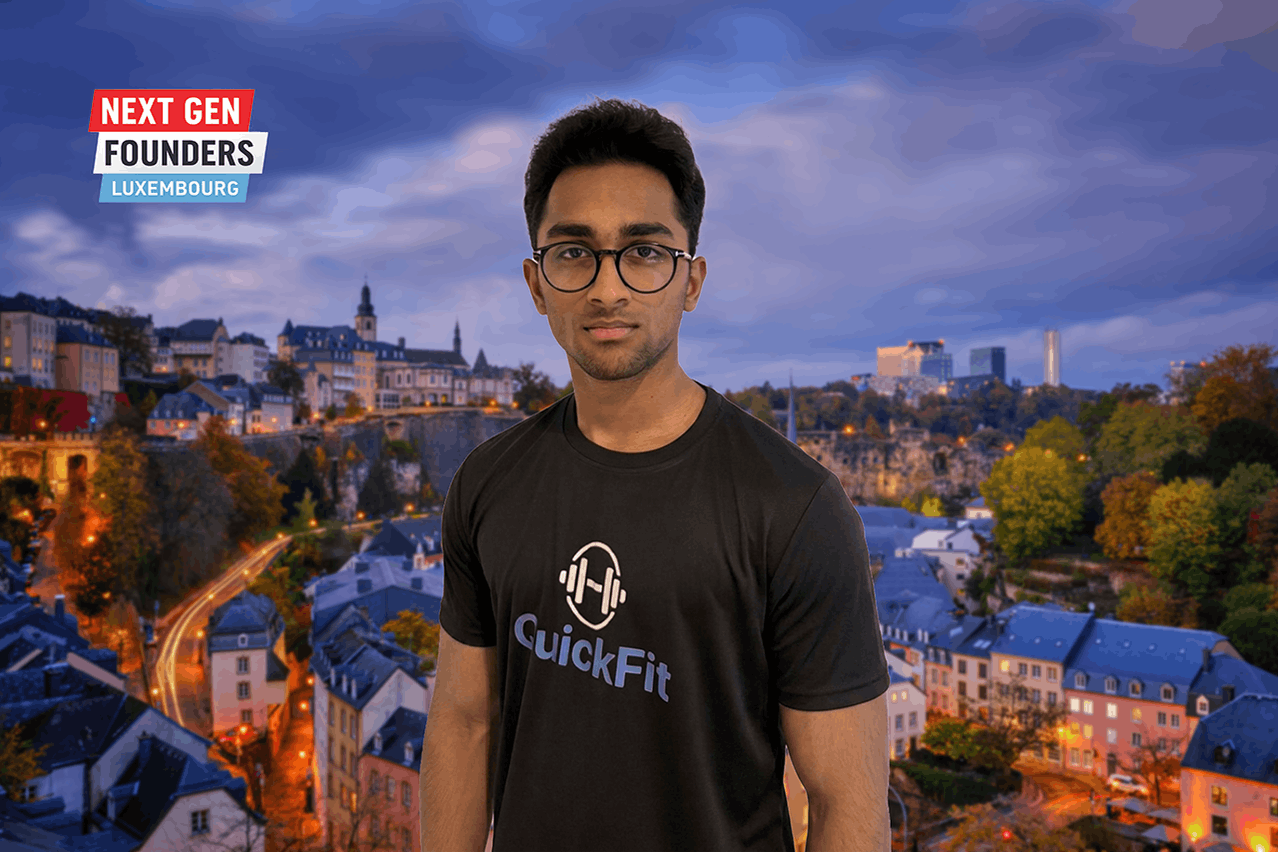
Most 16-year-olds spend their evenings studying, playing sports or scrolling through social media. Vatsal Agarwala spends part of his free time building a fitness platform.
The International School of Luxembourg student launched QuickFit last year, a platform that generates personalised workout and nutrition plans. Available online and, since May, as an Android app, the project has already attracted 205 users from 45 nationalities.
Turning a personal challenge into a project
Agarwala’s journey began when he started working out at the age of 13. Like many beginners, he quickly discovered that getting started was often the hardest part.
“I had to watch a lot of YouTube videos and read a lot of articles,” he says. “I needed to learn how to exercise properly, avoid injuries and understand nutrition. It took a lot of time.”
The more he trained, the more he felt there should be an easier way to access reliable information. Around the same time, he began exploring artificial intelligence through online courses. Initially, the goal was simply to learn a new technology.
Then the two interests collided. “I combined my passion for AI and fitness,” he explains. Last summer, during his school holidays, he started building QuickFit. The objective was straightforward: create a platform that would help beginners avoid the confusion he had experienced himself.
Learning skills that school doesn’t teach
The project forced him to learn far beyond the classroom. “I had to learn everything on my own,” he says. Over several months, Agarwala followed online courses, experimented with AI tools and taught himself how to turn an idea into a functioning product. When technical problems appeared, he searched for solutions wherever he could find them. “When I got stuck, I used AI, watched YouTube videos and kept learning.”
One of the biggest challenges was developing the logic behind the workout and nutrition recommendations. Unlike what many users might assume, most of QuickFit’s workout generation is not simply produced by a chatbot. Instead, the platform relies on a database of exercises and nutritional information combined with filters that adapt recommendations according to a user’s goals, preferences and available time.
The process also taught him an equally important lesson: building a product means listening to users. Feedback from family, friends and early testers helped shape several features, including exercise animations that show users how movements should be performed correctly.
Standing out in a crowded fitness market
Convincing people to try another fitness app is not easy. The market is already crowded with platforms promising faster weight loss, bigger muscles or personalised coaching. “Many fitness apps offer generic plans,” he says. “That can be confusing for beginners.”
QuickFit attempts to simplify the process by collecting information about a user’s goals, dietary preferences and daily routine before generating recommendations. The platform also includes a nutrition planner, an AI-powered food scanner capable of analysing meals from photos and a fitness chatbot.
Most features remain free. Agarwala has introduced a paid option for users who want a fully customised fitness plan created directly by him, and he is already considering additional premium features as the platform grows. For now, however, his focus remains on improving the product and expanding its user base.
Joining Luxembourg’s entrepreneurial ecosystem
QuickFit has also opened doors beyond technology.Earlier this year, Agarwala appeared on Radio ARA’s breakfast show to present the project. Through the International School of Luxembourg, he also became involved with Jonk Entrepreneuren Luxembourg, where he registered his first enterprise project and received an alumni award.
“Being part of Jonk Entrepreneuren helped me gain exposure and meet real founders,” he says. “It’s always valuable to learn from people who have already built something.”
The next milestone is already in sight. Next year, he plans to enter QuickFit into the Mini-Entreprise programme, one of Luxembourg’s best-known entrepreneurship initiatives for secondary school students.
Still learning
For now, however, school remains the priority. “When I don’t have exams, I focus more on QuickFit,” he says. “When exams come up, I focus more on school.” Despite building a platform used by more than 200 people, he remains reluctant to call himself an entrepreneur. ‘I think I have the mindset of an entrepreneur,’ he says. ‘But I still have a lot to learn.’
QuickFit may have started as a solution to a personal problem, but it has also become a practical lesson in product development, artificial intelligence and entrepreneurship. And for Agarwala, the learning curve appears far from over.