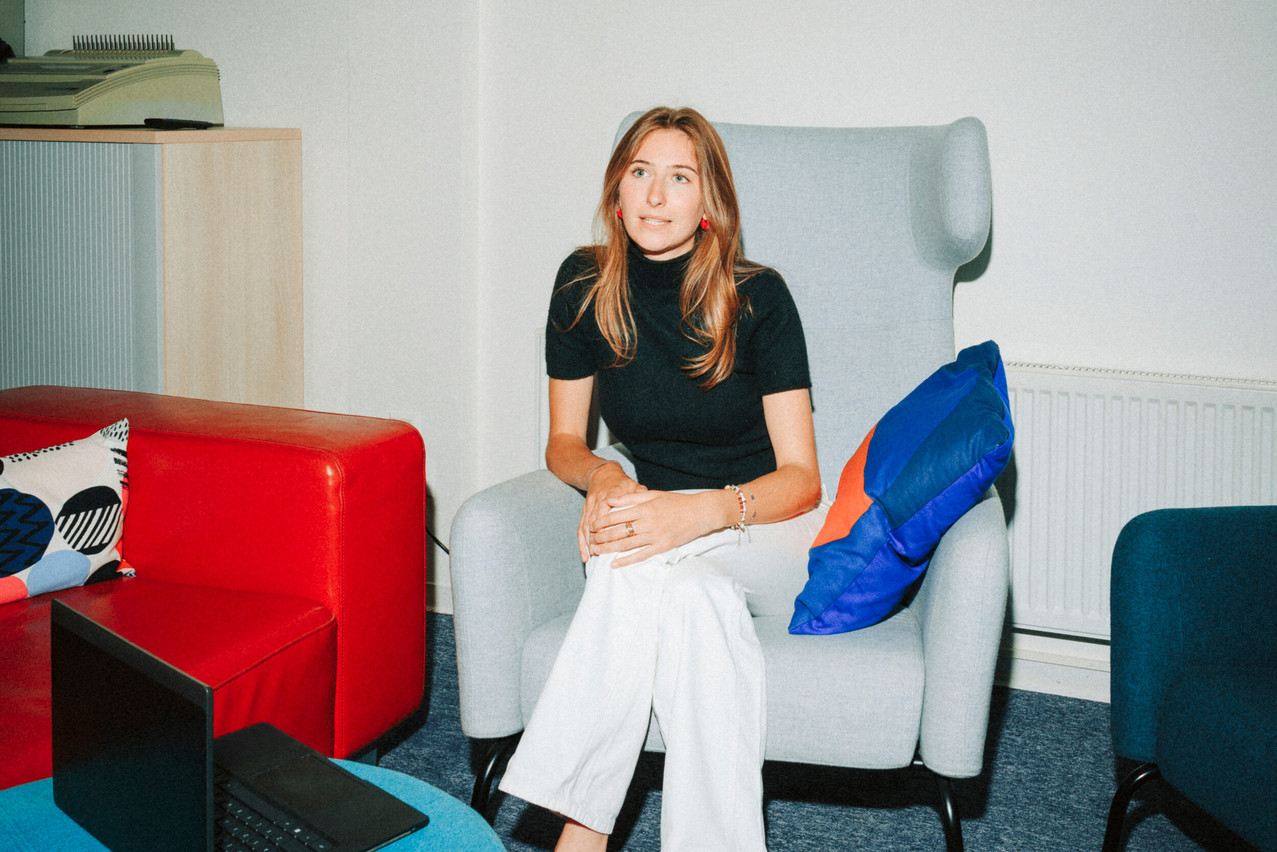
At 24, 
FrëschKëscht was founded in 2019 as part of the mini-company programme. At the time, Offner and her team wanted to build a project “that had meaning,” with a local, ecological and responsible dimension. The concept gradually evolved into curated boxes made up of Luxembourgish products, with the goal of “promoting what we can do here” and making local producers more accessible.
Today, the project has evolved. The team has been streamlined, and the activity refocused into a seasonal offering: end-of-year gift boxes, mainly for companies to offer to employees or partners. In 2025, FrëschKëscht reached its strongest performance yet, with more than 4,600 boxes sold. While now seasonal, the project continues to reflect a clear vision: supporting short supply chains and local know-how.
WeConnect, a concrete response to student housing
WeConnect was launched at the start of her higher education in 2022, following the EuroSkills competition, where Clémentine Offner and her co-founder Ivo Silva represented Luxembourg in entrepreneurship. The challenge—encouraging learning between generations—led to a simple idea: enabling students to live with people who have a spare room, through an intergenerational and intercultural co-living model.
The project is also rooted in a real issue observed early on. “We realised we could offer a solution to the housing problem for young people in Luxembourg,” she explains. Beyond financial barriers, she highlights a structural challenge: without a permanent contract or a traditional profile, accessing housing can be extremely difficult.
Since its launch, WeConnect has facilitated nearly 200 contracts. The goal now is to reach 150 active co-living arrangements by September 2026. To support this growth, the team is developing a more automated and user-friendly platform, while maintaining what they consider essential: “We don’t see ourselves as just a coliving agency, but as something much more human.”
After completing her studies, Clémentine Offner plans to dedicate herself fully to WeConnect to accelerate its development.
Between studies and entrepreneurship
Alongside her projects, Clémentine Offner continues her psychology studies and is currently completing an internship in Greece with an organisation supporting refugees along their migration journey to Europe. It is a demanding experience, requiring both time and emotional investment.
There will always be something to improve, but you also have to dare to act and adjust along the way.

Balancing everything remains challenging. “It’s not always easy,” she admits. Her approach relies on prioritisation, but also teamwork: delegating, adapting and adjusting depending on the period. Some phases are quieter for FrëschKëscht, while others are more intense for WeConnect or her studies. “It’s a constant learning and management process,” she says.
In the long term, her goal is clear: to focus fully on WeConnect and scale the project.
Learning by doing
Looking back, she highlights one key lesson: finding the balance between preparation and action. “There will always be something to improve, something that isn’t perfect,” she notes. Waiting until everything is ready can become a barrier. What matters is taking action—and adapting as you go.
The journey is far from linear. Stress, time constraints, slower progress, negative feedback or partnerships that fall through are all part of the process. “It’s not easy to stay motivated every day,” she says. In those moments, the challenge is to stay committed, even when results are not immediate.
People first
Whether through FrëschKëscht or WeConnect, Clémentine Offner emphasises a people-first approach. The first promotes local producers; the second creates connections between individuals who might never otherwise meet.
It’s not just about the figures; it’s about the quality and the human element behind them.
“It’s not just about the numbers,” she insists. While financial goals matter, they are not the sole driver. For her and her co-founder, what truly matters is “quality” and “the human element behind it”. A way of viewing entrepreneurship not only as a business model, but as a tool for meaningful impact.
This article was written for the May 2026 issue of Paperjam magazine, published on 29 April. The content is produced exclusively for the magazine. It is published on the site to contribute to Paperjam’s comprehensive archive. Click on this link to subscribe to the magazine.
Is your company a member of Club Paperjam? You can request a subscription in your name. Please let us know via club@paperjam.lu.


