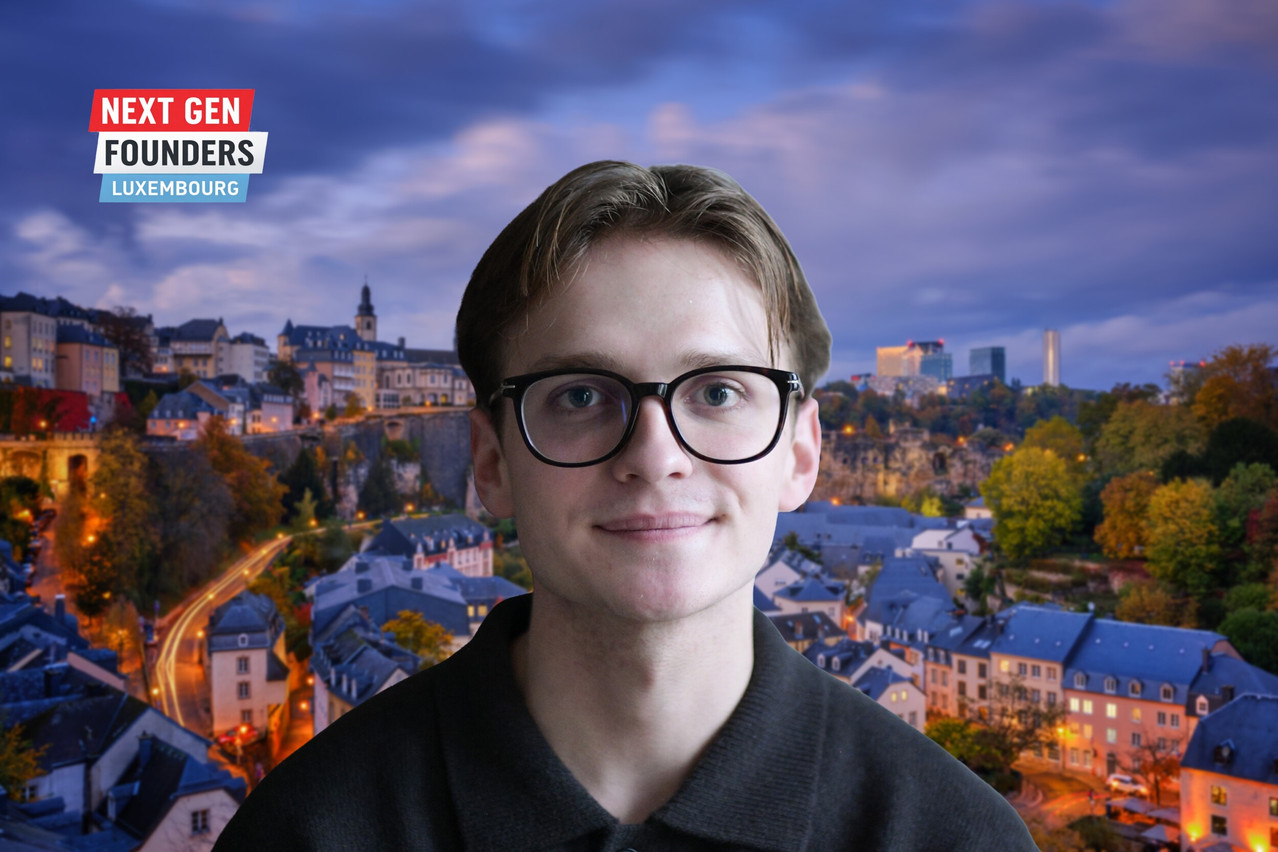
Just four weeks after its first installations, Revive Luxembourg already counts more than 35 partner venues. Bars, restaurants, gyms, museums, nightclubs and events: its charging stations are beginning to appear across the country.
For Antoine Estevez-Nousiainen, this rollout phase is critical. The young entrepreneur estimates that the business will reach break-even at around 100 stations. His personal target is already much higher. “My goal is to reach 200.”
At just 24 years old, he now devotes most of his time to expanding the network. Yet only a few years ago, this was not the path he had imagined for himself.
From Shanghai to Luxembourg
Antoine Estevez-Nousiainen grew up in Luxembourg before joining ESSEC Business School in Paris. He later moved to Madrid for a double degree in business administration before spending time in Brussels. Like many young Luxembourgers who leave the country to study abroad, he initially saw his future elsewhere. “After growing up in Luxembourg, I felt the need to explore other horizons.”
During his studies, he also took his first steps into entrepreneurship by working as a freelance graphic designer. The experience gave him a taste for independence and building projects of his own.
The real turning point came during a trip to Shanghai, where his brother lives. There, he discovered a service that had already become widespread in several Asian cities: self-service portable power banks. Users borrow a power bank from one station, charge their phone and return it at another station within the network. “I realised how powerful the concept becomes once it is widely adopted.”
The idea stayed with him, prompting him to explore how the European market worked. Through his brother, he first met one of Revive’s co-founders in Shanghai before being introduced to Koen Wisse, co-founder of Revive in the Netherlands. The two later met during the Amsterdam Dance Event. As discussions progressed, an opportunity emerged: bringing Revive to Luxembourg. A few months later, Antoine Estevez-Nousiainen returned home to launch Revive on the Luxembourg market.
Building a network
Although the product itself is a portable power bank, Antoine Estevez-Nousiainen believes the real value of Revive Luxembourg lies elsewhere. “The one who is most present is the one who thrives,” he says. For him, the objective is not simply to offer another portable charger, but to build a dense enough network for the service to become genuinely useful. A power bank borrowed at a gym should be returnable at a restaurant, museum or partner festival.
“The idea is that users can travel from point A to point B,” he explains. Rentals start at €2 and can cost up to €8 depending on how long the battery is used. In practice, customers keep a power bank for around one hour, paying an average of €4. Compatible with both USB-C and Lightning devices, each battery can fully charge up to two smartphones before being recharged in roughly one hour once returned to a station.
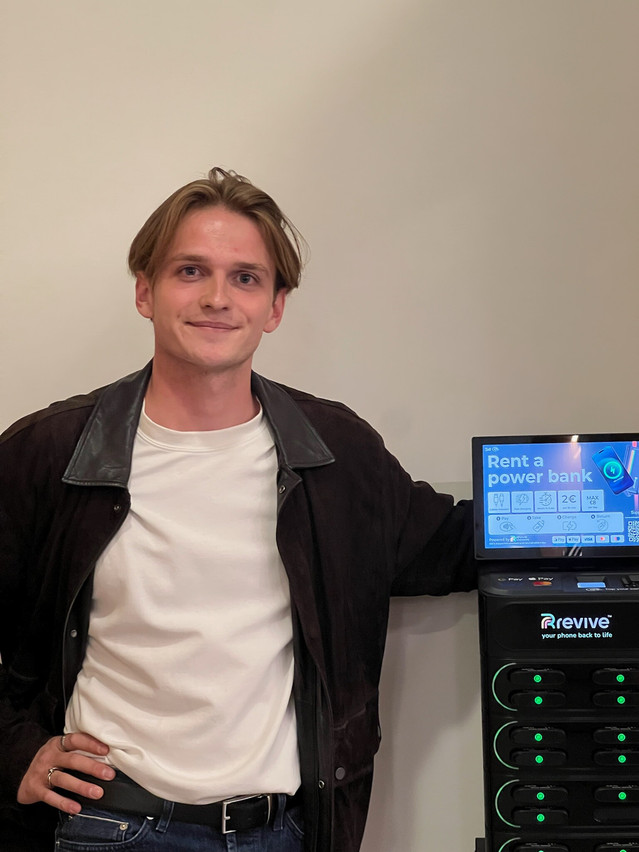
Whether permanently installed at partner venues or set up on an ad hoc basis for events, Revive stations allow you to hire a portable battery from as little as €2 and then return it to any other point in the network. (Photo: Antoine Estevez-Nousiainen)
This network approach explains the speed of the rollout. Revive Luxembourg has already been present at Nexus Luxembourg, the Fête de la Musique and the Francofolies festival. Discussions are already underway with other events in the coming months.
To convince potential partners, Antoine Estevez-Nousiainen relies on a very direct approach. “Most of the time, I carry one of the charging stations with me.” A live demonstration, he says, is often more convincing than a lengthy sales pitch.
A win-win business model
The business model is based on partnerships with the venues hosting the charging stations. Stations can either be installed permanently in partner establishments or temporarily during events. Partners do not need to invest in the equipment. In return, they currently receive 20% of the revenue generated through rentals.
For the founder of Revive Luxembourg, the value goes beyond simply charging a phone. “It is an innovative product that makes a venue even more attractive.” Bars, restaurants and gyms can therefore offer an additional service to customers without significant operational constraints.
This dual value proposition lies at the heart of the project: helping users stay connected while enabling partner venues to offer an additional service to their customers.
The realities of entrepreneurship
Today, the company does not yet pay him a salary. The first installations are still too recent, and expanding the network remains the priority. Supported by his family, Antoine Estevez-Nousiainen prefers to invest his energy in growing the business.
The venture is also a family affair. His two brothers support him in various aspects of the project, particularly financial and strategic matters.
Like many young founders, he is also discovering the sometimes less obvious realities of entrepreneurship. Looking back, he already identifies several mistakes. The first was sometimes assuming that a project would move forward on its own. “I thought that once I had submitted a file, all I had to do was wait.” A lesson that has prompted him to become much more proactive in following up on business opportunities.
The second concerns selecting more suitable tools to better structure Revive Luxembourg's operations as the company continues to grow.
A different view of Luxembourg
Launching Revive Luxembourg has also changed his perception of the country. Returning after several years abroad, Antoine Estevez-Nousiainen discovered a different Luxembourg from the one he had left behind. A Luxembourg where several of his friends had also become entrepreneurs, and where support structures seemed particularly accessible. He specifically highlights the role played by the House of Entrepreneurship during the project's early stages. “You receive support from A to Z.”
Beyond business, returning home has also allowed him to rediscover the country itself. Between installing charging stations, he has taken up climbing, dancing and theatre. Having once believed he knew Luxembourg inside out, he now sees it very differently. “I've discovered incredible people and beautiful places.”
The experience is now feeding his ambitions. Although Revive Luxembourg is still at an early stage, Antoine Estevez-Nousiainen is already looking beyond the country's borders. Once the network reaches 200 stations, he plans to replicate the model in Belgium and France.
For now, however, he continues travelling across Luxembourg, one charging station after another, one partner at a time, convinced that a successful network is built not only through technology, but also through the human relationships that bring it to life.