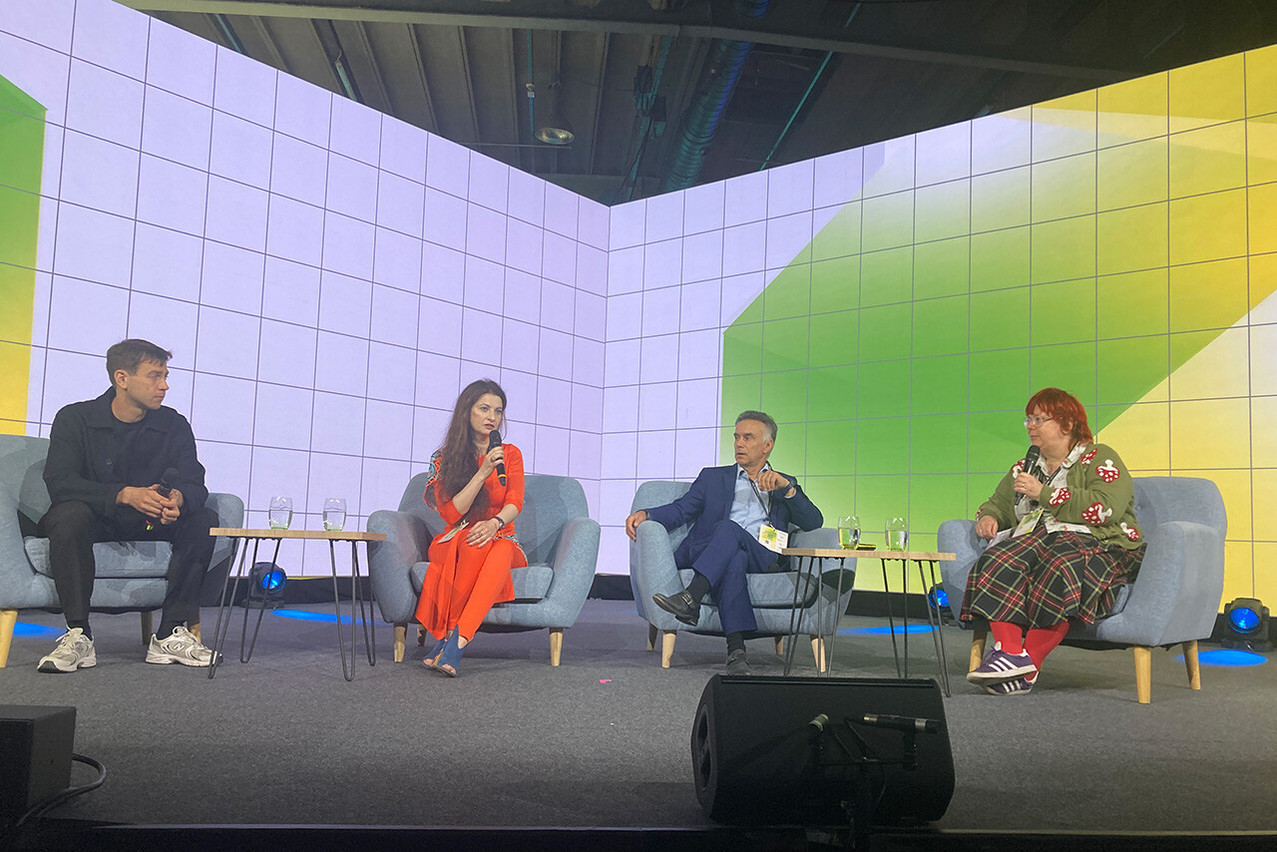
Artificial intelligence has already made its way into European newsrooms, but its integration remains very uneven. Gathering at Nexus Luxembourg on Thursday 11 June for a round-table discussion on the theme “Media in the age of AI: accelerating and automating without losing sight of the essentials”, Tanya Snopko, owner of the Ukrainian media group ekonomika+, Jon Mauno Pettersson, CEO, editor-in-chief and publisher of the Swedish media outlet Breakit, and João Luís de Sousa, director of the Portuguese group Vida Económica, shared their experiences in a discussion moderated by Cate Lawrence, senior journalist at Tech.eu.
For João Luís de Sousa, the advent of AI represents a paradigm shift comparable to that brought about by the internet, with one major difference. “The internet completely changed the distribution of information, but not so much the production of content. Today, AI is revolutionising content creation itself.” In his view, the ability to produce content at virtually no cost calls into question part of the media’s traditional value chain.
However, this technological revolution does not mean the end of the journalist. The Portuguese executive believes that human expertise remains essential for verifying information, providing context and producing long-term analysis. “AI’s short-term answers are not enough,” he sums up. In Sweden, Breakit has already taken several steps forward. Jon Mauno Pettersson explains that AI is used on a daily basis in his newsroom. The tech-focused media outlet relies on various tools for research, text editing and even identifying profiles to follow on LinkedIn. The company is also developing projects to automatically generate articles based on public data about companies.
Practical experience: irreplaceable
“We’re going through a lot of trial and error,” he explains. It’s a pragmatic approach that encourages the editorial team to try out new ways of working without waiting for strict rules to be put in place. At Breakit, some journalists are already using AI to draft the first version of their articles, provided that an editor then approves the content before publication.
The situation is very different in Ukraine. Tanya Snopko admits that she is personally enthusiastic about new technologies, but faces internal resistance. “My editorial team is still afraid that AI will take journalists’ jobs,” she says. The war is also complicating the investments needed to roll out solutions on a large scale.
At present, the use of AI within her media group is largely confined to the sales teams. In the newsrooms, the priority remains covering the conflict. For her, the experience gained on the ground remains irreplaceable. “People trust people,” confirms Cate Lawrence. A report produced from the heart of the fighting retains a value that AI cannot replicate.
The risk of standardising content
The issue of trust was a central theme in the discussions. All speakers highlighted the current limitations of generative models, particularly their tendency to produce errors or fabricated information. Tanya Snopko is particularly cautious: “I don’t think AI helps us with fact-checking at the moment. It still makes a lot of mistakes.”
João Luís de Sousa shares this concern. Beyond the risk of error, he fears a gradual erosion of the diversity of viewpoints. In his view, the internet had made it possible to increase the number of voices and content creators. AI could have the opposite effect by concentrating information sources and homogenising content. “Human intervention remains necessary to avoid this risk.” The adoption of AI is also changing the profiles sought after in newsrooms. Tanya Snopko says she now favours candidates who are proficient in as many technological tools as possible. The same is true at Breakit, where curiosity about new technologies has become an important recruitment criterion.
Economic pressure
The media must also contend with another consequence of the rise of AI: changing reader behaviour. Jon Mauno Pettersson is already seeing the first effects of AI-generated summaries in Google’s search results. For now, the impact remains limited thanks to the loyalty of its audience and the production of exclusive content, but he expects to see new media products emerge that rely entirely on artificial intelligence.
Economic pressures are another obstacle. Tanya Snopko points out that the investment required to integrate AI across an entire organisation remains substantial. In a Ukrainian advertising market weakened by the war, there is little room for manoeuvre. “We don’t really have a choice. We’ll have to do it. The question is how quickly we’ll find the means to roll it out.”
The speakers finally touched on the explosion of AI-generated content in media relations. All noted an increase in the number of press releases and media requests drafted using generative tools. For Jon Mauno Pettersson, this development is not necessarily a problem, but it does underscore the importance of human relationships. “If you want to catch a journalist’s attention, it’s better to build a relationship than simply send an AI-generated press release.”


