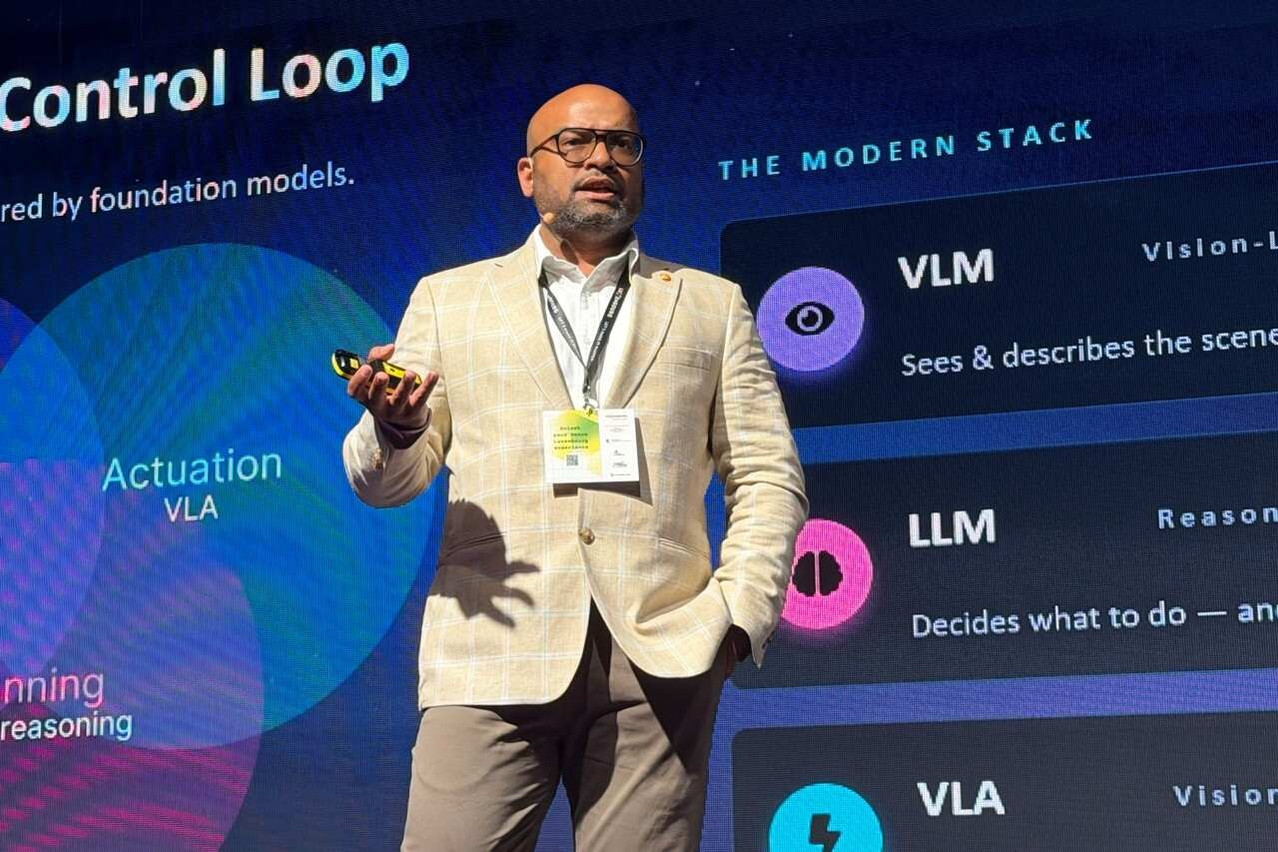
Speaking at Nexus Luxembourg 2026, Fujitsu senior AI leader Aditya Raj described today’s AI as “the brain that is trapped behind the screens.” His argument: AI has spent three years becoming extraordinarily intelligent and physically inert. It reasons, generates, translates. But it doesn’t make anything, move anything, or care for anyone. Yet, that is where real economic value is created: in factories, logistics, healthcare. Physical AI is the moment when the brain gets a body. It rests on four pillars (perception, prediction, action and coordination between humans and machines) and on a fundamental shift in the robotic control loop. The loop itself is not new, but the brain running it is. Three models now converge to power it: the VLM (Vision-Language Model), which sees and describes the environment; the LLM, which reasons and plans; and the VLA (Vision-Language-Action), which translates intent into motor commands. “Same loop. Same goal. New brain.”
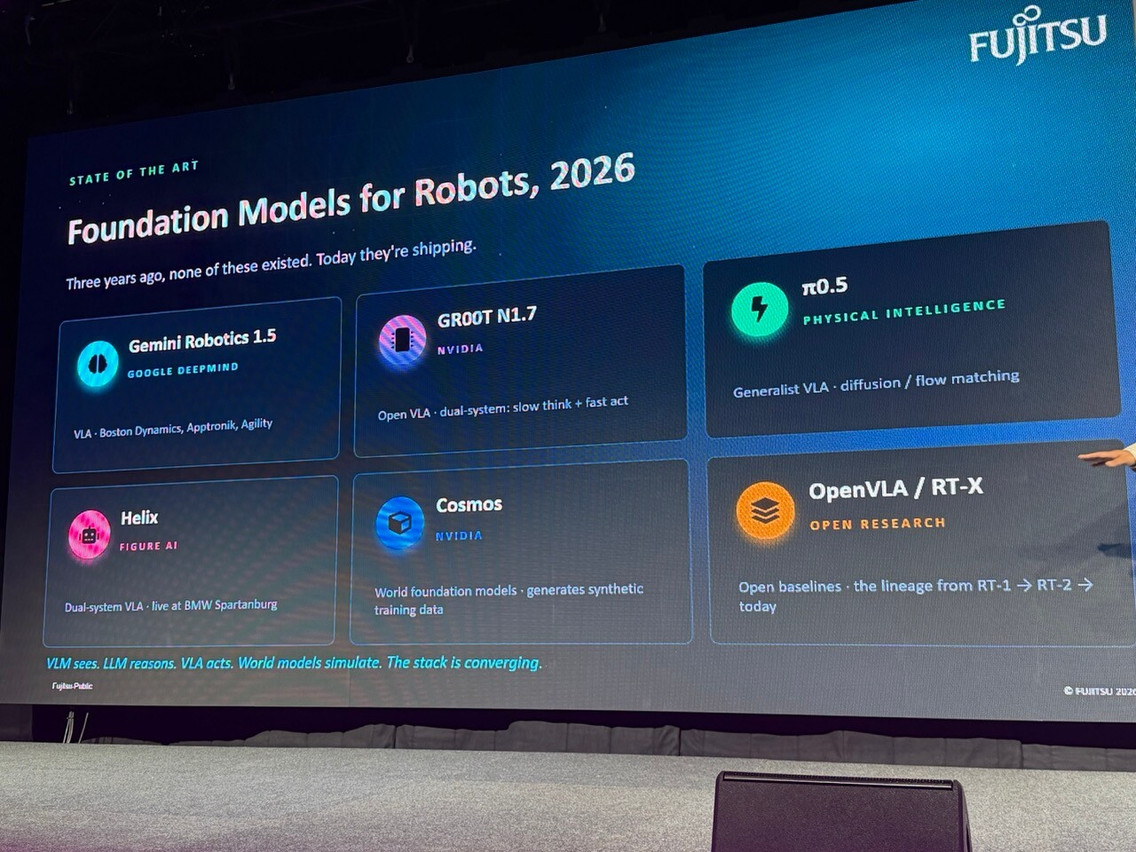
Foundation models for robots already shipping in 2026, according to Fujitsu. (Photo: Paperjam)
The ecosystem is already here
This is not a vision of the future and Aditya Raj made a point of proving it. A single slide mapped the foundation models for robots already shipping in 2026: Gemini Robotics 1.5 from Google DeepMind, integrated with Boston Dynamics and Agility; Helix from Figure AI, live on the BMW Spartanburg production floor; GR00T N1.7 and Cosmos from NVIDIA; π0.5 from Physical Intelligence; and the open-source OpenVLA/RT-X lineage. “Three years ago, none of these existed. Today they’re shipping.” The stack, as his slide put it, is converging: “VLM sees. LLM reasons. VLA acts. World models simulate.”
Products are made, goods are moved, care is delivered.

Fujitsu’s answer to this moment is Kozuchi Physical OS – described as an operating system for the real world, orchestrating robots, sensors, systems and spaces, with data sovereignty and safety built in. It combines a core AI development platform, a multi-agent orchestration layer, and a cloud-to-edge stack. The pitch is direct: “Business intent in. Coordinated real-world action out.” To back it up, Fujitsu has opened a physical AI research center at Carnegie Mellon and built partnerships with Nvidia, Kawasaki, Microsoft and Analog Devices. “We walk the talk,” Raj said. “It’s happening now.”