“My dearest Guy,
We exchanged few letters, preferring direct conversations and private dialogues. But you see, today my voice would be disturbed by my grief, constrained by my emotion, broken by irrepressible sobs. So let’s give way to an exchange of letters...
In the last few days, when I’ve been asked by so many people to remember you, I’ve asked myself a few essential questions. What differentiated your career, your character, your personality, from those of other friends I’ve cherished in my life? What made you unique, fascinating and so endearing? I’m not talking about your culture, your kindness or your integrity, qualities that are rare but not unique. I’m talking about unique characteristics that set you apart from everyone else.
So I went looking, because there had to be a miracle for you to be so unanimously admired, so highly regarded, so respected and loved.
During the long years of our friendship, but also of our professional collaboration, I have never seen you get angry, raise your voice, get upset, bang the table or even frown. You never did. And yet you weren’t a yes-man, an obsessive consensus-builder, a man prepared to abandon his principles or give in to some convenient opportunism.
But even before you tried to convince an opponent, you listened patiently, without interrupting, with infinite benevolence, trying to see if you could find reasons to agree with him.
Even when faced with the absurd, the height of stupidity, the unjust or the unbearable, when I was boiling over and letting my murderous impulses show, you kept an unimaginable composure. Oh, you didn’t think any less of me, you didn’t renounce your convictions, but you exemplified the very first facet of your rich personality: tolerance.
An infinite tolerance towards ideas, attitudes, approaches, itineraries, mistakes, wanderings, drifts... A tolerance that naturally accompanied your overwhelming empathy. An infinite tolerance generated by an empathy that never failed you.
For you, other people were not hell; other people were the possibility of harmony, and therefore of heaven. You accepted others, helped them, supported them... you gave to them without expecting anything in return.
Yet you didn’t see yourself as a secular saint, just an honest man. Whether it was your countless commitments to charitable causes or your voluntary chairmanships of cultural associations, your participation in charitable initiatives or your gracious contributions to memorial undertakings... your time, your talents, your experience, your know-how... you offered all this to others without counting the cost. To others, those fellow human beings whom you liked to hope, without any guilty naivety, would end up being worthwhile.
There’s no need to look elsewhere for the motivations that led you to be an exemplary senior civil servant, an outstanding diplomat, an extraordinary chairman of the board, a popular non-profit organisation leader…
Your mission was to serve others. To serve the community, the administration, the nation... With incomparable modesty, humility and discretion.
In your official biographies, we can count your international decorations. Not the least of them. Medals that others would have arrogantly flaunted. Awards that many would have claimed with pride. You didn’t hide them, nor did you despise them. You were grateful to those who wanted to distinguish you.
Grand Officer of the Order of Adolphe de Nassau, Grand Officer of the Order of the Oak Crown, Grand Officer of the Legion of Honour, Grand Cross of the Order of the Crown, Grand Cross of the Order of Leopold II, Knight iure sanguinis of the Sacred and Military Constantinian Order of St George, Honorary Doctor of Humanities from Miami University, Oxford, Ohio (USA). The list goes on.
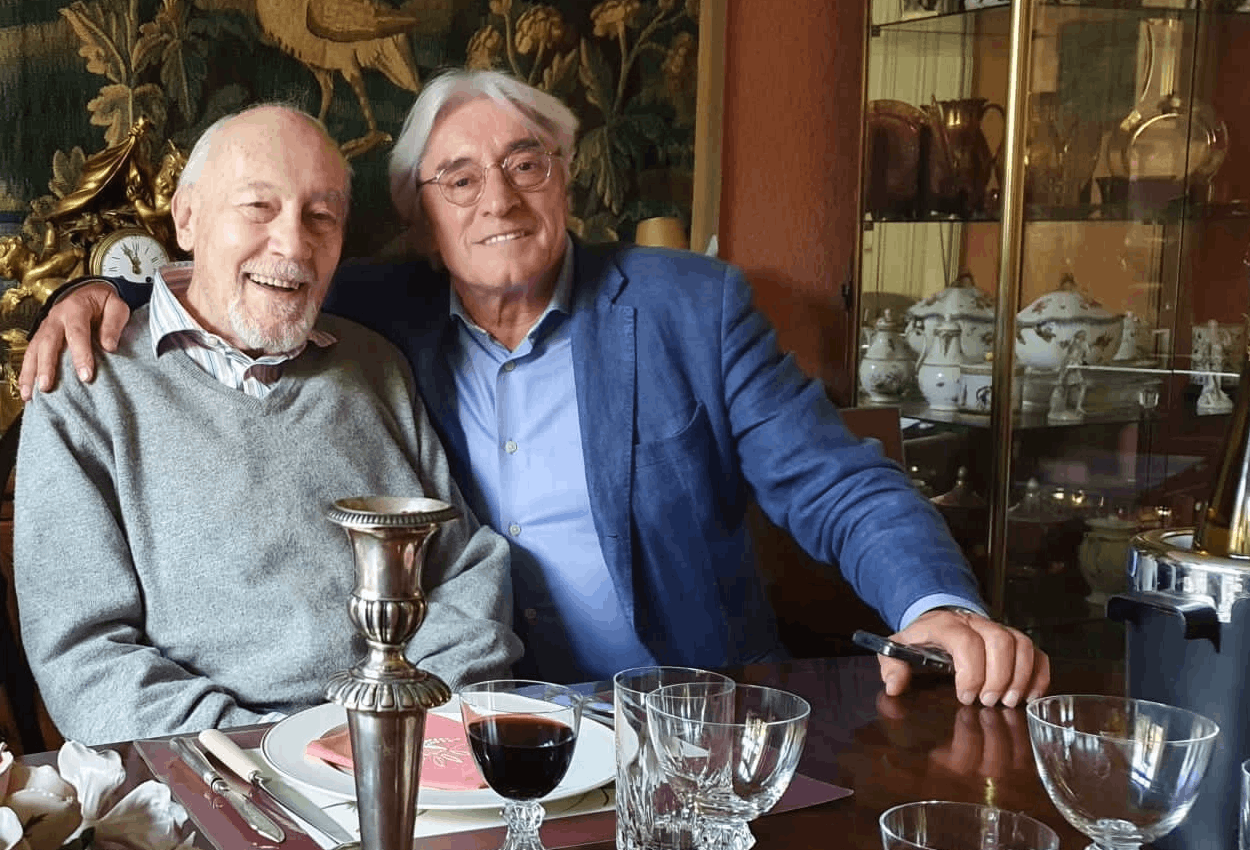
Guy de Muyser and Claude Frisoni. Photo: Claude Frisoni
And yet the real distinction, the one that really flattered and honoured you, was inadvertently given to you. I was a stunned witness to it.
On one of the countless evenings when you had offered Neumünster your presence and your kind support, a speaker, standing behind the lectern in the Robert Krieps Room, began his speech by saying: “I would first of all like to thank Monsieur Guy de Münster…”
This slip of the tongue was your greatest consecration. Merging your name with that of the institution you had served so selflessly had transported you.
You had known Grund Abbey as a prison. You had present, oppressive memories of damp, decrepit walls, cramped, dirty cells, corridors as narrow as nooses, cries of despair and the creaking of doors that closed so sinisterly…
The transformation of a place of misery into a place of creation, of a place of deprivation of freedom into a place of encounter, of dark cells into grey cells... this extraordinary transformation... you wanted to personify it, to defend it and to popularise it.
You were Guy de Münster. Even if you were just as totally available to the other associations and institutions to which you offered your talents. But prison as a place of artistic freedom was your greatest satisfaction.
So, you see, dear Guy, I don't know whether your lessons and your exemplary example will have helped me to progress towards that empathy of which you were the herald and hero, but I have at least learned in your shadow that, far from the official awards or the derisory competitions that mobilise the ambitious and the vain, the truth of a life is quite simple.
The real judge, the real master... it’s not power or money, it’s not appearance or showmanship, it’s not showing off or status... the real master is the one whose reflection you see in the morning as you shave and who can ask: ‘Have you lived up to what you can expect of yourself? Have you brought to others what only you can bring to them? Have you served humanity so as to make it more worthy of your services?’
Having closed the page of the book of your life only two years before your centenary, perhaps you thought, like Victor Hugo: ‘Earthly existence is nothing other than the slow growth of the human being towards that fulfilment of the soul which we call death.’
Thank you, Guy, for everything you have given us, for everything you have taught us, for everything you have left us as a farewell gift.”
CF
