For decades, companies built their reputations according to relatively simple rules. They communicated, consumers got the message, and the media acted as intermediaries. That was it. Next.
Today, this approach is largely a thing of the past. Social media has given everyone a voice, and now artificial intelligence is introducing a new player into the chain of trust: it interprets, summarises and makes recommendations.
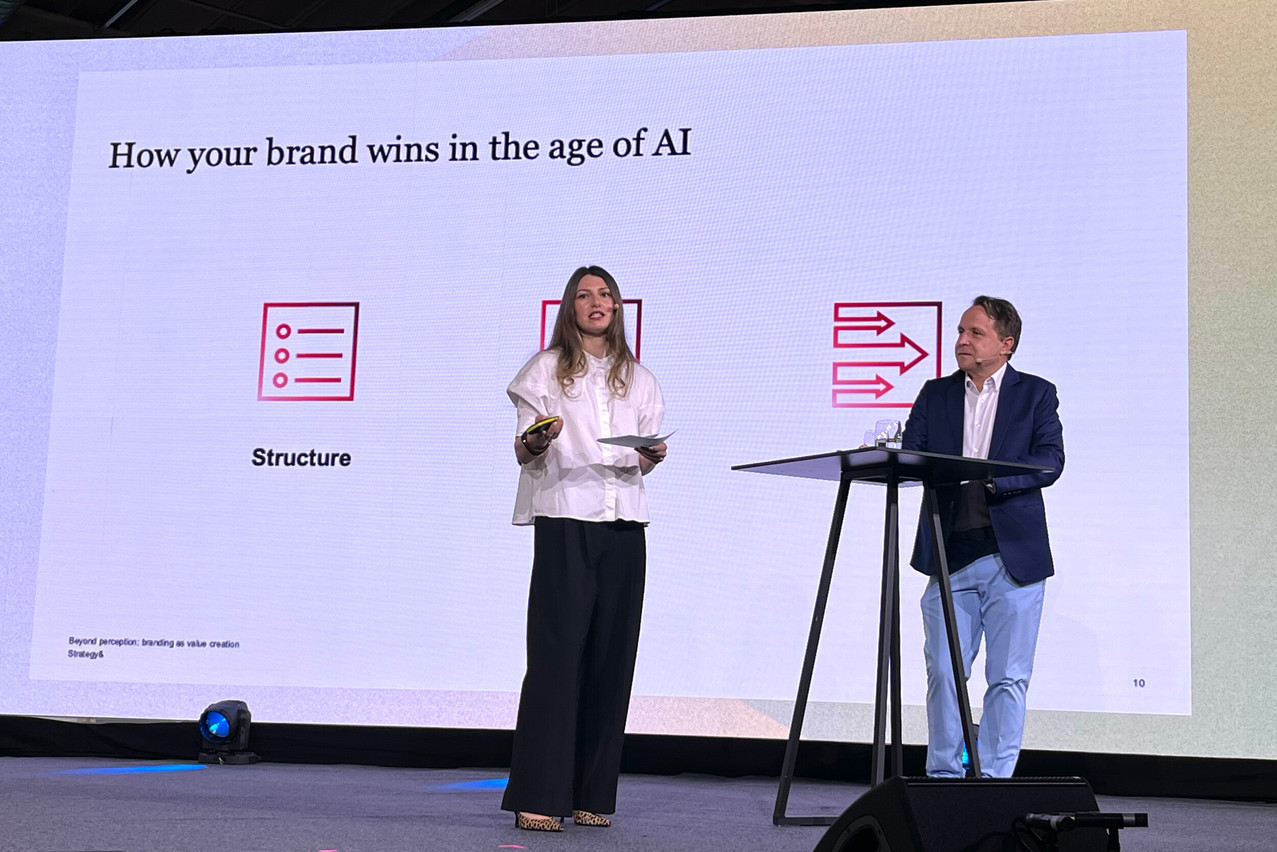
The conference, moderated by Camille Hollender, social media officer at PwC Luxembourg, and Benedikt Jonas, strategy & transformation leader, centred on this transformation. It is a topic that goes far beyond marketing. For behind the question of visibility lies the very issue of a company’s value.
Beyond SEO: the rise of GEO
“More than half the value of many companies today is linked to their brand,” notes Benedikt Jonas, citing recent market data. Long regarded as an intangible asset that is difficult to measure, the brand has become a key strategic consideration for executives, investors and investment funds.
Back in the 1990s, a brand would put out its message and consumers would listen. That was ages ago.

To illustrate this phenomenon, he looks back at Facebook’s acquisition of Instagram in 2012. At the time, the social network was bought for a billion dollars despite generating virtually no revenue. Many viewed the deal as unreasonable at the time. “Mark Zuckerberg wasn’t buying a profitable business. He was buying a community, trust and a brand,” he explains. Thirteen years on, few people still question that intuition.
This development is part of an even more profound transformation. Benedikt Jonas belongs to a generation that experienced the world before the internet. He remembers a time when companies had almost complete control over their communications. “In the 1990s, a brand would put out its message and consumers would listen. Prehistory.”
Then the internet arrived. First forums, then blogs, and finally social media gradually redistributed the power. Today, a brand is no longer just what the company says about itself. It has become what others say about it. And it’s a bottomless pit, a total paradigm shift.
Some companies think they know how they are perceived, even though they have never actually looked at what is being said about them online.

Camille Hollender observes this phenomenon on a daily basis. According to her, however, many organisations continue to overestimate their control over their reputation. “Some companies think they know how they are perceived, when in fact they have never really looked at what is being said about them online.” This disconnect can sometimes be dangerous.
The story of a downfall
The young woman refers in particular to the case of a French cosmetics brand whose CEO (despite being young and well aware of the pitfalls of social media) had sparked a heated controversy following an interview, in which she railed against the legal limit of 35 hours for interns and lamented that young graduates were unwilling to work very long hours.
Reputational damage can last much longer than executives realise.

Within a matter of days, social media had gone into overdrive, with negative reviews multiplying and online ratings plummeting. Two or three years on, the incident continues to appear in search results and to shape public perception of the brand. “Reputational damage can last much longer than executives imagine,” points out Camille Hollender.
But just as businesses are beginning to get to grips with social media, a new revolution is already underway: generative artificial intelligence.
When Benedikt Jonas asks how many people in the room have already asked ChatGPT for its opinion on a company, a product or a brand, the majority of hands go up. The finding is telling. Consumers now use AI to prepare for decisions, compare suppliers or search for partners even before visiting a website.
“When someone asks which bank to choose or which provider is the most reliable, the AI is already forming an opinion.” An opinion that often appears neutral and objective to the user, and which strongly influences the final decision.
This development also calls traditional SEO strategies into question. For twenty years, companies have sought to optimise their presence on Google. Now, they must also learn to establish a presence within the responses generated by ChatGPT, Gemini, Claude or Perplexity. According to figures presented at the conference, visitors from AI-powered search engines already show significantly higher conversion rates than those coming from traditional search.
Humans remain sensitive to emotions. Machines, on the other hand, look for information that is consistent, structured and credible.

For Benedikt Jonas, brands today face an unprecedented challenge: winning over two audiences at the same time. “People remain responsive to emotions, stories and experiences. Machines, on the other hand, look for information that is consistent, structured and credible.”
This new reality means that companies need to rethink the way they produce and distribute their content. The first challenge is that of clarity. The information must be easily interpretable by artificial intelligence models.
The second is consistency: the same narrative must be reflected on the website, in social media posts, in press articles and in external databases. Finally, credibility is essential. AI systems give greater weight to organisations cited by recognised sources that are considered reliable.
On the knowledge of AI…
Camille Hollender notes that some companies have already begun to adapt their practices. They no longer simply monitor their performance on Google or LinkedIn, but also analyse how their brand appears in the responses generated by large language models. This is an emerging discipline, sometimes referred to as ‘LLM Optimisation’, which could become as strategic as SEO has been over the past two decades.
The final question posed by the speakers undoubtedly sums up the real issue at stake. For a long time, companies have wondered what their customers think of them. In future, they will also have to ask themselves what artificial intelligence knows about them. For in a world where decisions increasingly begin with a conversation with an AI, reputation is built as much in algorithms as in the minds of consumers.
So, in your opinion, is your brand as strong in the minds of AI systems as it is in the minds of your teams?